HET COLLEGE VOOR DE
TOELATING VAN GEWASBESCHERMINGSMIDDELEN EN BIOCIDEN
BIJLAGE II bij het besluit d.d. 5 november 2010 tot uitbreiding van de toelating van het middel Infinito, toelatingnummer 12927 N
Contents Page
1. Identity of the plant protection product 2
2. Physical and chemical properties 4
3. Methods of analysis 11
4. Mammalian toxicology 16
5. Residues 32
6. Environmental fate and behaviour 39
7. Ecotoxicology 86
8. Efficacy 109
9. Conclusion 109
10. Classification and labelling 109
1. Identity
of the plant protection product
1.1 Applicant
Bayer
CropScience
Energieweg
1
3641 RT
Mijdrecht
The Netherlands
1.2 Identity of the active
substance
Fluopicolide
|
Common
name
|
fluopicolide
|
|
Name in
Dutch
|
fluopicolide
|
|
Chemical name
|
2,6-dichloro-N-[3-chloro-5-(trifluoromethyl)-2-pyridylmethyl]benzamide
[IUPAC]
|
|
CAS no
|
239110-15-7
|
|
EC no
|
Not allocated
|
The active substance was included on June 1st,,
2010 in
Annex I of Directive 91/414/EEC.
Propamocarb
|
Common name
|
propamocarb
|
|
Name in Dutch
|
propamocarb
|
|
Chemical name
|
propyl 3-(dimethylamino) propylcarbamate
(propamocarb)
propyl 3-(dimethylamino)propylcarbamate hydrochloride (propamocarb
hydrochloride)
|
|
CAS no
|
24579-73-5 (propamocarb)
256606-41-1 (propamocarb hydrochloride)
|
|
EC no
|
247-125-9 (propamocarb hydrochloride)
propamocarb: not allocated
|
The active
substance was included on October 1st, 2007 in Annex I of
Directive 91/414/EEC.
The active substance is formulated as its variant propamocarb
hydrochloride, which is included in the evaluation of the active substance
propamocarb in Annex I of Directive 91/414/EEC.
1.3 Identity of the plant
protection product
|
Name
|
Infinito
|
|
Formulation
type
|
SC
|
|
Content active substance
|
Fluopicolide: 62.5 g/L pure active substance
Propamocarb hydrochloride: 625 g/L pure propamocarb hydrochloride,
which is equal to 525.2 g/L pure propamocarb
|
The
formulation is part of the assessment of the active substance fluopicolide for
inclusion in Annex I of
Directive 91/414/EEC.
The
formulation is not part of the assessment of the active substance propamocarb
for inclusion in Annex
I of Directive 91/414/EEC.
1.4 Function
Fungicide.
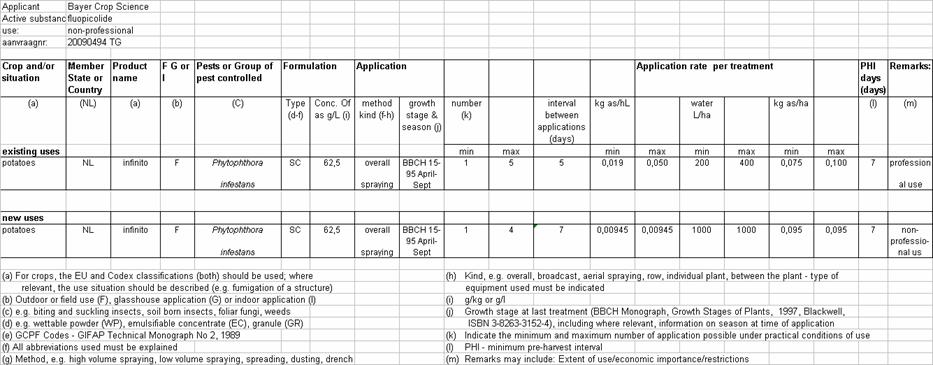
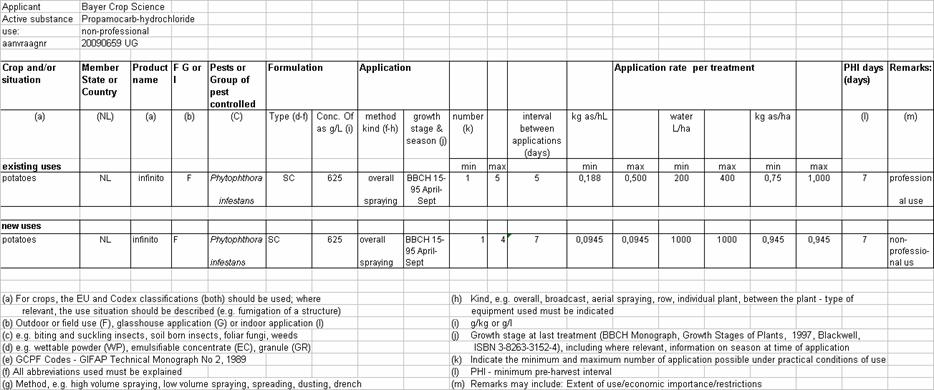
1.5 Uses applied for
See
GAP (Appendix 1).
1.6 Background to the
application
Extension of the authorization for non professional
uses.
1.7 Packaging details
1.7.1 Packaging description
|
Material:
|
HDPE
|
|
Capacity:
|
100 ml, 1, 5 or 10L
|
|
Type
of closure and size of opening:
|
100 ml: child resistant cap with foam disk, 29 mm opening
1, 5 or 10L: Screw cap 36, 50 or 63mm with HF
seal or internal wad or linerless
|
|
Other information
|
ADR and UN compliant
|
1.7.2 Detailed
instructions for safe disposal
See application form and MSDS (no particular
recommendations)
2.
Physical and chemical properties
2.1
Active substances
Identity (fluopicolide)
Fluopicolide
is a new active substance, included in Annex I of Directive 91/414/EEC. The
final List of Endpoints presented below is taken from the EFSA Scientific
report on fluopicolide (2009) 299; 1-158 (d.d. 4 June 2009), also taking into
account the final draft review report on fluopicolide (SANCO/10164/2009 – rev
4, to be published 27 November 2010). Where relevant, some additional
remarks/information are given in italics.
|
Active substance (ISO Common Name)
|
Fluopicolide
|
|
Chemical name
(IUPAC)
|
2,6-dichloro-N-{[3-chloro-5-(trifluoromethyl)-2-pyridinyl]methyl}benzamide
|
|
Chemical name (CA)
|
benzamide, 2,6-dichloro-N-[[3-chloro-5-(trifluoromethyl)
-2-pyridinyl]methyl]
|
|
CIPAC No
|
787
|
|
CAS No
|
239110-15-7
|
|
EEC No (EINECS or
ELINCS)
|
not yet allocated
|
|
FAO Specification
(including year of publication)
|
None
|
|
Minimum purity of
the active substance as manufactured (g/kg)
|
970 g/kg
|
|
Identity of relevant impurities (of toxicological, environmental
and/or other significance) in the active substance as manufactured (g/kg)
|
Toluene: max 0.3%
|
|
Molecular formula
|
C14H8Cl3F3N2O
|
|
Molecular mass
|
383.59
|
|
Structural formula
|

|
Physical-chemical properties
|
Melting point (state purity)
|
150°C (99.3%)
|
|
Boiling point (state purity)
|
Not measurable, decomposes above 320°C
|
|
Temperature of decomposition (state purity)
|
>320°C (99.3%)
|
|
Appearance (state purity)
|
Beige solid (pure
99.3 % and technical 96.1 %)
|
|
Relative density (state purity)
|
1.65 g/cm3 at 4°C
(Relative) (99.3%)
|
|
Surface tension
|
71.3 mN/m
at 20C
(concentration = 2.52 mg/l) (96.1%)
|
|
Vapour pressure (state temperature, state purity)
|
3.03 x 10⁻⁷ Pa at 20°C
(99.6%)
|
|
Henry’s law constant (in Pa·m3·mol-1)
|
4.15 x 10⁻⁵
Pa m3 mol-1
|
|
Solubility in water (state temperature, state purity and pH)
|
0.0028g/l at pH7 and 20C (solubility is
independent of pH) (99.3%)
|
|
Solubility in organic solvents (state temperature,
state purity)
|
n-hexane 0.2g/l at 20°C
(99.3%)
dichloromethane 126g/l at 20°C
(99.3%)
ethanol 19.2g/l at 20°C
(99.3%)
toluene 20.5g/l at 20°C(99.3%)
acetone 74.7g/l at 20°C(99.3%)
ethyl acetate 37.7g/l at 20°C(99.3%)
dimethylsulfoxide 183g/l at 20°C(99.3%)
|
|
Partition co-efficient (log Pow) (state temperature,
pH and purity)
|
Log Pow = 2.9 at 20C (pH7 ) (Log Pow is
independent of pH) (99.3%)
|
|
Hydrolytic stability (DT50) (state pH and temperature)
|
Hydrolytically stable at pH 4, 7 and 9 after 30 days at 25°C
|
|
Dissociation constant (state purity)
|
No dissociation (96.1%)
|
|
UV/VIS absorption (max.) incl ε at state purity,
pH)
|
Purity
(99.3%)
neutral,
methanol solution:
lmax (nm); ε (L.mol-1.cm-1)
203; 44519
271; 3601
No absorbance above 290nm. .
|
|
Photostability (DT50) (aqueous,
sunlight, state pH)
|
64 days at pH 7 and at 25°C
|
|
Quantum yield of direct photo-
transformation in water at λ > 290 nm
|
z · 3.50x10 –2 mol ·
Einstein -1
|
|
Photochemical
oxidative degradation in air
|
Atkinson
calculation using AOPWIN v.1.90. Rate constant 4.757 x 10⁻¹²
cm3/molecule/sec. Atmospheric half life 3.373 days assuming 24 hour OH
radical concentration of 0.5 x 10⁶ radicals/cm3.
|
|
Flammability (state
purity)
|
Not highly
flammable (96.1%)
|
|
Auto-flammability
|
No self-ignition up to 401 oC
|
|
Explosive properties (state purity)
|
Non-explosive (96.1%)
|
|
Oxidising properties (state purity)
|
Non- oxidising (96.1)
|
Identity: propamocarb
Data on the identity and the physical and
chemical properties is taken from the List of Endpoints (identity: EFSA Review
Report, April 2007; physical and chemical properties: EFSA Scientific Report
(2006) 78, 1-80 (d.d. 12 May 2006)). Changes and/or additions are taken up in italics.
|
Active substance (ISO Common Name)
|
propamocarb
(unless
otherwise stated, the following data relate to the variant propamocarb
hydrochloride)
The physical/chemical and residue evaluation
related to the variant Propamocarb HCl. Parent Propamocarb was considered to
be the residue definition from a residue viewpoint.
|
|
Chemical name
(IUPAC)
|
Propyl
3-(dimethylamino)propylcarbamate
(propamocarb)
Propyl
3-(dimethylamino) propylcarbamate
hydrochloride
|
|
Chemical name (CA)
|
Propyl
[3-(dimethylamino)propyl]carbamate
(propamocarb)
carbamic
acid, [3-dimethylaminopropyl]-, propyl ester,
monochloride
|
|
CIPAC No
|
399 (Propamocarb)
399.601 (Propamocarb HCl)
|
|
CAS No
|
24579-73-5 (Propamocarb)
25606-41-1 (Propamocarb HCl)
|
|
EEC No (EINECS or
ELINCS)
|
247-125-9 (Propamocarb HCl)
|
|
FAO Specification
(including year of publication)
|
No FAO
specification
|
|
Minimum purity of
the active substance as manufactured (g/kg)
|
TC: 92%
w/w, 920g/kg (Bayer CropScience)
TK: 69%
w/w, 749 g/L (Bayer CropScience)
920
g/kg (as propamocarb)
|
|
Identity of relevant impurities (of toxicological, environmental
and/or other significance) in the active substance as manufactured (g/kg)
|
None
identified
|
|
Molecular formula
|
C9H21ClN2O2
|
|
Molecular mass
|
224.7
|
|
Structural formula
|

|
Physical-chemical properties
Data is of the propamocarb hydrochloride variant
unless otherwise specified.
|
Melting point (state purity)
|
64.2ºC(100.3% purity)
|
|
Boiling point (state purity)
|
Product
decomposed at 150ºC (99.1% purity)
|
|
Temperature of decomposition
|
150ºC
(99.1% purity)
|
|
Appearance (state purity)
|
White/cream
soft solid (97.2% purity)
|
|
Relative density (state purity)
|
1.16 at
20.5 ºC (97.2% purity)
|
|
Surface tension
|
71.98mN/m at 20ºC (97.2% purity)
Concentration
of test substance = 1g/L
|
|
Vapour pressure (in Pa, state temperature)
|
Two
values have been submitted
8.1 x 10⁻⁵
Pa at 25ºC [97.7% purity]
1.66 x 10⁻³
Pa at 25ºC [99.1% purity]
Test
substance is slightly volatile
|
|
Henry’s law constant (in Pa·m3·mol-1)
|
K = 8.5 x 10 –9
Pa m3 mol-1 .
|
|
Solubility in water (in g/l or mg/l, state
temperature)
|
Between
89.2 and 93.5%w/w at pH 4
Between
89.1 and 93.8%w/w at pH 7
Between
89.6 and 94.6%w/w at pH 10 (20 ºC)
Purity of
test substance 99.1%
|
|
Solubility in organic solvents (in g/l, at 20 °C)
|
Solvent
|
g/l
|
|
Hexane
Toluene
Methanol
Dichloromethane
Ethyl
acetate
Acetone
Xylene
Heptane
Purity of
test substance 100.0%
|
<0.01
0.04
>656
>626
4.8
560
1.6 x 10⁻²
<1 x
10-4
|
|
Partition co-efficient (log Pow) (state pH and
temperature)
|
Two
values have been submitted
Log POW
= -2.9, -1.2 & 0.67 at pH 2, 7 & 9, respectively
Log POW
= -0.98, -1.4 & 0.32 at pH 2, 7 & 9, respectively
|
|
Hydrolytic stability (DT50) (state pH and
temperature)
|
<10%
hydrolysis at pH 4, 7 & 9 at 50ºC over a five day period
|
|
Dissociation constant
|
pKa = 9.6
at 20ºC
|
|
UV/VIS absorption (max.) (if absorption >290 nm state ε at wavelength)
|
Absorption
observed at λ
203 and 217nm at PH 7, in
0.1M HCl and in 0.1M NaOH. No absorbance >290nm.
|
|
Photostability (DT50) (aqueous, sunlight, state pH)
|
No
degradation of a.s. in aqueous solution when irradiated for 92hr. at 20ºC
with a wavelength of λ >290nm.
|
|
Quantum yield of direct photo-
transformation in water at λ > 290 nm
|
N.A. No
photodegradation.
|
|
Photochemical oxidative degradation in air
|
DT50
= 4 hours (OH radical rate constant > 9.54x10⁻¹¹ cm3molecule-1sec-1)
|
|
Flammability
|
not
flammable (TK)
|
|
Auto-flammability
|
312 oC
(99.1%)
|
|
Oxidative properties
|
Not oxidising
(theoretical assessment)
|
|
Explosive properties
|
Not explosive (99.1%)
|
2.2
Plant protection product: Infinito
Data about plant protection product
are taken from studies submitted by the applicant.
The range of the application
concentration of the plant protection product is 0.15 - 0.8 %
|
Section
(Annex
point)
|
Study
|
Guidelines
and GLP
|
Findings
|
Evaluation
and conclusion
|
|
B.2.2.1
(IIIA 2.1)
|
Appearance:
physical state
|
GLP: no
Visual
|
|
Acceptable
|
|
B.2.2.2
(IIIA 2.1)
|
Appearance:
colour
|
GLP: no
Visual
|
Beige, opaque
|
Acceptable
|
|
B.2.2.3
(IIIA 2.1)
|
Appearance:
odour
|
GLP: no
Organoleptic
|
No
odour
|
Acceptable
|
|
B.2.2.4
(IIIA 2.2)
|
Explosive
properties
|
GLP:
yes
EC A14
|
Not
explosive
|
Acceptable
|
|
B.2.2.5
(IIIA 2.2)
|
Oxidising
properties
|
Theoretical
assessment
|
Not
oxidising, based on the properties of the product’s individual components
|
Acceptable
|
|
B.2.2.6
(IIIA 2.3)
|
Flammability
|
|
Not
applicable
|
|
|
B.2.2.7 (IIIA
2.3)
|
Auto-flammability
|
GLP:
yes
EC A15
|
420 oC
|
Acceptable
|
|
B.2.2.8
(IIIA 2.3)
|
Flash
point
|
Theoretical
assessment
|
The
product is water based and contains no flammable ingredients.
|
Acceptable
|
|
B.2.2.9
(IIIA 2.4)
|
Acidity /
alkalinity
|
|
Not
applicable
|
|
|
B.2.2.10
(IIIA 2.4)
|
pH
|
GLP:
yes
CIPAC
MT75
|
1%
dispersion: 7.0 (23 oC)
|
Acceptable.
It is unlikely the undiluted product will have a pH of 4 or lower and
therefore a study with the undiluted product is not required.
|
|
B.2.2.11
(IIIA 2.5)
|
Surface
tension
|
GLP:
yes
EC A5
|
31 mN/m (1%
dispersion)
|
Acceptable,
because other triggers for labelling with Xn/R65 are not met.
|
|
B.2.2.12
(IIIA 2.5)
|
Viscosity
|
GLP:
yes
OECD 114
equivalent
|
At 20 oC:
20 s-1
: 221 mPa.s
100 s-1
: 100 mPa.s
|
Acceptable,
because other triggers for labelling with Xn/R65 are not met.
|
|
B.2.2.13
(IIIA 2.6)
|
Relative
density
|
GLP:
yes
CIPAC
MT3.3.1 / EC A3
|
Density:
1.130 g/ml (20 oC)
|
Acceptable
|
|
B.2.2.14
(IIIA 2.6)
|
Bulk (tap)
density
|
|
Not
applicable
|
|
|
B.2.2.15 (IIIA 2.7)
|
Storage
stability
|
GLP: no
CIPAC
MT46.3
|
Stable
for 2 weeks at 54 oC in HDPE.
The
following properties were determined before and after storage: content a.i., pH,
wet sieve, pourability, suspensibility, spontaneity of dispersion, foam
persistence, appearance, packaging stability.
|
Acceptable
|
|
B.2.2.15 (IIIA 2.7)
|
Storage
stability
|
GLP: no
CIPAC MT39.3
|
Stable
for 7 days at 0 oC
Suspensibility, spontaneity of
dispersion and wet sieve tests were performed before and after storage.
|
Acceptable
Content of
toluene, the relevant impurity described in the List of Endpoints was not
determined. This is considered acceptable, since toluene cannot be formed
during manufacture or storage of the formulation.
|
|
B.2.2.16
(IIIA 2.7)
|
Shelf life
|
GLP: no
CIPAC MT
75.2, 59.3, 148, 184, 160, 47.2
Analytical
method:
C-1094-01-03
P-1093-01-03
|
Stable
for 2 years at ambient temperatures in HDPE packaging.
|
Acceptable
|
|
B.2.2.17
(IIIA 2.8)
|
Wettability
|
|
Not
applicable
|
|
|
B.2.2.18
(IIIA 2.8)
|
Persistent
foaming
|
GLP: no
CIPAC
MT47.2
|
0 ml
after one minute (3.6 g/L and 9 g/L in CIPAC D water)
|
Acceptable
|
|
B.2.2.19
(IIIA 2.8)
|
Suspensibility
|
GLP: no
CIPAC MT
184
|
Fluopicolide:
3.6 g/L
(~0.36%): 98 - 100%
9 g/L
(~0.9%): 99 - 100%
Propamocarb:
3.6 g/L
(~0.36%): 99%
9 g/L
(~0.9%): 100%
|
Acceptable
Based on
the results it is considered acceptable that tests were not performed at the
minimal application concentration of 0.15 % .
|
|
B.2.2.20
(IIIA 2.8)
|
Spontaneity
of dispersion
|
GLP: no
CIPAC
MT160
|
100%
for both active substances
|
Acceptable
|
|
B.2.2.21
(IIIA 2.8)
|
Dilution
stability
|
|
Not
applicable
|
|
|
B.2.2.22
(IIIA 2.8)
|
Dry sieve
test
|
|
Not
applicable
|
|
|
B.2.2.23
(IIIA 2.8)
|
Wet sieve
test
|
GLP: no
CIPAC
MT59.3
|
<
0.1% retained on a 40 μm sieve.
.
|
Acceptable
A more fine sieve is used than the
75 μm sieve, which is considered acceptable
|
|
B.2.2.24
(IIIA 2.8)
|
Particle
size distribution
|
|
Not
applicable
|
|
|
B.2.2.25
(IIIA 2.8)
|
Content of
dust/fines
|
|
Not
applicable
|
|
|
B.2.2.26
(IIIA 2.8)
|
Attrition
and friability
|
|
Not
applicable
|
|
|
B.2.2.27 (IIIA 2.8)
|
Emulsifiability,
re-emulsifiability and emulsion stability
|
|
Not
applicable
|
|
|
B.2.2.28
(IIIA 2.8)
|
Stability
of dilute emulsion
|
|
Not
applicable
|
|
|
B.2.2.29
(IIIA 2.8)
|
Flowability
|
|
Not
applicable
|
|
|
B.2.2.30
(IIIA 2.8)
|
Pourability
(rinsibility)
|
GLP: no
CIPAC
MT148
|
2.7%
residue
|
Acceptable
|
|
B.2.2.31
(IIIA 2.8)
|
Dustability
|
|
Not
applicable
|
|
|
B.2.2.32
(IIIA 2.8)
|
Adherence
and distribution to seeds
|
|
Not
applicable
|
|
|
2.9.1
|
Physical
compatibility with other products
|
|
Not
applicable
|
|
|
2.9.2
|
Chemical
compatibility with other products
|
|
Not
applicable
|
|
Conclusion
The
physical and chemical properties of the active substance and the plant
protection product are sufficiently described by the available data. Neither
the active substance nor the product has any physical or chemical properties,
which would adversely affect the use according to the proposed use and label
instructions.
2.3 Data
requirements
None.
3.
Methods of analysis
Fluopicolide
is a new active substance, included in Annex I of Directive 91/414/EEC. The
final List of Endpoints presented below is taken from the EFSA Scientific
report on fluopicolide (2009) 299; 1-158 (d.d. 4 June 2009). Where relevant,
some additional remarks/information are given in italics.
3.1.
Analytical methods in technical
material and plant protection product
Fluopicolide
|
Technical
as (principle of method)
|
Fluopicolide in technical material was determined by HPLC-UV
|
|
Impurities in
technical as (principle of method)
|
Organic
impurities in technical material were determined by HPLC-UV
Water content was determined by Karl Fischer titration
|
|
Preparation
(principle of method)
|
HPLC-UV, Method
C-1094-01-03
Relevant
impurity toluene: GC-FID
|
Propamocarb
|
Technical
as (principle of method)
|
Test
substance dissolved in methanol/water (80:20, v/v) and analysed using HPLC
with UV detection.
|
|
Impurities in
technical as (principle of method)
|
The
following methods were used for analysis of the various impurities.
1. Test
substance dissolved in dichloromethane, analysed using GC with FID detection.
2. Test
substance dissolved in DMSO, equilibrated
at 75°C prior to headspace injection and analysis using
GC/FID.
3. Test material was dissolved in water, to which aqueous sodium
hydroxide was added. Following extraction with dichloromethane, the aqueous
solution was derivatized using benzoyl chloride and the resultant derivative
extracted into dichloromethane and analysed using GC/FID.
4. Test material diluted in methanol/water was analysed using HPLC,
with UV detection.
5. Test
material was dissolved in water, diluted to 50ml with 1,4-dioxane and
filtered. The sample was then analysed using GC/FID.
|
|
Preparation
(principle of method)
|
Method P-1093-01-03
A
CIPAC method for propamocarb is also available
Relevant
impurity toluene: GC-FID
|
Conclusion
The
analytical methods for propamocarb, fluopiclide and impurities in the technical
material and the analytical method for the determination of propamocarb and
fluopiclide in the preparation have been assessed in the DAR and are considered
to be acceptable. The analytical method for the determination of the relevant
impurity toluene in the formulation has been assessed and is considered to be
acceptable.
3.2
Residue analytical methods
Fluopicolide
|
Food/feed
of plant origin (principle of method and LOQ for methods for monitoring
purposes)
|
Fluopicolide
was determined by a modified version of the German multi residues method S19,
with an LOQ of
0.1 mg/kg, 0.02 mg/kg and 0.02 mg/kg for (grape,
wheat grain and potato respectively).
|
|
Food/feed
of animal origin (principle of method and LOQ for methods for monitoring
purposes)
|
Fluopicolide
and its metabolites M-01 and M-02
in animal product were determined by HPLC/MS/MS, with
an LOQ of 0.01 – 0.05 mg/kg.
However, a method is not required as currently no
MRLs are set for animal products.
|
|
Soil
(principle of method and LOQ)
|
Fluopicolide
and its metabolites M-01, M-03 and M-02 in soil were determined by HPLC/MS/MS,
with an LOQ of 0.005 mg/kg
|
|
Water
(principle of method and LOQ)
|
Fluopicolide
and its metabolites M-01 and M-02
in water (tap and surface) were determined by
HPLC/MS/MS, with an LOQ of 0.1 mg/l.
|
|
Air (principle of method and LOQ)
|
Fluopicolide
was determined by GC/ECD and GC/MS with an LOQ of 3 mg/m3
|
|
Body
fluids and tissues (principle of method and LOQ)
|
Not
required as fluopicolide is not classified as toxic
|
Propamocarb
|
Food/feed
of plant origin (principle of method and LOQ for methods for monitoring
purposes)
|
Propamocarb
residues were extracted with acetic acid (1% aqueous solution), eluted from
C18 SPE with acetonitrile/water/acetic acid (20:80:1, v/v). Residues were determined by HPLC
with MS/MS detection.
Detection
was at m/z = 189 (parent ion) –>102 + 144 (daughter ion).
LOQ = 0.01 mg/kg.
The method
was independently validated for tomatoes and lettuce.
The
method is acceptable for analysis of residues of propamocarb and its salts in
food/feed with high water content.
|
|
Food/feed
of animal origin (principle of method and LOQ for methods for monitoring
purposes)
|
An
analytical method is not required due to fact that no MRL is proposed.
|
|
Soil
(principle of method and LOQ)
|
1N Hydrochloric acid was added to soil and the samples were shaken on
a horizontal flatbed shaker for approx. 60min., then centrifuged and the
supernatant removed. The extracts were collected and brought to pH 6-7 with
an ammonia solution (~25%). The extract was cleaned up on a C18 column and
analysed using HPLC/MS/MS. Atmospheric pressure chemical ionisation (APCI)
mode was used. The parent ion m/z 189 and two fragment ions m/z 102.1 and 144
were used for quantisation
LOQ = 0.02mg/kg
Soil samples were shaken in methanol/saturated NaCl (5:1, v/v) and the
methanol fraction was evaporated. The aqueous fraction was adjusted to pH 3-4
using a 0.1N HCl solution. This was then washed with dichloromethane and the
pH of the aqueous phase was adjusted to >11.5. Combined dichloromethane
fractions were evaporated to dryness, reconstituted in methanol/water (80:20,
v/v) and analysed using HPLC/MS/MS in the positive ion mode. The ions
monitored were m/z 189.3 (parent ion) and m/z 102.3 (fragment ion).
LOQ = 0.02mg/kg
The
method is acceptable for analysis of residues of propamocarb and its salts in
soil
|
|
Water
(principle of method and LOQ)
|
Alkaline treated water was extracted with dichloromethane.
Dichloromethane was evaporated off and the extract reconstituted in a
suitable solvent prior to analysis using HPLC/MS/MS in the positive ion mode.
The ions monitored were m/z 189 (parent ion) and m/z 102 (fragment ion). The
samples tested represented both drinking and surface water
LOQ =
0.05µg/L
The
method is acceptable for analysis of residues of propamocarb and its salts in
drinking and surface water
|
|
Air (principle of method and LOQ)
|
Two methods were considered suitable for analysis of residues of
propamocarb in air.
1. Samples of air were drawn through silica gel adsorption tubes at a
flow rate of ~0.3L/min. for a period of 6 hr. (total air sampling volume =
0.1m3). The silica gel was extracted three times with a mixture of
acetonitrile/water/acetic acid/ammonia (200:800:10:2, v/v/v/v). The total combined extract was
analysed using LC/MS/MS with atmospheric pressure chemical ionisation (APCI)
source. Quantification was based on MS of the daughter ion peak 144m/z,
resulting from the protonated molecular propamocarb ion observed at 189m/z.
For further confirmation a second transition resulting in a daughter ion at
102m/z was included in the method.
LOQ =
9µg/m3.
2. Tenax TA was spiked with a methanol solution of propamocarb. The
efficiency of the extraction procedure with methanol/water (80:20) was
assessed by recovery after 7.5hr. with an air flow of 3L/min. The degree of
trapping was assessed by 2hr. and 7.5hr. recovery tests of samples, with an
air flow of 3L/min at 35ºC and >80% relative humidity.
The stability of propamocarb adsorbed on Tenax TA was demonstrated for
a period of 14 days at ambient temperature and at -20ºC. Residues were
determined by GC-MS-MS.
LOQ = 0.4µg/m3
|
|
Body
fluids and tissues (principle of method and LOQ)
|
Not
required, non toxic compound
|
Based on
the proposed use of the plant protection product analytical methods for
determination of residues in food/feed of plant origin are required for watery
matrices (potato).
|
Definition of the residue and
proposed MRL’s for fluopicolide
|
|
Matrix
|
Proposed definition of the residue for monitoring
|
EU MRL
|
|
Food/feed of plant origin
|
Fluopicolide
|
0.02 mg/kg (potatoes)
|
|
Food/feed of animal origin
|
No definition of the residue is proposed. No
relevant residues are expected to occur in food/feed of animal origin.
|
|
|
Required LOQ
|
|
Soil
|
Fluopicolide
|
0.05 mg/kg
|
|
Drinking water
|
Fluopicolide
|
0.1 µg/L (Dutch drinking water guideline)
|
|
Surface water
|
Fluopicolide
|
29 µg/L (EbC50 for algae)
|
|
Air
|
Fluopicolide
|
0.15 mg/m3
(derived from the AOEL according to SANCO/825/00)
|
|
Body fluids and tissues
|
The active substance is not classified as (very)
toxic thus no definition of the residue is proposed.
|
|
Definition of the residue and
MRL’s for propamocarb
|
|
Matrix
|
Definition of the residue for monitoring
|
EU-MRL
|
|
Food/feed of plant origin
|
Propamocarb
|
0.5 mg/kg
|
|
Food/feed of animal origin
|
No definition of the residue is proposed. No
relevant residues are expected to occur in food/feed of animal origin.
|
|
|
Required LOQ
|
|
Soil
|
Propamocarb
|
0.05 mg/kg (default)
|
|
Drinking water
|
Propamocarb
|
0.1 µg/L (drinking water guideline)
|
|
Surface water
|
Propamocarb
|
0.1 µg/L (HTB 1.0)
|
|
Air
|
Propamocarb
|
0.087
mg/m3 (derived from the AOEL (AOELsystemic = 0.29 mg/kg
bw/day) according to SANCO/825/00)
|
|
Body fluids and tissues
|
The active substance is not classified as (very)
toxic thus no definition of the residue is proposed.
|
The residue analytical methods, included in the
abovementioned List of Endpoints, are suitable for monitoring of the MRL’s for
propamocarb and fluopicolide.
The residue
analytical methods for water, soil and air, evaluated in the DAR, are
acceptable and suitable for monitoring of residues of propamocarb in the
environment.
Conclusion
The
submitted analytical methods meet the requirements. The methods are specific
and sufficiently sensitive to enable their use for enforcement of the MRL’s and
for monitoring of residues in the environment.
3.3 Data
requirements
None.
3.4 Physical-chemical
classification and labelling
Proposal
for the classification of fluopicolide (symbols and R phrases)
(EU classification) concerning physical chemical properties
|
Symbol(s):
|
-
|
Indication(s)
of danger: -
|
Proposal
for the classification of propamocarb (symbols and R phrases)
(EU classification) concerning physical chemical properties
|
Symbol(s):
|
-
|
Indication(s)
of danger: -
|
|
Risk
phrase(s)
|
-
|
-
|
Proposal
for the classification and labelling of the formulation concerning physical
chemical properties
|
Substances,
present in the formulation, which should be mentioned on the label by their
chemical name (other very toxic, toxic, corrosive or harmful substances):
|
|
-
|
|
Symbol:
|
-
|
Indication
of danger:
|
-
|
|
R phrases
|
-
|
-
|
|
|
|
|
|
S phrases
|
S21
|
When
using do not smoke.
|
|
|
|
|
|
Special provisions:
DPD-phrases
|
-
|
-
|
|
|
|
|
|
Child-resistant
fastening obligatory?
|
Not
applicable
|
|
Tactile
warning of danger obligatory?
|
Not
applicable
|
|
Explanation:
|
|
Hazard
symbol:
|
-
|
|
Risk
phrases:
|
-
|
|
Safety
phrases:
|
S21 is
assigned to product which contain halogenated compounds which may form toxic
fumes when incinerated or burned.
|
|
Other:
|
-
|
Supported shelf life of the formulation: 2 years
The
proposed labelling above is equal to the previous decision regarding the
labelling of the plant protection product Infinito (dated 1 June 2007).
4.
Mammalian toxicology
List of
Endpoints
Fluopicolide
Fluopicolide
is a new active substance, included in Annex I of Directive 91/414/EEC. The
final List of Endpoints presented below is taken from the EFSA Scientific
Report on fluopicolide (2009) 299; 1-158 (d.d. 4 June 2009).The final review
report on Fluopicolide is not yet available. Where relevant, some additional
remarks/information are given in italics.
Impact on Human and Animal Health
Absorption,
distribution, excretion and metabolism (toxicokinetics) (Annex IIA, point
5.1)
|
|
Rate and extent of oral absorption ‡
|
Moderately rapid absorption. Cmax in blood at
6 – 8 h. Approximately 62 % for
the pyridyl radiolabel
|
|
Distribution ‡
|
Well distributed into organs and tissues. Highest concentrations in liver, kidneys,
spleen and blood
|
|
Potential for accumulation ‡
|
No evidence of accumulation
|
|
Rate and extent of excretion ‡
|
Rapid and extensive (approximately 95 %)
within 48 h mainly via faeces. Biliary
fraction was approximately 52 % for the pyridyl radiolabel
|
|
Metabolism in animals ‡
|
Extensively metabolised. Biotransformations observed included aromatic ring hydroxylation,
hydrolysis, dealkylation, acetylation, oxidative N-dealkylation and
conjugation with glucuronic acid, sulphate and glutathione. Further
metabolism of glutathione conjugates to cysteine conjugates.
|
|
Toxicologically relevant compounds ‡
(animals and plants)
|
Parent compound and M 01
|
|
Toxicologically relevant compounds ‡
(environment)
|
Parent compound
|
|
Acute
toxicity (Annex IIA, point 5.2)
|
|
Rat LD50 oral ‡
|
> 5000 mg/kg bw
|
|
|
Rat LD50 dermal ‡
|
> 5000 mg/kg bw
|
|
|
Rat LC50 inhalation ‡
|
> 5.16 mg/l (the mean achieved
concentration, 4 h nose only)
|
|
|
Skin irritation ‡
|
Non-irritant
|
|
|
Eye irritation ‡
|
Non-irritant
|
|
|
Skin sensitisation ‡
|
Not sensitising (Buehler and Magnusson and
Kligman methods)
|
|
|
Short
term toxicity (Annex IIA, point 5.3)
|
|
Target / critical effect ‡
|
Liver, kidney, spleen and red blood cell
parameters
|
|
Relevant oral NOAEL ‡
|
17.7 mg/kg bw/day; 28-day dietary study in
rats
7.4 mg/kg bw/day; 90-day dietary study in rats
70 mg/kg bw/day; 90-day dog
300 mg/kg bw/day; 1-year dog
|
|
|
Relevant dermal NOAEL ‡
|
1000 mg/kg bw/day; 28-day dermal toxicity
study in rats
|
|
|
Relevant inhalation NOAEL ‡
|
No data.
Not required.
|
|
|
Genotoxicity
‡ (Annex IIA, point 5.4)
|
|
|
No genotoxic potential 1
|
|
1 The genotoxic potential was investigated in 8 in vitro studies (5 Ames
tests, 1 mammalian cell gene mutation test in Chinese hamster lung fibroblasts
V79, 1 mammalian cytogenetic test in Chinese hamster lung fibroblasts V79, 1
mammalian cytogenetic test in human lymphocytes) and in 4 in vivo study (3
micronucleus tests in mouse bone marrow (2 oral, 1 i.p.) and 1 UDS test).
Equivocal results were only obtained in one strain in 1 Ames test and in 1 oral
micronucleus test.
|
Long
term toxicity and carcinogenicity (Annex IIA, point 5.5)
|
|
Target/critical
effect ‡
|
Liver:
non-neoplastic lesions including centrilobular hepatocyte hypertrophy in the
liver of rats and mice; and neoplastic lesions, hepatocellular adenomas in
mice
|
|
Relevant
NOAEL ‡
|
8.4.
mg/kg bw/day in rats
7.9
mg/kg bw/day in mice
|
|
Carcinogenicity ‡
|
Hepatocellular adenomas in mice. Carcinogenic in mice by a mechanism
considered to be not relevant in humans.
|
|
|
Reproductive
toxicity (Annex IIA, point 5.6)
Reproduction
toxicity
|
|
Reproduction target / critical effect ‡
|
No specific evidence of reproductive
toxicity. Birth weights were normal,
however a reduction (ca. 8 – 14 %) in bodyweight gain in offspring in F1
and F2 generations at maternally toxic dose level of 103.4 mg/kg
bw/day
|
|
|
Relevant parental NOAEL ‡
|
25.5 mg/kg bw/day
|
|
|
Relevant reproductive NOAEL ‡
|
103.4 mg/kg bw/day for F0 males and
127.3 mg/kg bw/day for F0 females for the period before pairing
absence of reproductive toxicity at the highest test dose
|
|
|
Relevant offspring NOAEL ‡
|
25.5 mg/kg bw/day
|
|
|
Developmental
toxicity
|
|
Developmental
target / critical effect ‡
|
Reduction
in mean foetal body weights and crown-rump lengths in foetuses in rats and
rabbits at maternally toxic dose levels (60 mg/kg bw/day in rabbits and 700
mg/kg bw/day in rats). Maternal
toxicity: reduced body weight in rats and rabbits; apparent exceptional
toxicity was noted in rabbits including mortality, increased incidence of
premature delivery and reduced food consumption
|
|
|
Relevant maternal NOAEL ‡
|
20 mg/kg bw/day in rabbits
60 mg/kg bw/day in rats
|
|
|
Relevant developmental NOAEL ‡
|
20 mg/kg bw/day in rabbits
60 mg/kg bw/day in rats
|
|
|
Neurotoxicity
(Annex IIA, point 5.7)
|
|
Acute neurotoxicity ‡
|
Range-finding acute oral toxicity study: Peak effects in FOB tests
were observed at approximately 6 hours.
Acute neurotoxicity study: The NOAEL in the acute
neurotoxicity study was 100 mg/kg bw based on reduction in body temperature
and excessive grooming in females only at 2000 mg/kg bw in neurobehavioural
screening.
|
|
|
Repeated neurotoxicity ‡
|
The NOAEL for neurotoxicity in the 90-day
neurotoxicity study was 781 mg/kg bw/day based on the absence of
abnormal responses in repeated neurobehavioural screening tests;
The systemic NOAEL was 15 mg/kg bw/day based
on liver and kidney findings.
|
|
|
Delayed neurotoxicity ‡
|
No data; not required
|
|
|
Other
toxicological studies (Annex IIA, point 5.8)
|
|
Mechanism studies ‡
|
Mechanistic study to investigate liver
toxicity in mice at a dose level of 3200 ppm for 28 days:
- Increased Bromodeoxyuridine labelling index
(ca.6.5 x at interim sacrifice on day 7 but not on day 28.
- Evidence of increased Cytochrome P450
content and induction of the liver enzymes Benzoxyresofurin O-debenzylation,
Ethoxyresofurin O-deethylation, pentoxyresofurin O-depentylation suggested
indicating a phenobarbitone-type liver-enzyme induction and effects.
|
|
Studies performed on metabolites or impurities
‡
|
Extensive metabolism and
toxicity studies including genotoxicity studies on metabolites:
AE
C653711 (M-01)
AE
C657188 (M-02)
AE
C657378 (M-04)
AE 1344122
(M-05)
AE 1344123
(M-10)
AE 1388273 (M-14)
|
|
M01
or BAM
|
|
Toxicokinetic
(M01)
|
Oral absorption: ca
82 % of the dose based on urine, cage wash and tissues six days after
dosing.
Distribution: highest
concentration found in kidneys and liver.
No potential for
bioaccumulation.
Excretion mainly via
urine.
Metabolism by
hydrolysis of the amide group, hydroxylation and subsequent conjugation with glucuronic acid or sulphate, loss
of chlorine atom following glutathione conjugation and further metabolism of
the glutathione group to the mercapturic acid or S-methyl metabolites.
|
|
Acute
toxicity (M01)
|
Rat LD50 oral = 500 mg/kg bw (females); 2000 mg/kg bw (males) – acute
toxic class method
|
Xn; R22
|
|
Short
term toxicity (M01)
|
Target / critical effect:
Decreased
body weight gain, food intake and
clinical signs
Relevant oral NOAELs:
14 mg/kg bw/day (90-day rat)
22.5 mg/kg bw/day (90-day dog)
|
|
Genotoxicity
(M01)
|
No genotoxic potential
|
|
Long
term toxicity and
carcinogenicity
(M01)
|
Target / critical
effect:
Decreased
body weight gain, liver toxicity (rat only)
Relevant oral NOAELs:
5.7 mg/kg bw/day (2-year rat)
4.5 mg/kg bw/day (2-year dog)
Carcinogenicity:
No potential for carcinogenicity
|
|
Reproductive
toxicity (M01)
|
Reproduction
target / critical effect:
No effect on reproduction.
Parental and offspring’s reduced body weight. Organ weight changes in adults.
Relevant parental, NOAEL:
7.5 mg/kg bw/day
Relevant reproductive NOAEL:
13.5 mg/kg bw/day
Relevant offspring NOAEL:
7.5 mg/kg bw/day
|
|
|
Developmental
target / critical effect:
Maternal clinical signs; decreased body weight gain
and food consumption. (rabbit)
Relevant
maternal NOAEL:
30 mg/kg bw/day
Relevant
developmental NOAEL:
30 mg/kg bw/day
|
|
ADI
(M01)
|
0.05
mg/kg bw/day (2-year rat and dog studies; SF 100)
|
|
ARfD
(M01)
|
0.3
mg/kg bw (developmental study in rabbit; SF 100)
|
|
M02
|
|
Toxicokinetic
(M02)
|
Oral absorption: ca
87 % of the dose based on urine, cage wash and tissues six days after
dosing.
No potential for
bioaccumulation.
Excretion mainly
unchanged via urine.
|
|
Acute
toxicity (M02)
|
Rat LD50 oral > 2000 mg/kg bw
|
|
|
Short
term toxicity (M02)
|
Target / critical effect:
None
Relevant oral NOAELs:
1574 mg/kg bw/day (28-day rat)
|
|
Genotoxicity
(M02)
|
No genotoxic potential
|
|
M04
|
|
Acute
toxicity (M04)
|
Rat LD50 oral > 2000 mg/kg bw
|
|
|
Short
term toxicity (M04)
|
Target / critical effect:
Liver
and kidneys effects at 1775 mg/kg bw/day
Relevant oral NOAELs:
159.2 mg/kg bw/day (28-day rat)
|
|
Genotoxicity
(M04)
|
No genotoxic potential
|
|
M05
|
|
Acute
toxicity (M05)
|
Rat LD50 oral > 2000 mg/kg bw
|
|
|
Short
term toxicity (M05)
|
Target / critical effect:
Reduced
body weight and kidney degeneration at 1495 mg/kg bw/day
Relevant oral NOAELs:
152 mg/kg bw/day (28-day rat)
|
|
Genotoxicity
(M05)
|
No genotoxic potential
|
|
M10
|
|
Acute
toxicity (M10)
|
Rat LD50 oral > 2000 mg/kg bw
|
|
|
Short
term toxicity (M10)
|
Target / critical effect:
Clinical
signs and diarrhoea at 1748.2 mg/kg bw/day
Relevant oral NOAELs:
163.8 mg/kg bw/day (28-day rat)
|
|
Genotoxicity
(M10)
|
No genotoxic potential
|
|
M14
|
|
Genotoxicity (M14)
|
No genotoxic potential
|
|
|
The metabolites were
shown to be most likely non-genotoxic and were of lesser or comparable
toxicity with the parent, fluopicolide.
M-01, one of the principal metabolites was more acutely toxic than
fluopicolide by the oral route tested (LD50 of 500 mg/kg bw
compared with 5000 mg/kg bw for the parent) but the NOAEL for chronic
toxicity was comparable and or a similar order or magnitude to that of
fluopicolide. Differences in findings and dose levels at LOAELs were noted.
For the rotational crop
metabolites not found in rat metabolism studies (M-04, M-05, M-08 and M-09)
relevant data was provided for M-04 and M-05 as assessed above for
groundwater metabolites, whilst M-08 and M-09 were shown to have substantial
structural similarities with M-02 and predicted to share intermediate
metabolic pathways and have similar toxicity profiles.
|
|
Medical
data ‡ (Annex IIA, point 5.9)
|
|
|
Limited; a new active ingredient
|
|
Summary
(Annex IIA, point 5.10)
|
Value
|
Study
|
Safety factor
|
|
ADI ‡
|
0.08 mg/kg bw/day
|
78-week dietary study in mice, supported by
the 2-year rat study
|
100
|
|
AOEL ‡
|
0.05 mg/kg bw/day
|
90 day dietary study in rats
|
161.3
(100 + 62 %*)
|
|
ARfD ‡
|
0.18 mg/kg bw/day
|
28-day dietary study in rats and the rabbit
developmental study
|
100
|
* Correction for low oral absorption
(62 %).
|
Dermal
absorption ‡ (Annex IIIA, point 7.3) 2
|
|
Formulation (EXP11120A: SC containing
62.5 g fluopicolide/L
and 625 g propamocarb
hydrochloride/L)
|
Concentrate: 0.24 %
Spray dilutions:
2.75 %
Based on rat in vivo and comparative in
vitro (human/rat skin)
|
2 See 4.2
Propamocarb-hydrochloride
Propamocarb is an
existing active substance, included in Annex I of Directive 91/414/EEC. The
final List of Endpoints presented below is taken from the EFSA Scientific
Report on propamocarb (2006) 78;
1-80 (d.d. 12 May 2006), also taking into account the final review report on propamocarb (SANCO/10057/2006 – final,
d.d. 25 April 2007). In the formulations included in the review report as well
as in Infinito, propamocarb is present as propamocarb-hydrochloride. According
to the review report the evaluated data also belong to the variant
hydrochloride, unless otherwise specified. Where relevant, some additional
remarks/information are given in italics.
Absorption,
distribution, excretion and metabolism in mammals (Annex IIA, point 5.1)
|
Rate and extent of absorption ‡
|
Rapid (78 – 96%) within 72h
|
|
Distribution ‡
|
Mainly in organs associated with
biotransformation (liver, lung, kidney). These were the only ones which had
quantifiable amounts recorded (<0.17 mg equivalents/kg tissue). The highest transitory concentrations of
radiolabel were detected in liver and kidneys between 0.75 and 3 hours
post-dosing. Terminal half-life for all tissues was 11 – 26h
|
|
Potential for accumulation ‡
|
No evidence of accumulation
|
|
Rate and extent of excretion ‡
|
Rapid excretion - 91 to 94% within 72h for LD
and HD respectively. Majority via
urine (88 – 92% in 72h). Gender independent
|
|
Metabolism in animals ‡
|
Extensively metabolised with only between 1.1
and 11% excreted as unchanged propamocarb-anion in the low dose animals and
up to 20% in high dose. Four major
metabolites identified:
2-hydroxypropyl
3-(dimethylamino)propylcarbamate, propyl [3-(methylamino)propyl]carbamate,
propyl-3-(dimethylamino)propylcarbamate-N-oxide and
3-(3-dimethylaminopropyl)-4-hydroxy-4-methyloxazolidin-2-one
|
|
Toxicologically significant compounds ‡
(animals, plants and environment)
|
Propamocarb hydrochloride, 2-hydroxypropyl
3-(dimethylamino)propylcarbamate, propyl [3-(methylamino)propyl]carbamate,
propyl-3-(dimethylamino)propylcarbamate-N-oxide and
3-(3-dimethylaminopropyl)-4-hydroxy-4-methyloxazolidin-2-one
|
Acute
toxicity (Annex IIA, point 5.2)
|
LD50 oral
|
LD50 > 2000 mg/kg bw
|
|
LD50 dermal
|
LD50> 2000 mg/kg bw
|
|
LC50 inhalation
|
LC50 > 5.01 mg/L
|
|
Skin irritation
|
Non-irritant
|
|
Eye irritation
|
Non-irritant
|
|
Skin sensitization (result and test method
used)
|
Sensitiser (9/20 animals sensitised)
(Magnusson and Kligman) R43
|
Short term
toxicity (Annex IIA, point 5.3)
|
Target / critical effect ‡1
|
Vacuolar alterations of secretory epithelial
cells in rat and dog. In the rat vacuolation
occurred in the choroid plexus and lacrimal glands; in the dog vacuolation was evident in
salivary glands, tracheal glands, lungs (bronchial glands), oesophagus,
stomach (pyloric glands), duodenum (brunners glands), lacrimal glands and
mandibular lymph nodes.
|
|
Lowest relevant oral NOAEL / NOEL ‡
|
< 39 mg/kg /day Propamocarb (lowest dose
tested), in a 1-year dog feeding study.
45 mg/kg bw/day in 90 day dog study
100 mg/kg bw/day in 28 day rat study
|
|
Lowest relevant dermal NOAEL / NOEL ‡
|
300 mg/kg propamocarb, based on vacuolation of
the choroid plexus in a 28-day rat study. Dermal irritation was observed at
71.7 mg/kg a.s. in a 21-day rat study.2
|
|
Lowest relevant inhalation NOAEL / NOEL ‡
|
No data, not required
|
1In the DAR the
following is stated: “The overall lowest relevant NOAEL was considered to be
<39 mg/kg/day propamocarb hydrochloride, based on the vacuolar alterations
observed in the 52-week dog study (Frieling, 2003). A proper NOAEL could not
actually be determined exactly because in this 52-week dog study, vacuolation
was observed at 1000 ppm, the lowest dose tested (equivalent to 39 and 42
mg/kg/day of active substance in males and females respectively). Therefore 39
mg/kg/day corresponds to the lowest LOEL rather than the NOEL. However, the
vacuolation findings were all graded minimal to moderate and were not seen in
all animals at this dose level. In addition, no effects were noted in the
90-day dog study at this dose level (Schoenmakers, 2001b). It is acceptable to
assume that this dose can be considered as a threshold effect level and the
NOEL for the above effects is only slightly lower than the threshold level.
Moreover, the physiological meaning or adverse character of these lesions, i.e.
their toxicological impact on the animal’s life (quality), appeared to be
rather unobtrusive. A recovery period of 4 weeks (see 90-day rat study) did not
abolish these findings but diminished the severity of vacuolation, suggesting,
at least, partial reversibility. Finally, these lesions do not appear to affect
all species: dog seems to be the most sensitive as well as rat to a lesser
extent whereas vacuolation was not observed in mouse. In the dog the vacuolar
changes appeared to be quite widespread, occurring within a range of secretory
tissues and organs, whereas in the rat, the principle target organ appears to
be the choroid plexus (and, in some cases, also the lacrimal glands). The
toxicological significance to humans of these rather uncommon lesions remains
therefore uncertain.”
2 The List of Enpoints appears incorrect: In the
DAR 2 short-term dermal toxicity studies in the rat are evaluated. In study 1,
rats were dermally exposed for 5d/w during 3 weeks (occlusive exposure) to
Previcur N. No systemic effects were observed (NOAEL 717 mg as/kg bw/d), dermal
effects (scabbing and histopathologically dermatitis) were observed at 358 mg
as/kg bw/d (NOAEL 71.7 mg as/kg bw/d). In study 2 (28 d study duration,
exposure occlusive, 5d/w, tested formulation: Proplant), local and systemic
effects were observed at 1200 mg as/kg bw/d (NOAEL 300 mg as/kg bw/d).
Genotoxicity ‡ (Annex IIA, point 5.4)
3 Negative in Ames
tests, chromosome aberration studies in vitro and mammalian cell gene mutation
tests in vitro. Also negative in the following in vivo studies: mouse
micronucleus and dominant lethal essays.
Long term
toxicity and carcinogenicity (Annex IIA, point 5.5)
|
Target/critical effect ‡
|
Vacuolar change, choroid plexus
|
|
Lowest relevant NOAEL / NOEL ‡
|
29 mg/kg bw/day (female rat; 52-week dietary
study)
|
|
Carcinogenicity ‡
|
No evidence of carcinogenic potential
|
Reproductive
toxicity (Annex IIA, point 5.6)
|
Parental/maternal critical effect ‡
|
Bodyweight, food consumption and vacuolar
changes (Fo females)
|
|
Lowest relevant parental/maternal NOAEL / NOEL
‡
|
37 mg/kg bw/day as (rat, gavage)
|
|
Reproduction target / critical effect
|
Sperm concentration and count (F1 males)
|
|
Lowest relevant reproductive NOAEL / NOEL
|
37.5 mg/kg bw/day as (rat, gavage)
|
|
Developmental target / critical effect ‡
|
Increased number of small foetuses and ↓
weight of live foetuses
|
|
Lowest relevant developmental NOAEL / NOEL ‡
|
31 mg/kg bw/day (rat, dietary)
|
Neurotoxicity
/ Delayed neurotoxicity ‡ (Annex IIA, point 5.7)
|
Target / critical effects
|
Vacuolation of choroids plexus in ventricles
of cerebrum and cerebellum
|
|
Lowest relevant NOAEL / NOEL
|
72(♂); 86(♀) (1500 ppm) from rat
90-day study
Acute neurotoxicity – no neurotoxicity at 1321
mg/kg bw (highest dose tested), NOAEL 134 mg/kg bw (reduced bodyweight)
|
Other toxicological
studies ‡ (Annex IIA, point 5.8)
Medical data
‡ (Annex IIA, point 5.9)
|
|
No actual cases of human intoxication with
propamocarb (hydrochloride) documented.
The low animal toxicity of the active substance suggests accidental or
occupational poisoning to be unlikely. No known cases of general ill health
in production plant workers.
|
|
Summary
(Annex IIA, point 5.10)
|
Value
|
Study
|
Safety
factor
|
|
ADI ‡
|
0.29 mg propamocarb hydrochloride/kg bw/day
|
52-week dietary study in rats
|
100
|
|
AOELSystemic ‡4
|
0.29 mg propamocarb hydrochloride/kg bw/day
|
52-week dietary study in rats
|
100
|
|
ARfD ‡ (acute reference dose)
|
1 mg propamocarb hydrochloride/kg bw/day
|
28-day rat study (gavage)
|
100
|
4 In the expert meeting, the experts noted that, based on the proposed
pattern of use (e.g. greenhouses) a long term study was appropriate for the
derivation of the AOEL, instead of the 90-day study in dogs, leading to an AOEL
of 0.45 mg/kg bw/day. Therefore an AOEL of 0.29 mg propamocarb hydrochloride/kg
bw/day was derived, based on the NOAEL of 29 mg/kg bw/day in the 52 week rat
study was agreed with a safety factor of 100.
Dermal
absorption (Annex IIIA, point 7.3)
|
In
vivo dermal absorption, human
|
Provisional value of 10% for concentrate and
dilution based on rat in vivo and
rat/human in vitro (Previcur N).5
|
5 In the DAR, dermal absorption values from two in vivo rat studies were
used (12% for the concentrated formulation and 10% for the spray strength
dilution).
During the EPCO
meeting, an addendum with the evaluation of a new in vitro rat/human skin study
was produced by the rapporteur, which has not been peer reviewed. The
rapporteur Member
State proposes new,
lower, dermal absorption values. EFSA proposes to remain with the provisional
dermal absorption value of 10% and that the new study and evaluation by the
rapporteur Member
State is to be considered
by MS at national level.
Local effects
Fluopicolide does not produce local effects, neither after
a single nor repeated exposure.
Propamocarb-hydrochloride
Propamocarb-hydrochlide produces skin effects in a
sensitisation study, but these effects are covered in the risk
assessment/management by means of assignment of R- and S-phrases.
Propamocarb-hydrochloride produces skin irritation in
a 21-day dermal toxicity study in rats with NOAEL of 71.7 mg/kg bw/day.
It should
be realised that the exposure of laboratory animals in the repeated dose dermal
toxicity study is not comparable to the human exposure, mainly because the
lab-animals are exposed under (semi)occlusion, whereas humans will be exposed
to bare skin. This makes it very difficult to use the results from the
lab-animals for human risk assessment.
In rats a
dose of 71.7 mg/kg bw, at 10% of their body surface; assuming a body surface of
area of 400 cm2 for a 200 gram rat, corresponds to an area dose of
71.7 mg x 0.2 / 40 cm2 = 0.36 mg/cm2 . The estimated
maximum external human exposure is 4.8 mg at application, and assuming an exposed area of 1 m2, this equals
an area dose of 4.8/10,000 = 0.00048 mg/cm2.
Taking into
account the area doses and the NOAEL, and comparing this to the use as
described in the GAP and the lack of effects in medical reports, it is not
expected that adverse local effects will occur in the unprotected operator and
worker after dermal and respiratory exposure to propamocarb-hydrochloride as a result
of the application of Infinito by amateur use in potatoes.
Data requirements active
substance
Fluopicolide and propamocarb-hydrochlorie:
No additional data requirements are identified.
4.1 Toxicity of the formulated product (IIIA
7.1)
The
formulation Infinito does not need to be classified on the basis of its acute
oral (LD50 rat > 2500 mg/kg bw), dermal (LD50
rat > 4000 mg/kg bw), and inhalation toxicology (LC50
rat > 3.2 mg/L = max attainable dose).
The
formulation Infinito is not classifiable as a skin or eye irritant.
The
formulation Infinito is positive in a LLNA test for skin sensitisation and
needs to be classified as R43 ‘May cause sensitisation by skin contact’.
4.1.1 Data requirements formulated product
No additional data requirements are identified.
4.2 Dermal absorption (IIIA 7.3)
Fluopicolide
See
List of endpoints. The in vitro and in vivo dermal absorption
studies were performed with the formulation Infinito. In the original
evaluation of Infinito slightly higher values were used. The current values are
the final values, set after discussion
in the expert meeting.
Propamocarb
See
List of Endpoints. It
can be assumed that the dermal absorption of propamocarb in the SC formulation
Previcur N (evaluated in the DAR) is comparable to the dermal absorption of
propamocarb in the SC formulation Infinito. The value
in the List of Endpoints is considered to be worst case for Infinito; the new
study and evaluation by the RMS is however not considered at this stage based
on the calculated risk indices for Infinito using the List of Endpoints values.
4.3 Available toxicological data relating to
non-active substances (IIIA 7.4)
None
of the other formulants raise concerns that have not been addressed in the
submitted studies.
4.4 Exposure/risk assessments
Overview
of the intended uses
An
application has been submitted for the extension of the authorisation of the
plant protection product Infinito, a fungicide based on the active substances
fluopicolide and propamocarb-hydrochloride.
Infinito is a SC formulation and contains 62.5 g/L
fluopicolide and 625 g/L propamocarb-hydrochloride (equivalent to 525.2 g/L
propamocarb).
The
intended uses are listed under Appendix 1 (GAP).
4.4.1 Operator exposure/risk
According
to the Dutch Plant Protection Products and Biocides Regulations the risk
assessment is performed according to a tiered approach. There are four possible
tiers:
Tier 1:
Risk assessment using the EU-AOEL without the use of PPE
Tier 2:
Risk assessment using the NL-AOEL without the use of PPE
Tier 3:
Refinement of the risk assessment using new dermal absorption data
Tier 4:
Prescription of PPE
Fluopicolide
Tier 1
Calculation
of the EU-AOEL / Tolerable Limit Value (TLV)
For fluopicolide no TLV has been set. The AOEL will be
used for the risk assessment.
Since the formulation is applied 1-4 times during the period April –
September, with an interval of 7 days, a semi-chronic exposure duration is
applicable for the operator.
Since fluopicolide is included in Annex I of 91/414/EEC, the
semi-chronic EU-AOEL of 0.05 mg/kg
bw/day (= 3.15 mg/day for a 63-kg amateur operator), based on the 90-day study
in rats is used for the risk assessment (see List of Endpoints).
Exposure/risk
Exposure to
fluopicolide during mixing and loading and application of Inifinito is
estimated with models. The exposure is estimated for the unprotected operator.
In general, mixing and loading and application is performed by the same person.
Therefore, for the total exposure, the respiratory and dermal exposure during
mixing/loading and application have to be combined.
In the
Table below the estimated internal exposure is compared with the systemic
EU-AOEL.
Table
T.1 Internal operator exposure to fluopicolide and risk assessment for the use
of Infinito
|
|
Route
|
Estimated internal exposure a
(mg /day)
|
Systemic
EU-AOEL
(mg/day)
|
Risk-index b
|
|
Manual downward spraying on potatoes (uncovered)
|
|
Mixing/
Loadingc/d
|
Respiratory
|
<0.01
|
3.15
|
<0.01
|
|
Dermal
|
<0.01
|
3.15
|
<0.01
|
|
Applicatione
|
Respiratory
|
<0.01
|
3.15
|
<0.01
|
|
Dermal
|
0.13
|
3.15
|
0.04
|
|
|
Total
|
0.13
|
3.15
|
0.04
|
a Internal exposure was calculated with:
·
biological availability via
the dermal route: 0.24% (concentrate)
and 2.75% (spray dilution) (see 4.2)
·
biological availability via
the respiratory route: 100% (worst
case)
b The risk-index is calculated by dividing the
internal exposure by the systemic AOEL.
c External exposure is estimated with NL-model (inhalation).
d External exposure is estimated with EUROPOEM (dermal).
e External exposure is estimated with UK POEM.
Since the
EU-AOEL is not exceeded without the use of PPE, a higher tier assessment is not
required.
Propamocarb-hydrochloride
Tier 1
Calculation
of the EU-AOEL / Tolerable Limit Value (TLV)
For propamocarb-hydrochlide no TLV has been set. The
AOEL will be used for the risk assessment.
Since the formulation is applied 1-4 times during the period April –
September, with an interval of 7 days, a semi-chronic exposure duration is
applicable for the operator.
Since propamocarb is included in Annex I of 91/414/EEC, the chronic
EU-AOEL of 0.29 mg
propamocarb-hydrochloride/kg bw/day (= 18.3 mg/day for a 63-kg amateur
operator), based on the 52-week study in rats can be used for the risk assessment
(see List of Endpoints). This will result in some overestimation of the real
risk.
Exposure/risk
Exposure to
propamocarb-hydrochloride during mixing and loading and application of Infinito
is estimated with models. The exposure is estimated for the unprotected operator.
In general, mixing and loading and application is performed by the same person.
Therefore, for the total exposure, the respiratory and dermal exposure during
mixing/loading and application have to be combined.
In the
Table below the estimated internal exposure is compared with the systemic
EU-AOEL.
Table
T.2 Internal operator exposure to propamocarb-hydrochloride and risk assessment
for the use of Infinito
|
|
Route
|
Estimated internal exposure a
(mg /day)
|
Systemic
EU-AOEL
(mg/day)
|
Risk-index b
|
|
Manual downward spraying on potatoes (uncovered)
|
|
Mixing/
Loadingc/d
|
Respiratory
|
<0.01
|
18.3
|
<0.01
|
|
Dermal
|
0.19
|
18.3
|
0.01
|
|
Applicatione
|
Respiratory
|
0.06
|
18.3
|
<0.01
|
|
Dermal
|
4.78
|
18.3
|
0.26
|
|
|
Total
|
5.03
|
18.3
|
0.27
|
a Internal exposure was calculated with:
·
biological availability via
the dermal route: 10% (concentrate) and
10% (spray dilution) (see 4.2)
·
biological availability via
the respiratory route: 100% (worst
case)
b The risk-index is calculated by dividing the
internal exposure by the systemic AOEL.
c External exposure is estimated with NL-model (inhalation).
d External exposure is estimated with EUROPOEM (dermal).
e External exposure is estimated with UK POEM.
Since the
EU-AOEL is not exceeded without the use of PPE, a higher tier assessment is not
required.
4.4.2 Bystander exposure/risk
Fluopicolide
and propamocarb-hydrochloride
The
bystander exposure is only a fraction of the operator exposure. Based on the
low risk-index for the operator, no exposure calculations are performed for
bystanders.
4.4.3 Worker exposure/risk
Fluopicolide
and propamocarb-hydrochloride
Shortly after application it is not necessary to
perform any re-entry activities during which intensive contact with the treated
crop will occur.
Therefore no worker exposure is calculated.
4.4.4 Re-entry
Fluopicolide
and propamocarb-hydrochloride
See 4.4.3
Worker exposure/risk.
Overall
conclusion of the exposure/risk assessments
of operator, bystander, and worker
The product
complies with the Uniform Principles.
Operator exposure
Based on the risk assessment, it can be concluded that
no adverse health effects are expected for the unprotected amateur operator
after dermal and respiratory exposure to fluopicolide or
propamocarb-hydrochloride as a result of the application of Infinito in
potatoes.
Bystander exposure
Based on the risk assessment, it can be concluded that
no adverse health effects are expected for the unprotected bystander after
dermal and respiratory exposure to fluopicolide or propamocarb-hydrochloride as
a result of the application of Infinito in potatoes.
Worker exposure
Based on the risk assessment, it can be concluded that
no adverse health effects are expected for the unprotected worker after dermal
and respiratory exposure during re-entry activities in potatoes due to exposure
to fluopicolide or propamocarb-hydrochloride after the application of Infinito.
These conclusions are also
valid for the simultaneous exposure to fluopicolide and
propamocarb-hydrochloride (see 4.7).
4.5
Appropriate mammalian toxicology and operator exposure end-points
relating to the product and approved uses
See List of
Endpoints.
4.6 Data requirements
Based on
this evaluation, no additional data requirements are identified.
4.7 Combination toxicology
The
formulation Infinito is a mixture of 2 active substances. The combined
toxicological effect of these 2 active substances has not been investigated
with regard to repeated dose toxicity. However, the critical effects of these
two active substances differ considerably, liver hypertrophy for fluopicolide versus vacuolar changes (in the rat specifically in
the epithelial cells of the choroids plexus of the brain) for propamocarb-hydrochloride. Therefore, no extra risks are expected for the
simultaneous exposure to both substances.
4.8 Mammalian toxicology classification and
labelling
Proposal
for the classification of the active ingredient (symbols and R phrases)
(EU classification)
Fluopicolide
|
Symbol:
|
-
|
Indication
of danger: -
|
Propamocarb-hydrochloride
|
Symbol:
|
Xn
|
Indication
of danger: Harmful
|
|
Risk
phrases
|
R43
|
May cause
sensitisation by skin contact.
|
Proposal
for the classification and labelling of the formulation concerning health
Based on the profile of the substance, the provided toxicology of the
preparation, the characteristics of the co-formulants, the method of
application and the risk assessment for the operator, as mentioned above, the
following labeling of the preparation is proposed:
|
Substances, present in the formulation, which should be mentioned on
the label by their chemical name (other very toxic, toxic, corrosive or
harmful substances):
|
|
-
|
|
Symbol:
|
Xi
|
Indication
of danger:
|
Irritating
|
|
R phrases
|
R43 (optional based on
package size)
|
May cause sensitisation by skin contact.
|
|
|
|
|
|
S phrases
|
S2 (optional based on
package size)
|
Keep out of the reach of children.
|
|
|
S36/37 (optional based on
package size)
|
Wear suitable protective clothing and gloves
|
|
Special
provisions:
DPD-phrases3
|
-
|
-
|
|
|
|
|
|
Plant
protection products phrase:
DPD-phrase
|
DPD01
|
To avoid
risk for man and the environment, comply with the instructions for use
|
|
Child-resistant fastening obligatory?
|
n.a.
|
|
Tactile
warning of danger obligatory?
|
n.a.
|
|
Explanation:
|
|
Hazard
symbol:
|
-
|
|
Risk
phrases:
|
R43 is
optionally assigned since Infinito was positive in an LLNA test.
As the
contents of the package do not exceed 125 ml, it is not necessary to indicate
the R- and S-phrases.
|
|
Safety
phrases:
|
S2 is
optionally assigned to formulations intended for amateur-use when R43 is
assigned.
S36/37 is
optionally assigned based on R43.
As the
contents of the package do not exceed 125 ml, it is not necessary to indicate
the R- and S-phrases.
|
|
Other:
|
-
|
Applicant
has specified to add the optional R43 en S2 to the label, while S36/37 will not
be placed on the label.
5.
Residues
List of Endpoints
Fluopicolide
Fluopicolide is a new active substance, included in Annex I
of Directive 91/414/EEC. The final List of Endpoints presented below is taken
from the EFSA Scientific Report on fluopicolide (2009) 299; 1-158 (d.d. 4 June
2009).The final review report on Fluopicolide is not yet available. Where
relevant, some additional remarks/information are given in italics.
|
Metabolism in plants (Annex IIA, point 6.1 and 6.7, Annex
IIIA, point 8.1 and 8.6)
|
|
Plant groups
covered
|
Leafy crops (lettuce), root vegetables (potatoes) and
fruit crops (grapes)
|
|
Rotational crops
|
Lettuce, Wheat and Radish
|
|
Metabolism in
rotational crops similar to metabolism in primary crops?
|
Yes
|
|
Processed
commodities
|
Hydrolysis studies
simulating pasteurisation, boiling and sterilisation: Fluopicolide was shown
to be stable under these conditions.
|
|
Residue pattern in
processed commodities similar to residue pattern in raw commodities?
|
Yes
|
|
Plant residue
definition for monitoring
|
Fluopicolide
|
|
Plant residue definition for risk assessment
|
Fluopicolide
and metabolite M-01 separately
|
|
Conversion factor
(monitoring to risk assessment)
|
None
|
|
Metabolism in livestock (Annex IIA, point 6.2 and 6.7,
Annex IIIA, point 8.1 and 8.6)
|
|
Animals covered
|
Dairy cattle and hens
|
|
Time needed to
reach a plateau concentration in milk and eggs
|
Milk = 4 days
Egg = 8 days
|
|
Animal residue
definition for monitoring
|
Fluopicolide
|
|
Animal residue
definition for risk assessment
|
Fluopicolide and
metabolite M-01 separately
|
|
Conversion factor
(monitoring to risk assessment)
|
None
|
|
Metabolism in rat
and ruminant similar (yes/no)
|
Yes
|
|
Fat soluble
residue: (yes/no)
|
No
|
|
Residues in succeeding crops (Annex IIA, point 6.6, Annex
IIIA, point 8.5)
|
|
|
The rotational crop metabolism study indicated that ‘cold’
rotational crop studies would be required.
Therefore, rotational crop studies were carried out in the UK, Germany
and France. The studies showed that residues of parent
fluopicolide in rotational crops at harvest were below the limit of determination
(0.01 mg/kg), with the exception of wheat straw which contained residues of
up to 0.12 mg/kg. Therefore, as long
as the residue definition for monitoring remains as parent, EU MRLs will not
need to be set for rotational crops (EU MRLs are not currently set on straw).
|
Stability of residues (Annex IIA, point 6 introduction,
Annex IIIA, point 8 Introduction)
|
|
|
Freezer storage stability study indicated that residues of
fluopicolide, M-01 and M-02 are stable for up to 30 months in grape, potato
and wheat grain. Fluopicolide, M-01, M-04 and M-05 are stable in wheat straw
for at least 18 months.
For animal products, residues of fluopicolide, M-01 and
M-02 are stable for at least 2 months in milk, 4 months in fat and muscle and
9 months in liver and kidney.
|
|
Residues from
livestock feeding studies (Annex IIA, point 6.4, Annex IIIA, point 8.3)
|
|
|
Ruminant:
|
Poultry:
|
Pig:
|
|
|
Conditions of
requirement of feeding studies
|
|
Expected intakes
by livestock ³ 0.1 mg/kg
diet (dry weight basis) (yes/no - If yes, specify the level)
|
No
|
No
|
No
|
|
Potential for
accumulation (yes/no):
|
|
|
|
|
Metabolism studies
indicate potential level of residues ≥ 0.01 mg/kg in edible tissues
(yes/no)
|
|
|
|
|
|
Feeding studies
(Specify the feeding rate in cattle and poultry studies considered as relevant)
Residue levels in
matrices : Mean (max) mg/kg
|
|
Muscle
|
|
|
|
|
Liver
|
|
|
|
|
Kidney
|
|
|
|
|
Fat
|
|
|
|
|
Milk
|
|
|
|
|
Eggs
|
|
|
|
|
|
|
|
|
|
Processing factors (Annex IIA, point 6.5, Annex IIIA, point
8.4)
|
Crop/ process/
processed product
|
Number of studies
|
Processing factors
|
Amount transferred
(%)
(Optional)
|
|
Transfer factor
|
Yield factor
|
|
Wine
|
6
|
0.4
|
|
|
|
Must
|
6
|
0.5
|
|
|
|
Raisin
|
2
|
4
|
|
|
Propamocarb-hydrochloride
Propamocarb-hydrochloride
is an existing active substance/a new active substance, included in Annex I of
Directive 91/414/EEC. The final List of Endpoints presented below is taken from
the EFSA Scientific Report on propamocarb-hydrochloride
(2006) 78; 1-80 (d.d. 12 May 2006), also taking into account the final review
report on propamocarb-hydrochloride
(SANCO/10057/2006 – final, d.d. 25 April 2007). Where relevant, some additional
remarks/information are given in italics.
Metabolism in plants (Annex IIA, point 6.1 and 6.7, Annex
IIIA, point 8.1 and 8.6)
|
Plant groups covered
|
Leafy crops (spinach and lettuce), fruits (tomatoes and
cucumbers) and root vegetables (potatoes).
|
|
Rotational crops
|
Lettuce, radish and wheat.
|
|
Plant residue definition for monitoring
|
Sum of propamocarb and its salts, expressed as
propamocarb.
|
|
Plant residue definition for risk assessment
|
Same definition as above.
|
|
Conversion factor (monitoring to risk assessment)
|
Not applicable.
|
Metabolism in livestock (Annex IIA, point 6.2 and 6.7, Annex
IIIA, point 8.1 and 8.6)
|
Animals covered
|
A metabolism study was not required. A metabolism study in
the cow was however submitted.
|
|
Animal residue definition for monitoring
|
None required or proposed.
|
|
Animal residue definition for risk assessment
|
None required or proposed.
|
|
Conversion factor (monitoring to risk assessment)
|
Not applicable
|
|
Metabolism in rat and ruminant similar (yes/no)
|
Yes
|
|
Fat soluble residue: (yes/no)
|
Non fat soluble.
|
Residues in succeeding crops (Annex IIA, point 6.6, Annex
IIIA, point 8.5)
|
Information was provided
|
The studies indicate that residues may be present in crops
planted within 30 after the application of propamocarb. The residue pattern
in rotational crops is similar to that in primary crops. A recommendation on
propamocarb products should indicate that crops should not be sowed or
planted on soil within 120 days of the application of propamocarb.
|
Stability of residues (Annex IIA, point 6 introduction,
Annex IIIA, point 8 introduction)
|
Stability studies were presented.
|
Propamocarb was found to be stable in lettuce, cucumber,
tomato and in Brussels sprouts when stored in a freezer for the duration of
the test periods which ranged from 1 to 2 years.
|
Residues from livestock feeding studies (Annex IIA, point
6.4, Annex IIIA, point 8.3)
|
Intakes by livestock ³ 0.1 mg/kg diet/day:
|
Ruminant:
no
|
Poultry:
no
|
Pig:
no
|
|
|
No feeding studies required
|
Processing factors (Annex IIA, point 6.5, Annex IIIA, point
8.4)
|
Crop/processed crop
|
Number of studies
|
Transfer factor
|
% Transference *
|
|
Not applicable
|
Not applicable
|
* Calculated on the basis of
distribution in the different portions, parts or products as determined through
balance studies
Comments on/additions to List of Endpoints
No comments.
5.1 Summary of
residue data
Only points that
are not covered by the List of Endpoints or that need clarification are
discussed below.
5.1.5 Supervised
residue trials
Fluopicolide
The GAP-NL in potato involves 4 applications at 0.095 kg a.s./ha with an
interval of 7 days and a PHI of 7 days. Residue trials performed within a 25%
range from cGAP are acceptable: 4-6 x 0.075-0.125 kg ai/ha, interval
3-7d and PHI 6-8d.
The submitted studies on residue trials in Northern
Europe were evaluated in the monograph. During eight trials in
potato conducted in 2002 in
Northern Europe fluopicolide was sprayed 4 times at a dose of 0.1 kg a.s./ha with an
interval of 6-7 days (except for the interval between the first and second
treatment in two trials: 8 days). In all 8 trials the residues of fluopicolide
<0.01 mg/kg at a PHI of 0 days and 5-7 days. Four additional trials in
potato conducted in 2001 in
Northern Europe, where fluopicolide was sprayed 3 instead of 4 times at a dose
of 0.125 kg
a.s./ha with an interval of 5-8 days confirmed the non-residue situation for
fluopicolide at all PHIs between 0 and 14 days. In all trials, the residues of
metabolites M-01 and M-02 were also determined at a PHI of 7 days and found to
be <0.01 mg/kg in all cases. Based on these studies, the MRL may be set at
the LOQ of the analytical method (0.01* mg/kg). The EU MRL for potato proposed
in the draft monograph was 0.02 mg/kg, based on two detections at 0.01 mg/kg in
trials in Southern Europe.
The residue levels
selected for risk assessment are presented in table R1.
|
Crop
|
Residue levels selected for
MRL setting (mg/kg)
|
STMR
(mg/kg)
|
HR
(mg/kg)
|
|
Potato
|
12 x <0.01
|
<0.01
|
<0.01
|
Propamocarb-hydrochloride
The GAP-NL in potato involves 4 applications at 0.945 kg a.s./ha with an
interval of 7 days and a PHI of 7 days. Residue trials performed within a 25%
range from cGAP are acceptable: 4-6 x
0.75-1.25 kg
ai/ha, interval 3-7d and PHI 6-8d.
A report was submitted presenting the results of 4 trials in
potato conducted in 2002 at 4 locations in Northern Europe where
propamocarb-HCl was sprayed 4 times at a dose of 1 kg a.s./ha with an interval
of 6-7 days (except for the interval between the first and second treatment in
one trial: 8 days). In all 4 trials the residues of propamocarb-HCl were
<0.01 mg/kg at a PHI of 5-7 days. Although this information by itself would
suggest a non-residue situation, information submitted in the past indicates
that residues may be found at levels above the LOQ in potato tubers. In
previous evaluations the following trials in potato were described: 8 trials
with 14 treatments at 0.48
kg a.s./ha with an interval of 6-8 days, PHI 6-14 days,
residues <0.05 mg/kg (6X) and 0.06 mg/kg (2X); 8 trials with 6 treatments at
0.95 kg
a.s./ha with an interval of 13-15 days, PHI 5-14 days, residues <0.05 mg/kg
(6X) 0.07 mg/kg (1X) and 0.08 mg/k (1X). Although the 16 latter trials do not
comply with cGAP-NL, they indicate that trials in two growing seasons would be
required for the proposed use to demonstrate a non-residue situation. Further
information is not required however, since residues from the proposed use are
likely to be very low, and the EU-MRL is 0.5 mg/kg. This MRL covers the
proposed use.
The residue levels
selected for MRL setting and risk assessment are presented in table R2.
|
Crop
|
Residue levels selected for
MRL setting (mg/kg)
|
STMR
(mg/kg)
|
HR
(mg/kg)
|
|
Potatoes
|
4x <0.01
|
<0.01
|
<0.01
|
5.1.6 Residues in
succeeding crops
Fluopicolide
Confined rotational crop studies are available. [14C]
phenyl and pyridinyl ring labelled fluopicolide was applied to soil at a rate
of 0.4 kg
a.i./ha (maximal seasonal application rate for potatoes). Lettuce, wheat and
radish were planted after 29, 133 and 365 days of ageing. Translocation of
radioactive residues was observed. In crops planted after 29 days of ageing TRR
were max. 3 mg/kg in consumable parts and max. 14 mg/ in crop parts used for
animal feed. Due to the relatively high stability of fluopicolide in soil, TRR
found in crops after 365 days of ageing were still max. 0.6 mg/kg in consumable
parts and max. 2 mg/kg in crop parts used for animal feed.
Metabolism was found to be similar, but more extensive as in
primary crops. In lettuce, radish tops and radish roots fluopicolide, M-01 and
M-02 were identified as main components of the radioactive residues. Additionally
M-05 and M-09 were found in some of the matrices. The main components of
radioactive residues in wheat grain, forage and straw were fluopicolide, M-01,
M-02, M-04 and M-05. Low concentrations of M-06, M-08 and M-09 were identified
in some of the samples.
From the metabolites identified in rotational crops, M-05,
M-08 and M-09 were not found in the rat metabolism studies. However, they are
regarded as less toxic as fluopicolide. Therefore, they were not included in
the residue definition for risk assessment.
Nine field trials on rotational crops have been submitted.
After the harvest of potatoes which were treated with four foliar applications
of fluopicolide at a rate of 0.1
kg a.i./ha (N rate), winter and spring wheat, beans and
cabbage were planted into the soil after 28-227 days of ageing. Samples were
analysed for fluopicolide, M-01 and M-02, wheat samples additionally for M-04
and M-05. Fluopicolide was below the LOQ (0.01 mg/kg) in crops harvested at
maturity with the exception of wheat straw which contained up to 0.12 mg/kg.
M-01 was found in quantifiable concentrations in cabbage (max. 0.04 mg/kg) and
wheat straw (max. 0.03 mg/kg). Low levels (all below 0.1 mg/kg) of M-02, M-04
and M-05 were found in some samples of wheat grain and straw. On the basis of
the residue trials on rotational crops, levels of fluopicolide (proposed
residue definition for monitoring for plant matrices) below the LOQ are
expected in crop parts intended for the human consumption.
Propamocarb-hydrochloride
See List of Endpoints.
5.1.7 Residues
from livestock feeding studies
Fluopicolide
In the theoretical intake assessment for dairy cattle/beef
cattle/poultry/pigs it was shown that a livestock feeding study does not need
to be provided, as the estimated intake is less than 0.1 mg/kg feed (dry
weight).
Propamocarb-hydrochloride
In the theoretical intake assessment for dairy cattle/beef
cattle/poultry/pigs it was shown that a livestock feeding study does not need
to be provided, as the estimated intake is less than 0.1 mg/kg feed (dry
weight).
5.1.8 Processing
factors
Fluopicolide
Studies are not necessary as the total theoretical daily
intake (TMDI) is less than 10% of the ADI.
Propamocarb-hydrochloride
Studies are not necessary as the total theoretical daily
intake (TMDI) is less than 10% of the ADI.
5.1.9 Calculation
of the ADI and the ARfD
Fluopicolide
Calculation of the ADI
The ADI is based on the NOAEL of 8.0 mg/kg bw/d in the 78-week dietary
study in mice, supported by the 2-year rat study. Application of a
safety factor for inter- and intraspecies differences of 100 results in an ADI
of 0.08 mg/kg bw/day (see the List of Endpoints for mammalian toxicology).
Calculation of the
ARfD
The ARfD is based on the NOAEL of 18 mg/kg bw/d in the 28-day dietary
study in rats and the rabbit developmental study. Application of a
safety factor for inter- and intraspecies differences of 100 results in an ARfD
of 0.18 mg/kg bw/day (see the List of Endpoints for mammalian toxicology).
Metabolite M01
Calculation of the ADI
The ADI is based on the NOAEL of 5.0 mg/kg bw/d in the
2-year rat and dog studies. Application of a safety factor for inter- and
intraspecies differences of 100 results in an ADI of 0.05 mg/kg bw/day (see the
List of Endpoints for mammalian toxicology).
Calculation of the
ARfD
The ARfD is based on the NOAEL of 30 mg/kg bw/d in the rabbit
developmental study. Application of a safety factor for inter- and
intraspecies differences of 100 results in an ARfD of 0.3 mg/kg bw/day (see the
List of Endpoints for mammalian toxicology).
Propamocarb-hydrochloride
Calculation of the ADI
The ADI is based on the NOAEL of 29 mg/kg bw/d in the 52-week dietary
study in rats. Application of a safety factor for inter- and
intraspecies differences of 100 results in an ADI of 0.29 mg/kg bw/day (see the
List of Endpoints for mammalian toxicology).
Calculation of the
ARfD
The ARfD is based on the NOAEL of 100 mg/kg bw/d in the 28-day rat study
(gavage). Application of a safety factor for inter- and intraspecies
differences of 100 results in an ARfD of 1 mg/kg bw/day (see the List of
Endpoints for mammalian toxicology).
5.2 Maximum
Residue Levels
Fluopicolide
EU-MRLs are
present in Annex IIIa of Regulation (EC) 396/2005.
The product complies with the MRL Regulation. Notification
of a MRL is not necessary.
Propamocarb-hydrochloride
EU-MRLs are
present in Annex IIIa of Regulation (EC) 396/2005.
The product complies with the MRL Regulation. Notification
of a MRL is not necessary.
5.3 Consumer
risk assessment
Fluopicolide
Risk assessment for chronic exposure through diet
A calculation of the Theoretical Maximum Daily Intake (TMDI)
was carried out using EFSA PRIMo rev. 2.0, containing all available Member State
diets, and the EU-MRLs. The maximum TMDI is 11.0 % of the ADI for FR all
population. The TMDI is 3.4 % and 4.2 % of the ADI for the Dutch general
population and Dutch children ages 1-6, respectively.
Risk assessment for acute exposure through diet
A calculation of the Estimated Short
Term Intake (ESTI) was carried out using EFSA PRIMo rev. 2.0 and the EU MRL of 0.02 mg/kg for potatoes.
The highest percentage of the ESTI is 1.7 % of the ARfD for the UK infant. ESTI
values for the other commodities in all other consumer diets are all lower.
Metabolite M01
Risk assessment for chronic exposure through diet
A calculation of the Theoretical Maximum Daily Intake (TMDI)
was carried out using EFSA PRIMo rev. 2.0, containing all available Member
State diets, and the residue values of grapes (proposed HR of 0.05 mg/kg in the
DAR), potatoes (LOQ of 0.01 mg/kg), and rotational crops (for leaf vegetables, head and leaf brassica and herbs
at the highest residue level for cabbage of 0.04 mg/kg, for other root and
tuber vegetables and cereals at the LOQ of 0.01 mg). The maximum TMDI is
0.6 % of the ADI for the WHO cluster B diet.
Risk assessment for acute exposure through diet
A calculation of the Estimated Short
Term Intake (ESTI) was carried out using EFSA PRIMo rev. 2.0 and the residue values of potatoes
(LOQ of 0.01 mg/kg), and rotational crops (for leaf
vegetables, head and leaf brassica and herbs at the highest residue level for
cabbage of 0.04 mg/kg, for other root and tuber vegetables and cereals at the
LOQ of 0.01 mg). The highest percentage of the ESTI is 1 % of the ARfD
for the NL child for scarole. ESTI values for the other commodities in all
other consumer diets are all lower.
Propamocarb-hydrochloride
Risk assessment for chronic exposure through diet
A calculation of the Theoretical Maximum Daily Intake (TMDI)
was carried out using EFSA PRIMo rev. 2.0, containing all available Member State
diets, and the EU-MRLs. The maximum TMDI is 67.2 % of the ADI for DE child. The
TMDI is 18.7 % and 48.3 % of the ADI for the Dutch general population and Dutch
children ages 1-6, respectively.
Risk assessment for acute exposure through diet
A calculation of the Estimated Short
Term Intake (ESTI) was carried out using EFSA PRIMo rev. 2.0 and the EU MRL of 0.5 mg/kg for potatoes.
The highest percentage of the ESTI is 7.7 % of the ARfD for the UK infant. ESTI
values for the other commodities in all other consumer diets are all lower.
Conclusion
Based on the assessment for residues, no risk for the
consumer due to the exposure to fluopicolide and propamocarb-hydrochloride is
currently expected.
The product complies with the Uniform Principles.
5.4 Data
requirements
None.
6.
Environmental fate and behaviour
Fluopicolide is a new activ substance for the EU
included in Annex I (RMS UK).
The LoEP is taken from the EFSA
scientific report (4 June 2009).
Propamocarb-hydrochloride
is an existing active substance included in Annex I as propamocarb (RMS: Ireland),
inclusion directive 7/25/EC, inclusion date 1/10/2007. Furthermore, an EFSA
risk assessment is available (EFSA Scientific Report (2006) 78). The LoEP is taken from the
EFSA scientific report (May 2006). Notifiers are Bayer and Agriphar.
In the inclusion directive it is mentioned: With relevance to fate and behaviour, Member
States must pay particular attention to:
the protection of surface
and groundwater in vulnerable zones
List of
Endpoints Fate/behaviour
Fluopicolide
The
LoEP is taken from the EFSA scientific report (EFSA Scientific Report (2009) 299).
NL
commented on the DAR. Where relevant, some additional remarks/information
are given in italics. Some fate studies have additionally been evaluated by
the RIVM in report 10904. The results of this evaluation are also mentioned
within the LoEP and used in the risk assessment when appropriate.
Route of degradation
(aerobic) in soil (Annex IIA, point 7.1.1.1.1)
|
|
Mineralization
after 100 days ‡
|
0 - 0.2% AR at 94-98 days
in 3 soils (pyridinyl label)
0 - 2.0% AR at 94-98 days
in 5 soils (benzoyl label)
sterile conditions:
not detected
|
|
Non-extractable
residues after 100 days ‡
|
9.2 - 16.2% AR at 94-116
days in 3 soils (pyridinyl label)
4.0 - 12.0% AR at 94-120
days in 5 soils (benzoyl label)
sterile conditions:
3.1 – 8.0% AR at 120 days
|
|
Metabolites requiring
further consideration ‡
- name and/or code, % of applied (range and maximum)
|
M-01: range of max. formed 4.8-25.0% AR at 94-120
days in 5 soils (benzoyl label), detected
to a maximum of 40.2% at day 369
in one study but this is over the 120 day acceptable
limit for laboratory studies.
M-02: range of max. formed 1.5-7.3% AR at 42-116
days in 3 soils (pyridinyl label).
M-03: range of max. formed 1.4-10.6% AR at 77-120
days in 5 soils (benzoyl label). Range
of max. formed 1.5-7.8% AR at 77-120 days in 3 soils (pyridinyl label). Highest levels found in acid soils.
|
|
Route of degradation in
soil - Supplemental studies (Annex
IIA, point 7.1.1.1.2)
|
|
Anaerobic
degradation ‡
|
|
Mineralization
after 100 days
|
Not detected after 120 d (pyridinyl label) (n= 1)
0.1% AR after 120 d, (benzoyl label) (n= 1)
|
|
Non-extractable
residues after 100 days
|
4.4% AR after 120 d (pyridinyl label) (n= 1)
4.5% AR after 120 d, (benzoyl label) (n= 1)
|
|
Metabolites that
may require further consideration for risk assessment - name and/or code, %
of applied (range and maximum)
|
M-01 (max 2.1% AR at
120 days) (n = 1)
M-02 (max 8.9% AR at 120
days) (n = 1)
|
|
Soil photolysis ‡
|
|
Metabolites that may require further
consideration for risk assessment - name and/or code, % of applied (range and
maximum)
|
Continuous irradiation, equivalent to 4x the
average daily irradiation at 55˚N, 15 days duration.
M-01 max 8.6%AR at 15 days (n=1)
M-02 max 2.6%AR at 10 days (n=1)
|
|
Rate of degradation in
soil (Annex IIA, point 7.1.1.2, Annex IIIA, point 9.1.1)
|
|
Laboratory studies ‡
|
|
Fluopicolide
|
Aerobic conditions
|
|
Soil type
|
X[1]
|
pH (CaCl2)
|
t. oC / % MWHC
|
DT50 /DT90 (d)
|
DT50 (d)
20 °C pF2/10kPa
|
St.
(r2)
|
Method of calculation
|
|
Sandy loam
|
|
7.5
|
20/pF2-2.5
|
282/936
|
277/920
|
0.997/0.998
|
SFO, mean of 2
labels
|
|
Clay loam
|
|
5.9
|
25/75% of ⅓
bar
|
276/917
|
276/917
|
0.983/0.988
|
SFO, mean of 2
labels
|
|
Loamy sand
|
|
5.7
|
25/75% of ⅓
bar
|
329/1093
|
300/997
|
0.988/0.991
|
SFO, mean of 2
labels
|
|
Silty clay loam
|
|
7.4
|
20/pF2
|
194/644
|
194/644
|
-
|
SFO, single label
position
|
|
Loamy sand
|
|
4.9
|
20/pF2
|
266/884
|
266/884
|
-
|
SFO, single label
position
|
|
Clay loam
|
|
5.6
|
20/pF2.5
|
411/1365
|
333/1106
|
0.991/0.997
|
SFO, mean of 2
labels
|
|
Sandy loam
|
|
7.2
|
10/40%
|
667/2216
|
|
0.998
|
SFO, pyridinyl
label only
|
|
Geometric mean
(excludes 10˚C study)
|
|
|
271/900
|
|
|
Note: field derived DT50 values used in FOCUS
modelling
|
M-01 (BAM)
|
Aerobic conditions, metabolite applied as
starting substance
|
|
Soil type
|
X1
|
pH (H2O)
|
t. oC / % MWHC
|
DT50/ DT90
(d)
|
f.
f. kdp/kf
|
DT50 (d)
20 °C pF2/10kPa
|
St.
(r2)
|
Method of calculation
|
|
Sandy loam
|
|
4.8
|
25/75% of ⅓
bar
|
1831/6083
|
-
|
1848/6139
|
0.775
|
SFO
|
|
Sandy loam
|
|
7.7
|
25/75% of ⅓
bar
|
557/1850
|
-
|
808/2684
|
0.874
|
SFO
|
|
Geometric
mean/median
|
|
N/A
|
-
|
N/A
|
|
|
N/A = not appropriate, i.e.
due to small database; note: field derived DT50 values used in FOCUS
modelling
|
M-02
|
Aerobic conditions, metabolite applied as
starting substance
|
|
Soil type
|
X1
|
pH (CaCl2)
|
t. oC / % MWHC
|
DT50/ DT90
(d)
|
f.
f. kdp/kf
|
DT50 (d)
20 °C pF2/10kPa
|
St.
(r2)
|
Method of calculation
|
|
Sandy loam
|
|
7.2
|
20/40-50%
|
4.5/15
|
-
|
3
|
0.99
|
SFO
|
|
Loamy sand
|
|
5.4
|
20/40-50%
|
3.2/10.6
|
-
|
2.5
|
0.98
|
SFO
|
|
Silty clay loam
|
|
7.5
|
20/40-50%
|
4.5/15
|
-
|
3
|
0.99
|
SFO
|
|
Geometric mean
|
|
4.0/13.3
|
-
|
2.8*
|
|
|
* used in FOCUSgw modelling
|
M-03
|
Aerobic conditions, metabolite applied as
starting substance
|
|
Soil type
|
X1
|
pH (CaCl2)
|
t. oC / % MWHC
|
DT50/ DT90
(d)
|
f.
f. kdp/kf
|
DT50 (d)
20 °C pF2/10kPa
|
St.
(r2)
|
Method of calculation
|
|
Sandy loam
|
|
5.4
|
20/40%
|
2.2/7.3
|
-
|
1.7
|
0.99
|
SFO
|
|
Loamy sand
|
|
4.9
|
20/40%
|
5.0/16.6
|
-
|
4.7
|
0.96
|
SFO
|
|
Sandy loam
|
|
7.2
|
20/40%
|
0.1/0.3
|
-
|
0.1
|
1.0
|
SFO
|
|
Silt loam
|
|
7.1
|
20/40%
|
0.1/0.3
|
-
|
0.09*
|
1.0
|
SFO
|
|
Geometric mean
|
|
0.6/2
|
|
0.5
|
|
|
*FOCUSgw modelling DT50 of
0.09 days for scenarios with pH>6 and 55.5 days for scenarios with pH<6
(from field studies)
|
M-05
|
Aerobic conditions, metabolite applied as
starting substance
|
|
Soil type
|
X1
|
pH
|
t. oC / % MWHC
|
DT50/ DT90
(d)
|
f.
f. kdp/kf
|
DT50 (d)
20 °C pF2/10kPa
|
St.
(r2)
|
Method of calculation
|
|
Sandy loam
|
|
7.2
|
20/40-45%
|
60/199
|
-
|
41
|
0.99
|
SFO
|
|
Loamy sand
|
|
5.4
|
20/40-45%
|
130/432
|
-
|
100
|
0.96
|
SFO
|
|
Silty clay loam
|
|
7.5
|
20/40-45%
|
34/113
|
-
|
22
|
0.98
|
SFO
|
|
Geometric mean
|
|
64/213
|
-
|
45
|
|
|
|
|
Aerobic conditions,
metabolite M-02 applied as starting substance
|
|
Sandy loam
|
|
7.2
|
20/40-50%
|
31
|
0.256
|
20.7
|
|
SFO
|
|
Loamy sand
|
|
5.4
|
20/40-50%
|
118
|
0.184
|
90.7
|
|
SFO
|
|
Silty clay loam
|
|
7.5
|
20/40-50%
|
53
|
0.17
|
35.2
|
|
SFO
|
|
Geometric mean
|
|
58
|
0.203*
|
40.4
|
|
|
|
Geometric mean of
all M-05 normalised DT50 values for modelling
|
42.6
|
|
|
* arithmetic mean used as
some formation fractions were 0
in modelling of M-02 study; geometric mean cannot be calculated where 0
is present in the range of values
|
M-10
|
Aerobic conditions, metabolite applied as
starting substance
|
|
Soil type
|
X1
|
pH
|
t. oC / % MWHC
|
DT50/ DT90
(d)
|
f.
f. kdp/kf
|
DT50 (d)
20 °C pF2/10kPa
|
St.
(r2)
|
Method of calculation
|
|
Sandy loam
|
|
7.2
|
20/40-45%
|
253/840
|
-
|
194
|
0.89
|
SFO
|
|
Loamy sand
|
|
5.4
|
20/40-45%
|
36/120
|
-
|
24
|
0.95
|
SFO
|
|
Silty clay loam
|
|
7.5
|
20/40-45%
|
24/80
|
-
|
16
|
0.96
|
SFO
|
|
Geometric mean
|
|
60/199
|
|
42
|
|
|
|
|
Aerobic conditions,
metabolite M-02 applied as starting substance
|
|
Sandy loam
|
|
7.2
|
20/40-50%
|
4.5/
|
0.175
|
3.0
|
|
SFO
|
|
Loamy sand
|
|
5.4
|
20/40-50%
|
307/
|
0.036
|
236
|
|
SFO
|
|
Silty clay loam
|
|
7.5
|
20/40-50%
|
9.7/
|
0.074
|
6.4
|
|
SFO
|
|
Geometric
mean/median
|
|
24/79
|
0.095*
|
16.5
|
|
|
|
Geometric mean of
all M-10 normalised DT50 values for modelling
|
26.4
|
|
|
* arithmetic mean used as
some formation fractions were 0
in modelling of M-02 study; geometric mean cannot be calculated where 0
is present in the range of values
|
M-14
|
Aerobic conditions, metabolite applied as
starting substance
|
|
Soil type
|
X1
|
pH
|
t. oC / % MWHC
|
DT50/ DT90
(d)
|
f.
f. kdp/kf
|
DT50 (d)
20 °C pF2/10kPa
|
St.
(r2)
|
Method of calculation
|
|
Sandy loam
|
|
7.2
|
20/40-45%
|
8/27
|
-
|
6.3
|
1.0
|
SFO
|
|
Loamy sand
|
|
5.4
|
20/40-45%
|
5/17
|
-
|
3.3
|
1.0
|
SFO
|
|
Silty clay loam
|
|
7.5
|
20/40-45%
|
6/20
|
-
|
3.8
|
1.0
|
SFO
|
|
Geometric mean
|
|
|
-
|
4.3
|
|
|
|
|
Aerobic conditions,
metabolite M-02 applied as starting substance
|
|
Sandy loam
|
|
7.2
|
20/40-50%
|
7.9/26
|
0.384
|
5.3
|
|
SFO
|
|
Loamy sand
|
|
5.4
|
20/40-50%
|
-
|
0
|
-
|
|
SFO
|
|
Silty clay loam
|
|
7.5
|
20/40-50%
|
13.7/46
|
0.371
|
9.1
|
|
SFO
|
|
Geometric mean
|
|
10.4/35
|
0.384*
|
6.9
|
|
|
|
Geometric mean of
all M-10 normalised DT50 values for modelling
|
5.2
|
|
|
* not applicable as some
formation fractions were 0 in
modelling of M-02 study. Worst case 0.384 was agreed by PRAPeR 37 as end point
for the metabolite M14.
|
M-11/12
|
Aerobic conditions,
metabolite M-02 applied as starting substance
|
|
Soil type
|
X1
|
pH
|
t. oC / % MWHC
|
DT50/ DT90
(d)
|
f.
f. kdp/kf
|
DT50 (d)
20 °C pF2/10kPa
|
St.
(r2)
|
Method of calculation
|
|
|
|
|
|
|
|
|
|
|
|
Sandy loam
|
|
7.2
|
20/40-50%
|
41/136
|
0.013
|
27.3
|
|
SFO
|
|
Loamy sand
|
|
5.4
|
20/40-50%
|
86.1/286
|
0.127
|
66.2
|
|
SFO
|
|
Silty clay loam
|
|
7.5
|
20/40-50%
|
38.5/128
|
0.019
|
25.8
|
|
SFO
|
|
Geometric mean
|
|
51.4/171
|
0.053*
|
36
|
|
|
* arithmetic mean used
|
M-13
|
Aerobic conditions,
metabolite M-02 applied as starting substance
|
|
Soil type
|
X1
|
pH
|
t. oC / % MWHC
|
DT50/ DT90
(d)
|
f.
f. kdp/kf
|
DT50 (d)
20 °C pF2/10kPa
|
St.
(r2)
|
Method of calculation
|
|
|
|
|
|
|
|
|
|
|
|
Sandy loam
|
|
7.2
|
20/40-50%
|
10.9/36
|
0.085
|
7.3
|
|
SFO
|
|
Loamy sand
|
|
5.4
|
20/40-50%
|
43/143
|
0.03
|
33.1
|
|
SFO
|
|
Silty clay loam
|
|
7.5
|
20/40-50%
|
10.3/34
|
0.07
|
6.9
|
|
SFO
|
|
Geometric mean
|
|
16.9/56
|
0.062*
|
11.8
|
|
|
* arithmetic mean used
Field studies ‡
|
|
Fluopicolide
|
Aerobic conditions
|
|
Soil type (indicate if bare or cropped
soil was used).
|
Location (country or USA state).
|
X1
|
pH
|
Depth (cm)
|
DT50 (d)
actual
|
DT90(d)
actual
|
St.
(r2, chi2)
|
DT50 (d)
Norm.
|
Method of calculation
|
|
Loamy sand, bare
|
Germany (Philippsburg)
|
|
6.4
|
50
|
99
|
1184
|
0.879, 15.9
|
177.7
|
Actual: HS,
k1=0.0206 d-1, k2 0.00148 d-1, bp 28.6 d
Norm: SFO
|
|
Clay, bare
|
Germany (Rodelsee)
|
|
7.3
|
50
|
132
|
863
|
0.940, 12.2
|
123.3
|
Actual: HS,
k1=0.0309 d-1, k2 0.0022 d-1, bp 14.0 d
Norm: SFO
|
|
Loamy sand, bare
|
Germany (Huntlosen)
|
|
4.9
|
50
|
172
|
1000
|
0.789, 14.0
|
117.5
|
Actual: HS,
k1=0.0440 d-1, k2 0.0019 d-1, bp 8.5 d
Norm: SFO
|
|
Sandy silt loam,
bare
|
N France (Appilly)
|
|
7.1
|
50
|
104
|
1134
|
0.891, 14.9
|
161.2
|
Actual: HS,
k1=0.0067 d-1, k2 0.0014 d-1, bp 136.0 d
Norm: SFO
|
|
Sandy loam, bare
|
Spain (Valencia)
|
|
7.3
|
50
|
50
|
973
|
0.953, 11.8
|
223.6
|
Actual: HS,
k1=0.0138 d-1, k2 0.00163 d-1, bp 60.4 d
Norm: SFO
|
|
Sandy silt loam,
bare
|
S France (Senas Yr 1)
|
|
7.6
|
50
|
115
|
619
|
0.832, 8.7
|
77.0
|
Actual: HS,
k1=0.0608 d-1, k2 0.0032 d-1, bp 5.6 d
Norm: SFO
|
|
Sandy silt loam,
bare
|
S France (Senas Yr 2)
|
|
7.3
|
50
|
58
|
679
|
0.928, 12.7
|
77.0
|
Actual: HS,
k1=0.0119 d-1, k2 0.00242 d-1, bp 69.8 d
Norm: SFO
|
|
Geometric
mean/median
|
|
|
|
138.8
|
|
HS = Hockey stick; BP = break point in days
Note:
RMS UK
calculated SFO dissipation rates resulting in inferior fits compared to
Applicant ‘best fit’ approach listed above.
However, for simplistic PECsoil approaches, a worst-case SFO DT50 of 290
days (r2 = 0.818) is proposed on the basis of the following RMS calculated
SFO values:
|
Soil type (indicate if bare or cropped
soil was used).
|
Location (country or USA state).
|
DT50 (d)
actual
|
St.
(r2)
|
|
Loamy sand, bare
|
Germany (Philippsburg)
|
248
|
0.727
|
|
Clay, bare
|
Germany (Rodelsee)
|
253
|
0.818
|
|
Loamy sand, bare
|
Germany (Huntlosen)
|
290
|
0.818
|
|
Sandy silt loam,
bare
|
N France (Appilly)
|
187
|
0.884
|
|
Sandy loam, bare
|
Spain (Valencia)
|
174
|
0.817
|
|
Sandy silt loam,
bare
|
S France (Senas Yr 1)
|
174
|
0.931
|
|
Sandy silt loam,
bare
|
S France (Senas Yr 2)
|
133
|
0.826
|
|
M-01
|
Aerobic conditions
|
|
Soil type
|
Location
|
|
pH
|
Depth (cm)
|
DT50 (d) actual
|
DT90 (d) actual
|
St.
(r2)
|
DT50 (d) Norm.
|
Method of calculation
|
|
Loamy sand, bare
|
Germany
|
|
6.4
|
50
|
120
|
399
|
0.881
|
144.4
|
Actual: SFO from peak
Norm: SFO1
|
|
Clay, bare
|
Germany
|
|
7.3
|
50
|
315
|
1046
|
0.873
|
73.0
|
Actual: SFO from peak
Norm: SFO1
|
|
Loamy sand, bare
|
Germany
|
|
4.9
|
50
|
257 (unreliable, 4 data points only)
|
854
|
|
141.5
|
Actual: SFO from peak
Norm: SFO1
|
|
Sandy silt loam,
bare
|
N France
|
|
7.1
|
50
|
186
|
618
|
0.930
|
173.3
|
Actual: SFO from peak
Norm: SFO1
|
|
Sandy loam, bare
|
Spain
|
|
7.3
|
50
|
-
|
-
|
|
256.7
|
Actual: max too
close to end of study
Norm: SFO1
|
|
Sandy silt loam,
bare
|
S France
|
|
7.6
|
50
|
267
|
887
|
0.800
|
136.6
|
Actual: SFO from peak
Norm: SFO1
|
|
Sandy silt loam,
bare
|
S France
|
|
7.3
|
50
|
120
|
399
|
0.881
|
81.5
|
Actual: SFO from peak
Norm: SFO1
|
|
Geometric mean
|
|
|
|
137.7*
|
|
* for calculation of
geomean, the two S France results were meaned
before calculating overall mean.. This
value used in FOCUS exposure modelling
1 represents
degradation rate only for M-01, not dissipation rate
For simplistic PECsoil
calculations for M-01, it proposed that the longest dissipation DT50 of 315
days is used with maximum observed formation of 14.6% wt/wt.
M-03: a SFO normalised field degradation DT50 was
only calculable for this metabolite at one German loamy sand site with pH
4.9; this was 55.5 days from the
Huntlosen, Germany
site.
|
pH dependence ‡
(yes / no) (if yes type of dependence)
|
No pH dependence
for fluopicolide or M-01. Possibility
of pH dependence of degradation for M-03, slower degradation at acid pH.
|
|
Soil accumulation
and plateau concentration ‡
|
Three sites
Senas, S France, applications made 1999 – 2002; application at 500 g a.s./ha each year
Appilly, N France, applications made 2000 – 2004; application at
400 g/ha each year
Philippsburg, Germany, applications made 2000
– 2004; application at 400 g
a.s./ha each year.
|
|
|
|
Location
|
Plateau
concentration
|
Fluopicolide
(mg/kg)
|
M-01
(mg/kg)
|
|
0-10 cm
|
0-20 cm
|
0-10 cm
|
0-20 cm
|
|
Senas
|
High1
|
0.354
|
0.192
|
0.047
|
0.030
|
|
Low2
|
0.082
|
0.046
|
0.015
|
0.016
|
|
Appilly
|
High
|
0.387
|
0.197
|
0.036
|
0.026
|
|
Low
|
0.144
|
0.080
|
0.034
|
0.025
|
|
Philippsburg
|
High
|
0.341
|
0.191
|
0.070
|
0.042
|
|
Low
|
0.094
|
0.064
|
0.024
|
0.021
|
1 maximum of the
high values of the “saw teeth” curve
2 maximum of the low values of the “saw teeth” curve
|
|
|
|
|
Laboratory studies ‡
|
|
Fluopicolide
|
Anaerobic conditions
|
|
Soil type
|
X[2]
|
pH (CaCL2)
|
t. oC / % MWHC
|
DT50 / DT90 (d)
|
DT50 (d)
20 °C pF2/10kPa
|
St.
(r2)
|
Method of calculation
|
|
Sandy loam
|
|
7.5
|
20/flooded
|
424/1409
|
-
|
0.998
|
SFO, whole system,
mean of 2 labels
|
|
Laboratory studies ‡
|
|
Fluopicolide
|
Soil photolysis
|
|
Soil type
|
X[3]
|
pH (CaCL2)
|
t. oC /
% MWHC/illumination
|
DT50 /
DT90 (d)
|
DT50 (d)
20 °C pF2/10kPa
|
St.
(r2)
|
Method of
calculation
|
|
Sandy loam
|
|
7.3-7.4
|
20/air dry/15 days
continuous, equiv. 30 days natural summer sunlight in N EU (55ºN)*
|
40.4/134 34 experiment-al days
Dark control DT50 103 d/no degradation
(Applicant’s calculation)
61
experimental days
Dark control
DT50 198d/ no degradation
(RMS calculation)
|
-
|
0.998
|
SFO, mean of 2
labels
|
* Following expert meeting
discussion, an assessment was made of the contribution of photolysis to
degradation in soil at a range of European locations/latitudes from Athens, Greece
(36.03ºN) to Dundee, UK
(56.26ºN) based on example solar radiation in June for these locations; values
for Tunisia
have been ignored. Using the applicants
calculated photolytic DT50 for the studies, environmental DT50 values were in
the range 89 – 198 days.
|
Soil
adsorption/desorption (Annex IIA, point 7.1.2)
|
|
Fluopicolide ‡
|
|
Soil Type
|
OC %
|
Soil pH (CaCl2)
|
Kd (mL/g)
|
Koc
(mL/g)
|
Kf
(mL/g)
|
Kfoc
(mL/g)
|
1/n
|
|
Top soils
|
|
Sand
|
0.5
|
4.7
|
|
|
1.42
|
283
|
0.924
|
|
Sandy loam
|
2.21
|
7.5
|
|
|
7.53
|
341
|
0.929
|
|
Silty clay loam
|
0.9
|
7.4
|
|
|
3.20
|
356
|
0.905
|
|
Loamy sand
|
1.3
|
5.7
|
|
|
4.54
|
349
|
0.929
|
|
Sandy loam
|
0.6
|
6.3
|
|
|
1.49
|
248
|
0.841
|
|
Loamy sand
|
1.6
|
5.3
|
|
|
9.27
|
580
|
0.953
|
|
Clay
|
1.5
|
7.0
|
|
|
2.59
|
172
|
0.859
|
|
Silty clay loam
|
1.5
|
7.6
|
|
|
3.59
|
239
|
0.882
|
|
Arithmetic mean of
top soils
|
4.20
|
321.1
|
0.9028
|
|
Sediment
|
|
Clay loam
|
2.07
|
4.5
|
|
|
7.73
|
373
|
0.926
|
|
Sub soils
|
|
Sand
|
0.2
|
6.2
|
|
|
0.21
|
106
|
0.931
|
|
Loamy sand
|
0.2
|
6.2
|
|
|
0.17
|
83
|
0.951
|
|
pH dependence, Yes
or No
|
No pH dependence
|
|
M-01 ‡
|
|
Soil Type
|
OC %
|
Soil pH (H2O)
|
Kd (mL/g)
|
Koc
(mL/g)
|
Kf
(mL/g)
|
Kfoc
(mL/g)
|
1/n
|
|
Sandy loam
|
0.9
|
4.8
|
|
|
0.3588
|
39.9
|
0.97
|
|
Sandy loam
|
5.7
|
7.7
|
|
|
1.761
|
31
|
0.8085
|
|
Sand
|
1.4
|
6.3
|
|
|
0.529
|
38
|
0.9163
|
|
Sand
|
4.2
|
4.9
|
|
|
1.89
|
45
|
0.9125
|
|
Clay loam
|
0.4
|
6.6
|
|
|
0.208
|
51
|
0.9718
|
|
Arithmetic
mean/median
|
0.95
|
40.98
|
0.92
|
|
pH dependence (yes
or no)
|
No pH dependence
|
|
M-02 ‡
|
|
Soil Type
|
OC %
|
Soil pH (CaCl2)
|
Kd (mL/g)
|
Koc
(mL/g)
|
Kf
(mL/g)
|
Kfoc
(mL/g)
|
1/n
|
|
Sandy loam
|
2.6
|
7.2
|
|
|
0.029
|
1.1
|
0.725
|
|
Loamy sand
|
1.1
|
5.4
|
|
|
0.116
|
10.5
|
0.887
|
|
Silty clay loam
|
1.3
|
7.5
|
|
|
0.082
|
6.3
|
0.709
|
|
Arithmetic
mean/median
|
0.076
|
6.0
|
0.774
|
|
pH dependence (yes
or no)
|
No pH dependence
|
|
M-03 ‡
|
|
Soil Type
|
OC %
|
Soil pH (CaCl2)
|
Kd (mL/g)
|
Koc
(mL/g)
|
Kf
(mL/g)
|
Kfoc
(mL/g)
|
1/n
|
|
Sandy loam
|
3.5
|
4.1
|
|
|
2.86
|
82
|
0.961
|
|
Loamy sand
|
1.7
|
4.5
|
|
|
2.26
|
133
|
1.012
|
|
Loamy sand
|
1.1
|
5.4
|
|
|
1.23
|
112
|
0.939
|
|
Arithmetic
mean/median
|
2.12
|
109
|
0.971
|
|
pH dependence (yes
or no)
|
No pH dependence at
acid pH. M-03 not tested at more
alkaline pH due to instability at such pH.
|
|
M-05 ‡
|
|
Soil Type
|
OC %
|
Soil pH (CaCl2)
|
Kd (mL/g)
|
Koc
(mL/g)
|
Kf
(mL/g)
|
Kfoc
(mL/g)
|
1/n
|
|
Sandy loam
|
2.6
|
7.2
|
|
|
0.294
|
11
|
0.883
|
|
Loamy sand
|
1.1
|
5.4
|
|
|
0.544
|
49
|
0.954
|
|
Clay loam
|
1.3
|
7.5
|
|
|
0.218
|
17
|
0.918
|
|
Arithmetic
mean/median
|
0.352
|
26
|
0.918
|
|
pH dependence (yes
or no)
|
No pH dependence
|
|
M-10 ‡
|
|
Soil Type
|
OC %
|
Soil pH (CaCl2)
|
Kd (mL/g)
|
Koc
(mL/g)
|
Kf
(mL/g)
|
Kfoc
(mL/g)
|
1/n
|
|
Sandy loam
|
2.6
|
7.2
|
0.003
|
0.07
|
|
|
|
|
Loamy sand
|
1.1
|
5.4
|
0.09
|
8.24
|
|
|
|
|
Clay loam
|
1.3
|
7.5
|
0.14
|
10.66
|
|
|
|
|
Arithmetic mean/median
|
0.08
|
6.3
|
|
|
|
|
pH dependence (yes
or no)
|
No pH dependence
|
M-11, M-12, M-13: Koc value of 0
assumed as a worse-case; 1/n 0.9 assumed
as default.
M-14: Koc 19.2 from HPLC determination; 1/n 0.9 assumed as default.
|
Mobility in soil (Annex
IIA, point 7.1.3, Annex IIIA, point 9.1.2)
|
|
Column leaching ‡
|
Not submitted, not
required
|
|
|
|
Aged residues
leaching ‡
|
Not submitted, not
required
|
|
|
|
|
Lysimeter/ field
leaching studies ‡
|
Location: Germany
Study type (e.g.
lysimeter, field): lysimeter
Soil properties:
loamy sand, pH = 5.2, OC= 1.1, MWHC = NA
Dates of
application : Lysimeter 32 – 27/5/99, 17/6/99, 20/7/99, 30/7/99; Lysimeter 33 – first year, 27/5/99,
17/6/99, 20/7/99, 30/7/99, second year 6/5/00, 19/5/00, 23/6/00, 10/7/00
Crop :
/Interception estimated: Potato/applied post emergence, interception not
quantified for whole lysimeter surface area but interception did occur.
Number of
applications: Lysimeter 32, 1 year, 4 applications per year; Lysimeter 33, 2 years, 4 applications per
year.
Duration. 3 years
Application rate:
Lysimeter 32, 422.2 g
a.s./ha/year; Lysimeter 33, 429.5 g a.s./ha/year 1, 412.0 g a.s./ha/year
2. Pyridinyl labelling position used
Average annual
rainfall (mm): see below
Average annual
leachate volume (mm):see below
% radioactivity in
leachate (maximum/year): Lysimeter 32, 1.83 – 2.67 % AR; Lysimeter 33, 1.04 – 1.57 % AR
Individual annual
maximum concentrations (e.g. 1st, 2nd, 3rd
yr): see below.
Individual annual
average concentrations (e.g. 1st, 2nd, 3rd
yr): see below.
Amount of
radioactivity in the soils at the end of the study = Lysimeter 32, 43.12 %
AR; 22.7% AR extractable in top 20cm, virtually all as parent; Lysimeter 33, 48.92 % AR; 28.9% AR
extractable in top 20cm, virtually all as parent.
M-01 not detected
as benzoyl labelling position NOT used
|
|
Annual average concentration of metabolites in
lysimeter leachate over 3 years.
|
|
Year 1
|
Year 2
|
Year 3
|
|
L32
|
L33
|
L32
|
L33
|
L32
|
L33
|
|
Total rainfall (mm)
|
666.1
|
825.7
|
928.0
|
|
Total rainfall +
irrigation (mm)
|
850.1
|
830.1
|
875.7
|
1008.0
|
|
Total leachate volume (mm)
|
335.6
|
360.3
|
374.2
|
333.5
|
469.2*
|
374.9
|
|
Fluopicolide (µg/l)
|
<LOD
|
<LOD
|
<LOD
|
<LOD
|
<LOD
|
<LOD
|
|
M-01 (µg/l)
|
-
|
-
|
-
|
-
|
-
|
-
|
|
M-05 (µg/l)
|
0.37
|
0.31
|
0.33
|
0.46
|
0.31
|
0.90
|
|
M-10 (µg/l)
|
0.83
|
0.68
|
0.07
|
0.23
|
0.10
|
0.29
|
|
M-11 (µg/l)+
|
0.55
|
0.47
|
0.45
|
0.47
|
0.30
|
0.34
|
|
M-12 (µg/l)+
|
0.36
|
0.31
|
0.30
|
0.31
|
0.20
|
0.23
|
|
M-13 (µg/l)
|
0.05
|
0.04
|
0.08
|
0.08
|
0.07
|
0.14
|
|
M-14 (µg/l)
|
0.04
|
0.05
|
0.08
|
0.06
|
0.08
|
0.19
|
|
M-15 (µg/l)
|
0.03
|
<LOD
|
0.04
|
0.09
|
<LOQ
|
0.101
|
|
M-16 (µg/l)
|
0.03
|
<LOD
|
0.04
|
0.06
|
<LOD
|
0.08
|
|
M54
|
0.02
|
<LOD
|
0.02
|
0.03
|
<LOD
|
<LOQ
|
|
P6A
|
0.02
|
<LOD
|
0.02
|
0.03
|
<LOD
|
<LOQ
|
|
P6
|
<LOD
|
<LOD
|
0.04
|
0.03
|
0.06
|
0.07
|
|
M3
|
0.02
|
<LOD
|
0.03
|
0.02
|
0.02
|
0.04
|
|
M29
|
0.02
|
0.09
|
<LOD
|
<LOQ
|
<LOD
|
<LOQ
|
|
Unresolved
|
0.15
|
0.04
|
0.03
|
0.00
|
0.04
|
0.16
|
*52.1
litres collected in one day (10/07/01) – Applicant proposes that this is due
to preferential flow during heavy thunderstorms.
+two isomers of the
same metabolite
LOD = Limit of detection (0.004 to 0.014 µg/l)
LOQ = Limit of quantification (0.008 to 0.028
µg/l)
1 =
rounded to 0.10 µg/l from 0.095 µg/l
Individual annual
max concentration in leachate samples (only results >0.1 µg/l given)
|
|
Year 1
|
Year 2
|
Year 3
|
|
L32
|
L33
|
L32
|
L33
|
L32
|
L33
|
|
Total rainfall (mm)
|
666.1
|
825.7
|
928.0
|
|
Total rainfall +
irrigation (mm)
|
850.1
|
830.1
|
875.7
|
1008.0
|
|
Total leachate volume (mm)
|
335.6
|
360.3
|
374.2
|
333.5
|
469.2*
|
374.9
|
|
Fluopicolide (µg/l)
|
<LOD
|
0.761
|
<LOD
|
<LOD
|
<LOD
|
<LOD
|
|
M-01 (µg/l)
|
-
|
-
|
-
|
-
|
-
|
-
|
|
M-05 (µg/l)
|
|
|
0.823
|
1.903
|
0.679
|
2.256
|
|
M-10 (µg/l)
|
|
|
0.187
|
0.629
|
0.224
|
0.609
|
|
M-11 (µg/l)+
|
|
|
0.916
|
1.082
|
0.699
|
0.721
|
|
M-12 (µg/l)+
|
|
|
0.611
|
0.721
|
0.466
|
0.480
|
|
M-13 (µg/l)
|
|
|
0.163
|
0.317
|
0.160
|
0.344
|
|
M-14 (µg/l)
|
|
|
0.156
|
0.197
|
0.217
|
0.418
|
|
M-15 (µg/l)
|
|
|
|
0.216
|
|
0.134
|
|
M-16 (µg/l)
|
|
|
|
0.118
|
|
0.127
|
|
P6A
|
|
|
|
|
0.102
|
|
|
P6
|
|
|
|
|
|
0.202
|
Results for
metabolites in year 1 not available
|
|
Non
RL field leaching study (Germany), 400g/ha fluopicolide applied in year 1 to
lettuce, leachate collected for 3 years using suction samplers installed at 5
different depths down to 150
cm. Range of
maximum annual average concentration over the three years:
Fluopicolide: 30 cm 1.145-1.688 µg/l, 50 cm 0.078-0.173 µg/l, 85 cm <LOQ-0.081 µg/l,
no residues found above LOQ (0.075µg/l) below this depth during remainder of
study.
M-01: 30 cm 2.930-6.691 µg/l, 50 cm 3.257-5.764 µg/l, 85 cm 0.845-4.361 µg/l, 120 cm 0.282-2.928 µg/l, 150 cm 0.085-2.415 µg/l.
M-02: 30 cm 0.054-0.100 µg/l, 50 cm <LOQ-0.058 µg/l,
no residues found above LOQ (0.075µg/l) below this depth during remainder of
study.
M-03: No residues found
above LOQ (0.075µg/l) throughout study.
|
PEC (soil) (Annex IIIA,
point 9.1.3)
|
Parent
Method of
calculation
|
Potato (based on
applicant calculation): accumulation
calculated using FOCUS-PELMO with Hamburg
and Thiva scenarios. Soil bulk density
1.5 g/cm3. GAP 4 x 100
g/ha, 2 applications with 50% interception, 2 applications with 80%
interception, 5 day intervals, application once every two years. Fluopicolide DT50 = 200.7 days,
M-01 DT50 215.0 days (both values 90th percentile worst case DT50
at 20˚C and pF2 calculated from field studies). Incorporation to 20 cm for potato, peak
concentration adjusted for incorporation in 5/10 cm following final
application.
Vines (based on RMS
calculation): accumulation calculated
with simplistic spreadsheet method.
Soil bulk density 1.5 g/cm3. GAP 3 x 133 g/ha, 70% interception, 10 day
intervals, application each year. DT50
290 days (longest 1st order un-normalised DT50 calculated by RMS
from field dissipation studies). M-01
DT50 315 days, 11.9% w/w conversion from parent. Incorporation into 5cm depth of soil due to
lack of cultivation.
|
|
Application data
|
See above
|
|
Metabolite
Method of
calculation
|
Based on
accumulated parent concentration in vines and potato adjusted for maximum
observed formation of metabolite. M-02
maximum observed formation 9.6% on mass basis from field studies (16.3% molar
basis); M-03 maximum observed formation 6.4% on mass
basis from field studies (6.1% molar basis).
|
|
Application data
|
See above
|
|
Parent
Method of
calculation
|
Field accumulation/
dissipation trials were evaluated further.
The accumulation
potential of parent and M-01 at each trial site were evaluated using SFO
kinetics. (M-02 and M-03 were not
considered since M-02 was detected occasionally at low levels and M-03 was
only detected in acidic soils).
Concentrations were converted from mg/kg to g/ha for total
soil depth assuming soil density of 1.5 g/cm3. Plateau concentrations over each trial
duration were reported. Potential
accumulation in successive years was estimated by least squares optimisation
of SFO degradation rate constants and initial soil residue in an Excel
spreadsheet (using Solver tool).
Predicted plateau concentrations were compared to the measured
experimental data.
RMS considers that:
Overall data
indicated that parent fluopicolide appeared to have reached a plateau
concentration within the study duration at Phillipsburg and Senas sites. The data were considered inconclusive as to
whether a plateau was reached during the trial at the Appilly site.
Modelling did not
predict significant increases of parent in soil in successive years after
trial duration. (Comments on the fit of this modelling reported in the Addendum).
|
|
Metabolite M-01
|
As above, with
parent compound assumed to be 100% transformed to M-01.
RMS considers that:
Based on the measured data there was
insufficient evidence of a plateau concentration being reached at
Philippsburg and Appilly sites, although it did appear to be reached at Senas
site.
Concentrations of
M-01 were not predicted to increase significantly in soil in successive years
after trial duration. However based
on the modelling data, concentrations
of M-01 compared to the measured data were underestimated at later time
points for Philippsburg, overestimated at Senas and generally close to
measured data at Appilly, with some initial under-estimation.
|
Route and rate of
degradation in water (Annex IIA, point 7.2.1)
|
Hydrolytic
degradation of the active substance and metabolites > 10 % ‡
|
Fluopicolide
Stable (i.e.
<10% degradation during study) at 50˚C (5 day duration) and 25
˚C (30 day duration) at pH 4, 7 and 9
|
|
|
M-01
Stable (i.e.
<10% degradation during study) at 50˚C (5 day duration) and 25
˚C (30 day duration) at pH 4, 7 and 9
|
|
|
M-03
DT50 45.5 hours at
pH5 and 20 ºC
DT50 4.71 hours at pH6 and 20 ºC
DT50 0.75 hours at pH7 and 20 ºC
DT50 0.14 hours at pH8 and 20 ºC
|
|
Photolytic
degradation of active substance and metabolites above 10 % ‡
|
Xenon lamp,
wavelengths >290 nm only, 31 day duration in 12 hour light/dark cycles,
equiv. midsummer sunlight at 37.45˚N.
Benzoyl labelled study. DT50
64 days under study conditions (initial concentration constrained to 100%);
dark control no significant degradation over study period. Predicted DT50 values for the
following latitudes during the summer season were calculated: 30°N 77 days,
40°N 81 days, 50°N 88 days, 35°N 231 days (spring season, Tokyo).
M-01 detected up to 4.5% by study end.
Pyridinyl labelled
study only conducted over 10 days, no degradation seen. Sterile natural water study conducted over
16 days, no degradation seen. Aqueous
photolysis is unlikely to be a significant route of degradation in natural
surface waters.
M-01 stable to
aqueous photolysis.
|
|
Quantum yield of
direct phototransformation in water at S > 290 nm
|
z · 3.50x10 –2 mol · Einstein -1
|
|
Readily
biodegradable ‡
(yes/no)
|
No (NOTE FOR
LABELLING PURPOSES: substance failed
the 10 day window criteria but mineralisation exceeded 70% within 28 days).
M-01 ‘not readily
biodegradable’.
|
|
Degradation in
water / sediment
|
|
Fluopicolide
|
Distribution (Mill Stream system, max 76.2% AR in
sediment at 85 DAT; Iron Hatch system,
max 40.6 % AR in sediment at 182 DAT)
|
|
Water / sediment
system
|
pH
water phase
|
pH sed (CaCl2)
|
t. oC
|
DT50-DT90
whole sys.
|
St.
(r2)
|
DisT50-DisT90
water
|
St.
(r2)
|
DT50- DT90
sed
|
St.
(r2)
|
Method of
calculation
|
|
Mill Stream
|
8.4
|
6.5
|
20
|
1428/4570 days
|
0.996
|
8.9/29.5 days
|
0.944
|
Not calculated
|
|
SFO, mean of 2
labels
|
|
Iron Hatch
|
8.3
|
6.6
|
20
|
873/2881 days
|
0.998
|
263/873 days
|
0.958
|
Not calculated
|
|
SFO, mean of 2
labels
|
|
Geometric
mean/median
|
|
1116.5
|
|
|
|
|
|
|
Note: separate DegT50 for
water and DegT50 for sediment not calculated.
Inverse modelled DT50 in total system using TOXSWA gave geomean DT50
809 days (710.1 – 921.42 days)
|
M-01
|
Distribution:
Mill Stream system, 1.5% AR in water at 135 DAT (closest to 100 day
SETAC duration; 5.1% AR at 365 DAT), 1.9% AR in sediment at 135 DAT (closest
to 100 day SETAC duration; 3.9% AR at 365 DAT); Iron Hatch system ,3.9 % AR in water at 135
DAT (closest to 100 day SETAC duration; 18.2% AR at 365 DAT), 0.3% AR in
sediment at 85 DAT (closest to 100 day SETAC duration; 2.1% AR at 365 DAT)
|
|
Water / sediment system
|
pH water phase
|
pH sed
|
t. oC
|
DT50-DT90 whole sys.
|
St.
(r2)
|
DT50-DT90
water
|
r2
|
DT50- DT90
sed
|
St.
(r2)
|
Method of calculation
|
|
Mill Stream
|
8.4
|
6.5
|
20
|
Effectively no
degradation
|
|
Not calc
|
|
Not calc
|
|
SFO degradation
rate only
|
|
Iron Hatch
|
8.3
|
6.6
|
20
|
Effectively no
degradation
|
|
Not calc
|
|
Not calc
|
|
SFO degradation
rate only
|
|
Geometric
mean/median
|
|
|
|
|
|
|
|
|
|
M-02
|
Distribution: Mill Stream system, 0.8% AR in water at 135
DAT, 0.8% AR in sediment at 135 DAT;
Iron Hatch system, 3.3 % AR in water at 135 DAT (closest to 100 day
SETAC duration; 7.4% AR at 365 DAT), 0.1% AR in sediment at 28 DAT (within
100 day SETAC duration; 0.8% AR at 365 DAT)
|
|
Water / sediment system
|
pH water phase
|
pH sed
|
t. oC
|
DT50-DT90 whole sys.
|
St.
(r2)
|
DT50-DT90
water
|
r2
|
DT50- DT90
sed
|
St.
(r2)
|
Method of calculation
|
|
Mill Stream
|
8.4
|
6.5
|
20
|
9.1 d
|
|
Not calc
|
|
Not calc
|
|
SFO degradation rate
only with TopFit
|
|
Iron Hatch
|
8.3
|
6.6
|
20
|
1517 d
|
|
Not calc
|
|
Not calc
|
|
SFO degradation
rate only with TopFit
|
|
Geometric
mean/median
|
|
|
|
|
|
|
|
|
|
Mineralization and non extractable residues
|
|
Water / sediment
system
|
pH water
phase
|
pH sed
|
Mineralization
x % after n d. (end
of the study).
|
Non-extractable
residues in sed. max x % after n d
|
Non-extractable
residues in sed. max x % after n d (end of the study)
|
|
Mill Stream
|
8.4
|
6.5
|
1.2 – 1.3% at 365 d
|
7.9 – 10.3% at 182
d
|
6.1 – 9.7% at 365 d
|
|
Iron Hatch
|
8.3
|
6.6
|
1.9 – 2.8% at 365 d
|
6.6 – 7.7% at 182 d
|
4.9 – 5.8% at 365 d
|
PEC (surface water) and PEC
sediment (Annex IIIA, point 9.2.3)
|
Fluopicolide
Parameters used in
FOCUSsw step 1, 2 and 3
|
|
Parameter
|
Fluopicolide
|
|
Molecular weight
|
383.59
|
|
Vapour pressure
(Pa)
|
3.03 x 10⁻⁷
at 20˚C
|
|
Solubility (mg/l)
|
3.02 at 20˚C
|
|
Plant uptake
|
0.5
|
|
Soil degradation
|
|
|
DT50, 20˚C
& pF2
|
138.8 days2
|
|
Water/Sediment
(20˚C)
|
|
|
Whole system DT50
|
809 days
|
|
WaterDegT50
|
809 days
|
|
Sediment DegT50
|
809 days
|
|
Adsorption
|
|
|
Koc
|
321.1
|
|
1/n
|
0.9028
|
|
|
|
2 = Derived from
field dissipation studies
|
|
Application rate
|
Vines
3 x 133 g a.s./ha, GS 53 – 77 N
& S Europe (up to GS81 in Czech Rep), 10
- 14 day interval.
Step 1-2: crop interception set to ‘full
canopy’. ‘Late vines’ chosen. Applicant used ‘Southern Europe, Mar –
May’; this provides the worst case PEC values for any combination of Northern
Europe or Southern Europe with March – May
and June – September timings.
Step 3: two application scenarios, ‘early’ and
‘late’, but crop option chosen in Step 3 is ‘late vines’. It should be noted that this is a worst
case in terms of spray drift, but it is not known what influence this has on
crop interception. Minimum application
window is 50 days, but in all cases has been set longer by the Applicant as
detailed below.
Application window
details for FOCUSsw Step 3 modelling of fluopicolide on vines:
|
PEC (ground water) (Annex
IIIA, point 9.2.1)
|
Method of calculation and type of study (e.g. modelling, field leaching,
lysimeter )
|
For FOCUS gw modelling, values used –
Model(s) used: (with version control no.(s))
PEARL3.3.3
see below for input parameters
PELMO 3.3.2 see below for input parameters.
Scenarios (list of names):
Vines:
Châteaudun, Hamburg,
Kremsünster, Piacenza, Porto,
Sevilla, Thiva.
Potatoes:
Châteaudun, Hamburg,
Jokioinen, Kremsünster, Okehampton, Piacenza, Porto, Sevilla, Thiva.
See degradation and sorption input parameters
below. Degradation parameters were
calculated from field dissipation data.
Metabolites: M-01, M-02, M-03, M-05, M-10, M-11,
M-12, M-13 and M-14. See input
parameters below.
|
|
Application rate
|
Vine: 3 applications of 133 g/ha at 10 day
intervals. Timing – first application
set to 5 weeks after leaf emergence.
Crop interception set to 60 +70+ 70%.
Potato: 4 applications of 100 g/ha at 5 day
intervals, applied (i) every year, (ii) every 2 years and (iii) every 3
years. Timing – first application set
to 3 weeks after emergence.
|
Summary of degradation
and sorption parameters used in FOCUS groundwater scenarios
|
Compound
|
FOCUS scenario
|
DT50
(days)
|
Koc
(L/kg)
|
Kom
(L/kg)
|
Freundlich exponent
(1/n)
|
|
Fluopicolide
|
All
|
138.8 a
|
321.1
|
186.2
|
0.9028
|
|
M-03
|
pH < 6
|
55.5 c
|
108.8
|
63.1
|
0.9707
|
|
pH > 6
|
0.09 d
|
|
M-01
|
All
|
137.7
|
40.9
|
24
|
0.9158
|
|
M-02
|
All
|
2.82
|
5.99
|
3.47
|
0.7737
|
|
M-05
(P1x)
|
All
|
42.6
|
25.9
|
15
|
0.9182
|
|
M-10
(P4)
|
All
|
26.4
|
6.3
|
3.7
|
0.9*
|
|
M-14
(P7)
|
All
|
5.2
|
19.2
|
11.14
|
0.9*
|
|
M-11
and M-12
|
All
|
35.95
|
0
|
0
|
0.9*
|
|
M-13
|
All
|
11.8
|
0
|
0
|
0.9*
|
a standard overall
degradation half-life used in PELMO
c in acidic soils (Hamburg, Jokioinen, Okehampton, Porto)
d in alkaline soils
(Châteaudun, Kremsmünster, Piacenza,
Sevilla, Thiva)
* default 1/n
Formation fractions used for FOCUS PEARL and PELMO
scenarios
|
Compound
|
FOCUS scenario
|
Formation fraction
|
kij (d-1)
|
|
f (fluopicolide ®
M-02/M-01)
|
pH < 6
|
0.712
|
0.00356
|
|
pH > 6
|
0
|
0
|
|
f (fluopicolide ® M-03)
|
pH < 6
|
0.288
|
0.00144
|
|
pH > 6
|
1
|
0.00499
|
|
f (M-03 ® M-02/M-01)
|
pH < 6
|
1
|
0.01249
|
|
pH > 6
|
1
|
7.7016
|
|
f (M-02 ® M-05)
|
all
|
0.203
|
0.05
|
|
f (M-02 ® M-10)
|
all
|
0.095
|
0.0233
|
|
f (M-02 ® M-13)
|
all
|
0.062
|
0.0152
|
|
f (M-02 ® CO2)*
|
all
|
0.587
|
0.1444
|
|
f (M-02 ® M-14)
|
all
|
0.053
|
0.013
|
|
f (M-05 ® M-14)
|
all
|
0.384#
|
0.006248#
|
|
f (M-05 ® CO2)
|
all
|
0.748
|
0.01002#
|
|
f (M-14 ® CO2)
|
all
|
1
|
0.1333
|
|
f (M-10® CO2)
|
all
|
1
|
0.02622
|
|
f (M-13 ® CO2)
|
all
|
1
|
0.05864
|
# = worst case values used.
Fate and behaviour in air
(Annex IIA, point 7.2.2, Annex III, point 9.3)
|
Direct photolysis
in air ‡
|
Not studied - no
data requested
|
|
Quantum yield of
direct phototransformation
|
active
substance: 3.50x10 –2 mol · Einstein -1
|
|
Photochemical
oxidative degradation in air ‡
|
Atkinson
calculation using AOPWIN v.1.90. Rate constant 4.757
x 10-12 cm3/molecule/sec. Atmospheric half life 3.373 days assuming
24 hour OH radical concentration of 0.5 x 10⁶ radicals/cm3.
|
|
Volatilisation ‡
|
from plant surfaces
(BBA guideline): no data submitted
|
|
|
from soil surfaces
(BBA guideline) no data submitted
|
|
Metabolites
|
None
|
Residues requiring further assessment
|
Environmental
occurring metabolite requiring further assessment by other disciplines
(toxicology and ecotoxicology) or for which a groundwater exposure assessment
is triggerred.
|
Soil: fluopicolide
and metabolites M-01, M-02 and M-03
Surface Water: fluopicolide
and soil metabolites M-01, M-02 and M-03
Sediment: fluopicolide
and soil metabolites M-01, M-02 and M-03
Ground water: fluopicolide
and metabolites M-01, M-02, M-03, M-05, M-10, M-11, M-12, M13 M-14 and M15
Air: fluopicolide
|
|
Monitoring data, if
available (Annex IIA, point 7.4)
|
|
Soil (indicate
location and type of study)
|
New active
substance, none available
|
|
Surface water (indicate
location and type of study)
|
New active
substance, none available
|
|
Ground water
(indicate location and type of study)
|
New active
substance, none available
|
|
Air (indicate
location and type of study)
|
New active
substance, none available
|
Points pertinent to the classification and proposed
labelling with regard to fate and behaviour data
Propamocarb-HCL
For propamocarb-HCl the LoEP included in the EFSA conslusion d.d. May
2006 is used for the assessment.
List of
Endpoints Fate/behaviour
Route of degradation (aerobic) in soil (Annex IIA, point 7.1.1.1.1)
|
Mineralization after 100 days ‡
|
At 20 °C:
11.7-52.5% AR after 90d (n = 9)
At 25 °C
82.2-83.6% AR after 90d (n = 2)
Two different radiolabelled versions
(aminopropyl-1-[14C] and aminopropyl-2-[14C]) of
propamocarb hydrochloride were used in the fate studies. The position of
radiolabelling was not observed to have an effect on any fate endpoint.
|
|
Non-extractable residues after 100 days ‡
|
NER maximum levels
17.8-49.0% AR after 90d at 20 °C (n=9)
11.8-12.6% AR after 90d at 25 °C (n=2)
|
|
Relevant metabolites - name and/or code, % of
applied ‡ (range and maximum)
|
Transient unidentified metabolites reached maximum
individual levels ranging from 1.0-8.7% of applied radioactivity (time of maximum
occurrence = 0-90 days) (n = 22 incubations; 15 soils tested – 9 soils
incubated at 20 °C, 3
soils incubated at 10 °C, 1
soil incubated at 15 °C, 1
soil incubated at 22 °C, 5
soils incubated at 25 °C)
|
Route of degradation in soil - Supplemental studies (Annex IIA, point
7.1.1.1.2)
|
Anaerobic degradation ‡
|
n = 2 soils (>30 days conditioning under
anaerobic conditions followed by 121-365 days anaerobic incubation)
Mineralisation: CO2 = 1.9, 3.5, and 7.7%
after 365, 121, and 90 days, respectively
Non-extractable residues: 8.1, 33.5, and 40.64%
after 14, 269, and 121 days, respectively
Metabolites:
Transient unidentified metabolites reached maximum
individual levels of <2.0% and 6.65% after 180 and 365 days, respectively
|
|
Soil photolysis ‡
|
n = 2 soils
Mineralisation: CO2 = 1.9-2.7% after 31
days (irradiated samples), CO2 = 0.0-8.8% after 31 days
(non-irradiated samples)
Non-extractable residues: 9.5-21.0% after 31 days
(irradiated samples), 6.6-15.6% after 31 days (non-irradiated samples)
Metabolites:
Transient unidentified metabolites reached maximum
individual levels of 1.0% and 8.7% after 14 and 30 days, respectively
|
Rate of degradation in soil (Annex IIA, point 7.1.1.2, Annex IIIA, point
9.1.1)
|
Method of calculation
|
Laboratory:
Aerobic studies on propamocarb hydrochloride –
non-linear simple first order, mono-exponential regression of parent (using
Microsoft Excel tools Solver and RATEFIT). Where a short lag phase was
observed the lag time data was fitted using zero-order degradation.
Aerobic studies on metabolites – not applicable
Anaerobic study – non-linear simple first order,
mono-exponential and simple linear first order regression of parent, was used
for the total system. A bi-exponential equation was used for the water phase.
Soil photolysis study – non-linear simple first
order, mono-exponential and simple linear first order regression, accounting
for the effect of non-photolytic degradation
Saturated zone degradation studies – not applicable
Field studies:
Non-linear simple first order regression of parent.
|
|
Laboratory studies ‡ (range or median, with n value,
with r2 value)
|
Aerobic studies (HCl: hydrochloride):
Propamocarb HCl DT50lab (20 °C, aerobic): 10.9, 11.7, 14.1, 17.8, 22.4, 23.4,
29.7, 87.7, 137 days (n = 9 soils, r2 = 0.91-0.98), mean = 39.3
days
Propamocarb HCl DT50lab (25 °C, aerobic): 10.0, 13.0, 14.0, 28.0 days, (n = 3
soils) mean = 16.25 days
Propamocarb HCl DT50lab (22 °C, aerobic): 17.7 days (n = 1 soil)
Metabolites: Not applicable
For FOCUSgw modeling (two studies):
Propamocarb HCl DT50lab (aerobic, 1st order kinetics):
mean = 17.08 days and 10.20 days (normalised to 10kPa, 20 °C with Q10 of 2.2)
If the datasets of both notifiers are considered as
a whole, the geometric mean DT50 value of laboratory aerobic
topsoil values normalised to 20 °C and
pF2 moisture content from both datasets is 13.91 days (n = 17 values).
Metabolites: Not applicable
|
|
|
Propamocarb HCl DT90lab (20 °C, aerobic): 36.1-452.0 days (n = 8 soils, r2
= 0.91-0.98), mean = 130.6 days
Propamocarb HCl DT90lab (25 °C, aerobic): 17.0-72.4 days (n = 3 soils), mean =
35.5 days
Propamocarb HCl DT90lab (22 °C, aerobic): 27.8 days (n = 1 soil)
Metabolites: Not applicable
|
|
|
(10 °C,
aerobic): laboratory values
Propamocarb HCl DT50lab (10 °C, aerobic): 25.3, 47.2, 73.7 days (n = 3 soils, r2
= 0.93), mean = 48.7
Propamocarb HCl DT50lab (15 °C, aerobic): 22.0, 24.0 days (n = 2 soils), mean =
23.0 days
Metabolites: Not applicable
Propamocarb HCl DT90lab (10 °C, aerobic): 84.1, 156.9, 245.0 days (n = 3 soils, r2
= 0.93), mean = 162.0
Propamocarb HCl DT90lab (15 °C, aerobic): 73.1, 79.7 days (n = 2 soils), mean =
76.4 days
Metabolites: Not applicable
|
|
|
Anaerobic soil:
Propamocarb HCl DT50lab (20 °C, anaerobic): 65.68-308.16 days (n = 1 soil type, 2
incubations, r2 = 0.9815-9838)
Propamocarb HCl DT50lab (25 °C, anaerobic): 459.0 days (n = 1 soil, r2
= 0.76)
Metabolites: Not applicable
[Rates are whole-system values (soil and flood water
combined)]
Anaerobic water phase:
Propamocarb HCl DT50lab (20 °C, anaerobic): 7.03-14.70 days (n = 1 water system
type, 2 incubations, r2 = 0.9797-0.9873)
Metabolites: Not applicable
|
|
|
Soil photolysis:
Propamocarb HCl DT50lab (irradiated samples): 35.4,
199.2 days (8 h light, 16 h dark, and 12 h light and dark photoperiods) (n =
2 soils, r2 = 0.812-0.819) mean = 117.3 days
Propamocarb DT50lab (dark control
samples): 103.1 days (n = 1 soil, r2 = 0.86)
Metabolites: Not applicable
|
|
|
Aerobic subsoil degradation (n = 1 soil, 10 °C):
Propamocarb HCl DT50lab (aerobic): 73.7, 136.0, 239.0,
267.0 days (n = 4 subsoil horizons 20-90cm) mean = 178.9 days
Metabolites: Not applicable
|
|
Field studies ‡
(state location, range or median with n value)
|
DT50f:
USA, Georgia,
loamy sand (bare soil):
Propamocarb HCl DT50field: 17.6 days (n = 1, r2
= 0.76)
USA, Georgia,
loamy sand (thatch):
Propamocarb HCl DT50field: 17.4 days (n = 1, r2
= 0.78)
Metabolites: Not applicable
USA, California, sandy loam
(bare soil):
Propamocarb HCl DT50field: 22.1 days (n = 1, r2
= 0.99)
USA, California, sandy loam
(thatch):
Propamocarb HCl DT50field: 23.7 days (n = 1, r2
= 0.92)
Metabolites: Not applicable
|
|
|
DT90f:
USA, Georgia,
loamy sand (bare soil):
Propamocarb HCl DT90field: 58.6 days (n = 1, r2
= 0.76)
USA, Georgia,
loamy sand (thatch):
Propamocarb HCl DT90field: 57.7 days (n = 1, r2
= 0.78)
Metabolites: Not applicable
USA, California, sandy loam
(bare soil):
Propamocarb HCl DT90field: 73.3 days (n = 1, r2
= 0.99)
USA, California, sandy loam
(thatch):
Propamocarb HCl DT90field: 78.6 days (n = 1, r2
= 0.92)
Metabolites: Not applicable
|
|
Soil accumulation and plateau concentration ‡
|
Not applicable
|
Soil adsorption/desorption (Annex IIA, point 7.1.2)
|
Kf /Koc ‡
Kd ‡
pH dependence ‡ (yes / no) (if yes type of
dependence)
|
Propamocarb HCl (topsoil):
Kf: 0.671-77.20 mL/g (mean = 10.50 mL/g,
12 soils)
Kfoc: 41.0-2451.0 mL/g (mean = 535.56
mL/g, 12 soils)
1/n: 0.822-0.926 (mean = 0.867, 12 soils)
Kd: 1.34-17.6 mL/g (mean = 7.77 mL/g, 4
soils)
Koc: 59.14-1680.79 mL/g (mean = 718.81
mL/g, 4 soils)
Propamocarb HCl (subsoil horizons):
Kf: 0.72-1.04 mL/g (mean = 0.93 mL/g, 1
soil)
Kfoc: 171.0-3600.0 mL/g (mean = 1190.0
mL/g, 1 soil)
1/n: 0.86-0.91 (mean = 0.872, 1 soil)
[Kfoc = Kf normalized to
organic carbon content, Koc = Kd normalized to organic
carbon content]
Metabolites: not applicable
No obvious pH dependence for Propamocarb. However,
there is a possibility that adsorption to soil may depend on the clay content
of the soil.
|
Mobility in soil (Annex IIA, point 7.1.3, Annex IIIA, point 9.1.2)
|
Column leaching
‡
|
Guideline: BBA Part IV, Section 4-2 (1986)
Precipitation: 200 mm
Time period: 5 days
Leachate: 0.043-0.260% total residues in leachate,
37.0-92.8% radioactivity retained in top 5 cm, 0.5-41.62% radioactivity retained in 5-10 cm column segment,
0.5-13.1% radioactivity retained in 10-15 cm column segment, <0.1-0.2%
radioactivity retained in 15-20
cm column segment, <0.1% radioactivity retained in
the remaining segments 20-25
cm and 25-30 cm
|
|
Aged residues leaching ‡
|
Guideline: SETAC (1995), Part 1, Section 6
Aged for: 12 days (Midwest 3), 23 days (Speyer 2.3)
Time period: 2 days
Precipitation: 200 mm
Leachate: 0.67-0.90% radioactivity in leachate,
27.88-44.49% radioactivity retained in top 6 cm, 6.21-14.86%
radioactivity retained in 6-12
cm column segment, 1.60-10.90% radioactivity retained
in 12-18 cm
column segment, 0.28-3.90% radioactivity retained in 18-24 cm column segment,
0.07-1.06% radioactivity retained in 24-30 cm column segment
|
|
Lysimeter/ field leaching studie ‡
|
Not required
|
Route and rate of degradation in water (Annex IIA, point 7.2.1)
|
Hydrolysis of active substance and relevant
metabolites (DT50) ‡
(state pH and temperature)
|
pH 4 and pH 5 (HCl: hydrochloride)
Propamocarb HCl DT50 (pH 4 & 5, 50 °C): stable (DT50
>365 days)
Propamocarb HCl DT50 (pH 4 & 5, 25 °C): stable (DT50
>365 days)
Metabolites: not applicable
|
|
|
pH 7
Propamocarb HCl DT50 (50 °C): stable (DT50
>365 days)
Propamocarb HCl DT50 (25 °C): stable (DT50
>365 days)
Metabolites: not applicable
|
|
|
pH 9
Propamocarb HCl DT50 (50 °C): stable (DT50
>365 days)
Propamocarb HCl DT50 (25 °C): stable (DT50
>365 days)
Metabolites: not applicable
|
|
Photolytic
degradation of active substance and relevant metabolites ‡
|
Propamocarb HCl: (pH 4-5, 24 °C) stable
[Irradiation with artificial light, stated to be
equivalent to 4´ light
intensity seen in summer at Les
Borges, Switzerland.]
UV-VIS study indicates that wavelength of maximum
absorption is <250 nm. Irradiation at wavelengths ³290 nm are not expected to induce any photochemical
transformation.
Metabolites: not applicable
|
|
Readily biodegradable
(yes/no)
|
[Mean cumulative CO2 production data obtained from
Propamocarb HCl test
mixtures are ambivalent. Results from a study indicate highly variable CO2
evolution from test replicates. However, Propamocarb HCl route and rate of
degradation has been extensively investigated in soil metabolism and
water/sediment studies.]
|
|
Degradation in
water/sediment
DT50 water ‡
DT90 water ‡
DT50 whole system
‡
DT90 whole system
‡
|
[Two aerobic studies provided and one anaerobic
study for Propamocarb HCl]
Water phase:
Propamocarb HCl (aerobic) DT50 = 11.6-12.0 days, DT90
= 38.4-39.9 days (1st order, n = 2, r2 = 0.894-0.967)
Propamocarb HCl (aerobic) DT50 = 10.0-15.0 days, DT90
= 34.0-49.0 days (non-linear 1st order using KIM B1.0 model, n =
2)
Metabolites: not applicable
Propamocarb HCl (anaerobic) DT50 = 12.1 days, DT90
= 40.1 days (linear 1st order regression, n = 1)
Metabolites: not applicable
Whole system:
Propamocarb HCl (aerobic) DT50 = 15.5-15.9 days, DT90
= 51.5-52.7 days (1st order, n = 2, r2 = 0.905-0.913)
Propamocarb HCl (aerobic) DT50 = 16.0-21.0 days, DT90
= 53.0-69.0 days (non-linear 1st order using KIM B1.0, n = 2)
Metabolites: not applicable
Propamocarb HCl (anaerobic) DT50 = 100.0 days, DT90
= 332.3 days (linear 1st order regression, n = 1)
Metabolites: not applicable
|
|
Mineralization
|
CO2 maximum (aerobic) = 67.5-94.7% (at
104-105 days, study end, n = 4)
CO2 maximum (anaerobic) = 69.0 % (at 370
days, study end, n = 1)
|
|
Non-extractable
residues
|
Non-extractable maximum residues (aerobic) =
10.3-16.0% (at 42-63 days, n = 4)
Non-extractable maximum residues (anaerobic) = 20.1%
(at 110 days, n = 1)
|
|
Distribution in
water / sediment systems (active substance) ‡
|
Water phase:
Propamocarb HCl (aerobic) = 87.0-102.3% (day 0), 82.7-86.9% (day 1)
and not detected by day 104/105 (n = 4 systems)
Propamocarb HCl (anaerobic) = 100.9% (day 0), 53.3% (day 13), 0.3%
(day 370) (n = 1 system)
Sediment phase:
Propamocarb HCl (aerobic) = 12.4-21.5% (day 1), 15.8-36.9% (7-28
days), 0.0-5.6% (104/105 days) (n = 4 systems)
Maximum of 36.9% applied radioactivity in sediment
after 14 days.
DT50 in sediment (aerobic) 23-26 days (1st
order, n = 2)
Propamocarb HCl (anaerobic) = 2.0% (day 0), 80.1% (day 54), 14.0%
(day 370) (n = 1 system)
Maximum of 80.1% applied radioactivity in sediment
after 54 days.
DT50 in sediment (anaerobic) 93 days (1st
order, n = 1)
[Dosing method – application to water, no mixing]
|
|
Distribution in water / sediment systems
(metabolites) ‡
|
Transient unidentified metabolites reached maximum
individual levels in aerobic water and sediment phases combined of 1.7-5.6%
of applied radioactivity (time of maximum occurrence = 7-28 days) (n = 4
systems, incubated at 20 °C)
Transient unidentified metabolites reached maximum
individual levels in anaerobic water and sediment phases of 3.9% and 0.9%,
respectively (time of maximum occurrence = 13 days) (n = 1 system, incubated
at 25 °C)
|
Fate and behaviour in air (Annex IIA, point 7.2.2, Annex III, point 9.3)
|
Direct photolysis in air ‡
|
Not determined – no data requested
|
|
Quantum yield of direct phototransformation
|
Not determined in air
|
|
Photochemical oxidative degradation in air ‡
|
DT50 = 4.03 and 13.4 hours (Atkinson
method)
|
|
Volatilization ‡
|
From plant surfaces: Propamocarb hydrochloride was
found to volatilise from plant surfaces (French beans) <10.0%, this value
is less than the BBA trigger value of 20.0% in volatilisation studies
conducted over a 24 hour period.
|
|
|
from soil: volatilisation loss of Propamocarb hydrochloride is
estimated to be <0.0001% of the applied amount within 24 hours after
treatment (Dow method) and was found to evaporate <15.0% in volatilisation
studies conducted over a 24 hour period, which is less than the BBA trigger
value of 20.0%.
|
Definition of the Residue (Annex IIA, point 7.3)
|
Relevant to the environment
|
Soil:
Propamocarb and its salts, expressed as propamocarb
Water (surface and ground water):
Propamocarb and its salts, expressed as propamocarb
Air:
Propamocarb and its salts, expressed as propamocarb
|
Monitoring data, if available (Annex IIA, point 7.4)
|
Soil (indicate location and type of study)
|
Relevant European data not available
|
|
Surface water (indicate location and type of study)
|
Relevant European data not available
|
|
Ground water (indicate location and type of study)
|
Relevant European data not available
|
|
Air (indicate location and type of study)
|
Relevant European data not available
|
Classification and proposed labelling (Annex IIA, point 10)
|
with regard to fate and behaviour data
|
Candidate for
R53 May
cause long-term adverse effect in the aquatic environment
|
Appendix
A: Metabolite names, codes and other relevant information of the pesticide
Infinito with a.s. fluopicolide and
propamocarb-HCl.
The compounds shown below
were found in one or more studies involving the metabolism and/or environmental
fate of fluopicolide and propamocarb. The parent compound structure of
fluopicolide (AE C638206) is shown first in this list and followed by degradate
or related compounds. Than the parent compound structure of fluopicolide (AE
C638206) is shown.
|
Compound name
|
Code number(s)
|
IUPAC name
|
Structural formula
|
Structure
|
Molecular Weight
[g/mol]
|
Observed in study (% of
occurrence/ formation)
|
|
fluopicolide
|
(AE C638206)
|
2,6-dichloro-N-[3-chloro-5-(trifluoromethyl)-2-pyridylmethyl]benzamide
|
C14H8Cl3F3N2O
|

|
383.59
|
Bv
Soil (lab degradation): x %
Water: xx %
Sediment (mesocosm):
Air
|
|
M01
|
(AE C653711)
|
2,6-dichlorobenzamide
(BAM)
|
|

|
|
25% in soil
|
|
M02
|
(AE C657188)
|
3-chloro-5-(trifluoromethyl)pyridine-2-carboxylic
acid
|
|

|
|
2x 5% in soil
|
|
M03
|
(AE 0608000)
|
2,6-dichloro-N-{[3-chloro-5-(trifluoromethyl)pyridin-2-yl](hydroxy)methyl}benzamide
|
|

|
|
10.6% in soil
|
|
M05
|
(AE 1344122)
|
3-(methylsulfinyl)-5-(trifluoromethyl)pyridine-2-carboxylic
acid
|
|

|
|
>0.1 lysimeter
|
|
M10
|
(AE 1344123)
|
3-sulfo-5-(trifluoromethyl)pyridine-2-carboxylic
acid
|
|

|
|
>0.1 lysimeter
|
|
M11
|
|
6-hydroxy-3-sulfo-5-(trifluoromethyl)pyridine-2-carboxylic
acid
|
|

|
|
>0.1 lysimeter
|
|
M12
|
|
4-hydroxy-3-sulfo-5-(trifluoromethyl)pyridine-2-carboxylic
acid
|
|

|
|
>0.1 lysimeter
|
|
M13
|
|
3-chloro-4-hydroxy-5-(trifluoromethyl)pyridine-2-carboxylic
acid
|
|

|
|
>0.1 lysimeter
|
|
Propamocarb HCl
|
|
Propyl 3-(dimethylamino) propylcarbamate
hydrochloride
|
(C9H21ClN2O2)
|
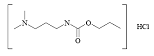
|
224.7
|
parent
|
6.1 Fate and
behaviour in soil
6.1.1 Persistence
in soil
Article 2.8
of the Plant
Protection Products and Biocides Regulations (RGB) describes the
authorisation criterion persistence. If for the evaluation of the product a
higher tier risk assessment is necessary, a standard is to be set according to
the MPC-INS
method. Currently this method equals the method described in the Technical Guidance Document (TGD). Additional guidance is presented in
RIVM-report 601782001/2007.
For the
current application this means the following:
fluopicolide
The
following normalised laboratory DT50 values are available for the
active substance fluopicolide: 277, 276, 300,194, 266 and 333 days (geomean 271
days).
Due to the
exceeding of the threshold value of 60 days for the mean DT50 (lab)
for fluopicolide, it must be demonstrated by means of field dissipation studies
that the field DT50 is < 90 days. The following relevant best fit
non-normalised field data are provided: 99, 132, 172, and 104 days (geomean 124
days). Data from Spain and Southern France are not used for the Dutch assessment.
For the
metabolite M01 the following normalised laboratory DT50-values are
available: 1848, and 808 days.
Due to the
exceeding of the threshold value of 60 days for the mean DT50 (lab)
for M-01 (BAM), it must be demonstrated by means of field dissipation studies
that the field DT50 is < 90 days. The following relevant non-normalised best-fit field data
are provided:120, 315, and 186 days (geomean 191.6 days)
From the
results it is shown that the mean field DT50 is > 90 days.
Based on
the above, the proposed applications of the pesticide infinito do not meet the
standards for persistence as laid down in the RGB. Because the field DT50 is > 90 days, it has to be
demonstrated that application of the pesticide does not lead to accumulation of
the a.s. fluopicolide and metabolite M01 (BAM) to the extent that it will have
an unacceptable effect on non-target-organisms. In order to prevent this, the
sum of the concentrations in which the a.s. fluopicolide and the metabolite M01
are present 2 years after the last application after 10 years of annual
application in the upper 20 cm
of the soil where the pesticide has been applied (Gp,10) (see Table M.4),
should not exceed the MPC-INS value for soil organisms.
For the
metabolite M02 the following normalised laboratory DT50-values are
available: 3, 2.5 and 3 days (geomean 2.8 days).
For the
metabolite M03 the following normalised laboratory DT50-values are
available: 1.7, 4.7, 0.1 and 0.09 days (geomean 0.5 days).
For the
metabolite M05 the following normalised laboratory DT50-values are
available: 41, 100, 22, 20.7, 90.7 and 35.2 days (geomean 42.6 days).
For the
metabolite M10 the following normalised laboratory DT50-values are
available: 194, 24, 16, 3, 236 and 6.4 days (geomean 26.4 days).
For the
metabolite M14 the following normalised laboratory DT50-values are
available: 6.3, 3.3, 3.8, 5.3 and 9.1 days (geomean 5.2 days).
For the
metabolite M11/M12 the following normalised laboratory DT50-values
are available: 27.3, 66.2, and 25.8 days (geomean 36 days).
For the
metabolite M13 the following normalised laboratory DT50-values are
available: 7.3, 33.1, and 6.9 days (geomean 11.8 days).
Based on
the above, the standards of persistence as laid down in the RGB are met for
metabolites M02, M03, M05, M10, M14, M11/M12 and M13.
Propamocarb-HCl
The following
laboratory DT50 values at 20°C are available for the active substance
propamocarb HCl: 10.9, 11.7, 14.1, 17.8, 22.4, 23.4, 29.7, 87.7, 137 days (mean
39.3 days, geomean = 26.3 days). The following laboratory DT50
values at 25°C
are available for the active substance propamocarb HCl: 10.0, 13.0, 14.0 and 28
days (mean = 16.25 days). The following
laboratory DT50 value at 22°C is available for the active substance
propamocarb HCl: 17.7 days. The overall geomean of all the above data
normalised to 20 °C
and pF2 (n=17, data both notifiers) is 13.9 days.
The mean
DT50-value of the a.s. can thus be established to be <90 days.
Furthermore it can be excluded that after 100 days there will be more than 70%
of the initial dose present as bound (non-extractable) residues together with
the formation of less than 5% of the initial dose as CO2.
In this way, the standards for persistence as laid
down in the RGB are met.
MPCsoil
In RIVM
report 12639A01 the MPC (maximum permissable concentration, Dutch: MTR) for
soil is derived for a.s. fluopicolide. In RIVM report 12645A01 the MPC (maximum
permissable concentration, Dutch: MTR) for soil is derived for metabolite M01, BAM.
fluopicolide
Data sources
The
derivation of the MPC for fluopicolide is based on the data available in the
EU-dossier. Data from the Draft Assessment Report were re-assessed for their
reliability in view of the specific use for MPC-derivation. In addition, an
on-line literature search was performed via SCOPUS, available via
http://www.scopus.com/. For information on coverage, see
http://info.scopus.com/detail/what/
The
following search was performed:
((TITLE-ABS-KEY(fluopicolide)
OR CASREGNUMBER(239110-15-7)) AND
((TITLE-ABS-KEY(plant* OR microorganism* OR springtail* OR
earthworm* OR Eisenia)) OR (TITLE-ABS-KEY(soil* OR earth)) OR (TITLE(terrestrial)) OR
(SRCTITLE(terrestrial)))) AND
((TITLE-ABS-KEY(bioassay* OR toxic* OR ecotoxic* OR mortalit*
OR sensitiv* OR phytotox* OR reproduct* OR lethal* OR growth OR teratogen* OR
ec50* OR ec20* OR ec10* OR lc50* OR lc20* OR lc10* OR noec* OR loec* OR matc OR
tlm OR chv OR ecx OR bioassay*)) OR (TITLE(expos* OR respons* OR effect* OR
impact OR toxic* OR ecotoxic* OR mortalit* OR sensitiv* OR assess*)))
This search
did not result in any references from which an endpoint could be derived.
Further, an RIVM report (no. 10904a00) containing information regarding to
route and rate of degradation in soil and adsorption, desorption and mobility
in soil was available for fluopicolide. However, in this report was stated that
the original study reports were not available and that these reports are
essential for the assessment of the studies and (if neccessary) recalculation
of results. Therefore, only information from the DAR
is used for determination of DT50 and Koc values for
fluopicolide.
Data for
human toxicology and secondary poisoning:
If no
suitable data are available, according to the INS-method no MPC is derived for
these two routes, without further consequences for the final MPC.
Bioconcentration and biomagnification
Since the geometric
mean of the log Kow values is > 3 (3.5), the trigger for
bioconcentration and biomagnification is exceeded and a risk for
bioconcentration and biomagnification could occur. The MPCsp, soil
for secondary poisoning is derived below.
Human
toxicological threshold limits and carcinogenicity
Fluopicolide
is proposed to be assigned no R-phrases for effects on human health.
For the
plant protection product 'EXP 11074B' (fluopicolide 44.4 g/kg +
fosetyl-aluminium 666.7 g/kg), R36 and the hazard symbol Xi are proposed. For
the plant protection product 'EXP 11120A' (fluopicolide 62.5 g/L + propamocarb
hydrochloride 625 g/L), R43 and the hazard symbol Xi are proposed.
For
ecotoxicological effects, both the active substance and the two plant
protection products are proposed to be assigned R50/53 and the hazard symbol N.
The ADI is 0.08 mg/kg bw/d, based on a 78-week dietary
study in mice (NOAEL 7.9 mg/kg bw/d, assessment factor 100). The MPChuman,
soil is derived as describerd below.
Ecotoxicological effect data
Laboratory data
The
available chronic ecotoxicity data for soil organisms and/or processes are
summarised in Table M.1.
Table M.1 Ecotoxicity
data for soil organisms (lowest value in bold)
|
Taxonomic
group
and
processes
|
L(E)C50
standard soil 10% OM
[mg/kgdwt]
|
NOEC
standard soil
10% OM
[mg/kgdwt]
|
Remark
|
|
Bacteria
|
|
|
|
|
Soil microflora
|
|
≥ 4.49
|
Nitrogen transformation
|
|
Soil microflora
|
|
≥ 30.7
|
Carbon
transformation
|
|
|
|
|
|
|
Fungi
|
|
|
|
|
Mucor circinelloides
|
|
≥ 300
|
|
|
Phytophora
nicotianae
|
|
3
|
|
|
Cladorrhinum
foesundissimum
|
|
≥ 300
|
|
|
Penicilium janthinellum
|
|
≥ 300
|
|
|
Suillus granulatus
|
|
≥ 300
|
|
|
|
|
|
|
|
Annelida
|
|
|
|
|
Eisenia foetida
|
> 1000
|
125
|
|
|
|
|
|
|
|
Insecta
|
|
|
|
|
Folsomia candida
|
|
62.5
|
|
Field
data
No field
data were available for fluopicolide.
Derivation
of the MPCsoil
MPCeco, soil – ecotoxicity data
According
to the INS-Guidance (Section
2.2.2.8), part of the endpoints presented in Table M.1 cannot be used for the
derivation of the MPCeco, soil because in some the studies the test
concentration was not high enough to determine the NOEC or L(E)C50.
NOECs are available for three species from two trophic
levels. The MPCeco, soil is derived by using an assessment factor of
50 to the lowest NOEC (3 mg/kgdwt derived in a 6-d study with the
fungi Phytophora nicotianae),
resulting in an MPCeco, soil of 0.06 mg/kgdwt
MPCsp, soil – secondary poisoning
Since the
log Kow is ≥ 3, the MPCsoil
via secondary poisoning is derived. The MPCoral per species is
calculated applying the appropriate assessment factor (see Table M.2). The
lowest value is used for MPC derivation according to Section 3.3.5 of the INS-Guidance.
Table M.2 Toxicity
data for birds and mammals
|
|
Duration
|
NOAEC
diet
[mg/kgdiet]
|
AF
|
MPCoral,
mammal
MPCoral,
bird
[mg/kg diet]
|
|
Mammals
|
|
|
|
|
Mouse
|
78 weeks
|
50
|
30
|
1.67
|
|
Rabbit
|
22 days
|
66.6
|
300
|
0.2
|
|
Rat
|
2 generation
|
500
|
30
|
16.7
|
|
Rat
|
2 generation
|
600
|
30
|
20
|
|
Rat
|
13 weeks
|
200
|
90
|
2.22
|
|
|
|
|
|
|
|
Birds
|
|
|
|
|
|
Bobwhite
quail
|
5 days
|
3160
|
3000
|
1.05
|
|
Bobwhite
quail
|
21 weeks
|
1000
|
30
|
33.3
|
|
Mallard duck
|
5 days
|
1780
|
3000
|
0.59
|
|
Mallard duck
|
21 weeks
|
≥ 1000
|
30
|
33.3
|
Because for
rats and birds more than one study is available, the most appropriate MPCoral
for these organisms should be selected first. According to the INS-Guidance (Section 3.1.4.2, point 2, last
lines), it is recommended in this case “to use the most sensitive endpoint
divided by the appropriate assessment factor (i.e. the factor implied by the
study with the longest test duration)”.
Taking the
lowest from the MPCoral-values for rat, mouse, rabbit and bird, the
MPCoral,min is set to 1.67 mg/kg diet.
· The MPCoral, min is 1.67
mg/kg diet
· A BCF
value for soil organisms is not available. Using the log Kow of 3.5,
the calculated BCF is 39 kg/kg ww (Eq.
8 of the INS-Guidance; RHOearthworm
= 1)
· Using the Koc of 318 and
the Henry-coëfficient of 4.15 x 10⁻⁵ Pa.m3/mol, the Ksoil-water
is calculated as 10 m3/m3 (Eq. 57, 59 and 60 of the INS-Guidance).
· Combining this input and using the
default parameters as given in the INS-Guidance,
the MPCsp, soil is 0.30 mg/kg dwt, for standard soil with 10% OM.
MPChuman, soil – human exposure
The MPChuman,
soil is calculated according to Section 3.3.6 of the INS-Guidance, using the ADI
of 0.08 mg/kg bw/d as input. Other input parameters needed for the
(intermediate) calculations are the Kow (103.5 = 2971)
and Koc (318) and Henry’s law constant and water solubility as given
in Table 2. Using the defaults as given in Table 31 of the INS-Guidance, the following results are obtained.:
MPChuman,soil leaf 4.988
x 10-8 kg/kgwwt soil
MPChuman,soil root 1.812
x 10-7 kg/kgwwt soil
MPChuman,soil milk 6.278 x
10-5 kg/kgwwt soil
MPChuman,soil meat 3.700
x 10-5 kg/kgwwt soil
The most
critical MPChuman, soil for exposure via leaf crops (4.988 x 10⁻⁸
kg/kgwwt soil) is equivalent to 0.17 mg/kgdwt for
standard soil at 10% OM.
Conclusion
The
following MPCs are derived for the soil compartment for standard soil with 10% OM:
MPCeco, soil = 0.06 mg/kg dwt
MPCsp, soil = 0.30 mg/kg dwt
MPChuman, soil = 0.17
mg/kg dwt
The lowest
of these values is selected as the final MPCsoil. The MPCsoil
of fluopicolide is
0.06 mg/kg
dwt soil, based on standard soil with 10% OM.
Fluopicolide
metabolite M01
Data
sources
The
derivation of the MPC for fluopicolide metabolite M-01 is based on the data
available in the EU-dossier. Data from the Draft Assessment Report were
re-assessed for their reliability in view of the specific use for
MPC-derivation. In addition, an on-line literature search was performed via
SCOPUS, available via http://www.scopus.com/. For information on coverage, see http://info.scopus.com/detail/what/
The
following search was performed:
((TITLE-ABS-KEY(fluopicolide
metabolite) OR CASREGNUMBER(2008-58-4)) AND
((TITLE-ABS-KEY(plant* OR microorganism* OR springtail* OR
earthworm* OR eisenia)) OR (TITLE-ABS-KEY(soil* OR earth)) OR (TITLE(terrestrial)) OR
(SRCTITLE(terrestrial)))) AND
((TITLE-ABS-KEY(bioassay* OR toxic* OR ecotoxic* OR mortalit*
OR sensitiv* OR phytotox* OR reproduct* OR lethal* OR growth OR teratogen* OR
ec50* OR ec20* OR ec10* OR lc50* OR lc20* OR lc10* OR noec* OR loec* OR matc OR
tlm OR chv OR ecx OR bioassay*)) OR (TITLE(expos* OR respons* OR effect* OR
impact OR toxic* OR ecotoxic* OR mortalit* OR sensitiv* OR assess*)))
This search
did not result in any references from which an endpoint could be derived.
Data for
human toxicology and secondary poisoning:
If no
suitable data are available, according to the INS-method no MPC is derived for
these two routes, without further consequences for the final MPC.
Bioconcentration and biomagnification
Since the
log Kow is < 3, the trigger for bioconcentration and
biomagnification is not exceeded. Therefore, the MPCsp, soil for
secondary poisoning is not derived.
Human
toxicological threshold limits and carcinogenicity
Based on an
oral LD50 in rat of 500 mg/kg classifiaction with R 22, Xn was
proposed.
The parent
compount fluopicolide is proposed to be assigned no R-phrases for effects on
human health. For the plant protection product 'EXP 11074B' (fluopicolide 44.4
g/kg + fosetyl-aluminium 666.7 g/kg), R36 and the hazard symbol Xi are
proposed. For the plant protection product 'EXP 11120A' (fluopicolide 62.5 g/L
+ propamocarb hydrochloride 625 g/L), R43 and the hazard symbol Xi are
proposed.
For
ecotoxicological effects, both the active substance and the two plant protection
products are proposed to be assigned R50/53 and the hazard symbol N.
The ADI of fluopicolide metabolite M-01 is 0.05 mg/kg
bw/d, based on the long term (two-year) rat and dog studies (NOAEL 5 mg/kg
bw/d, assessment factor 100). The MPChuman, soil is derived in
Section 1.5.3.
Ecotoxicological effect data
Laboratory
data
The
available chronic ecotoxicity data for soil organisms and/or processes are
summarised in Table 4. The lowest L(E)C50 and NOEC value are
presented in bold.
Table M.3 Ecotoxicity
data for soil organisms
|
Taxonomic
group
and
processes
|
L(E)C50
standard soil 10% OM
[mg/kgdw]
|
NOEC
standard soil
10% OM
[mg/kgdw]
|
Remark
|
|
Bacteria
|
|
|
|
|
Soil microflora
|
|
≥ 9.2
|
Nitrogen transformation
|
|
Soil microflora
|
|
≥ 9.2
|
|
|
|
|
|
|
|
Fungi
|
|
|
|
|
Mucor circinelloides
|
|
≥ 300
|
|
|
Phytophora nicotianae
|
|
≥ 300
|
|
|
Cladorrhinum
foesundissimum
|
|
≥ 300
|
|
|
Penicilium janthinellum
|
|
≥ 300
|
|
|
Suillus granulatus
|
|
≥ 300
|
|
|
|
|
|
|
|
Annelida
|
|
|
|
|
Eisenia foetida
|
750
|
250
|
|
|
|
|
|
|
|
Insecta
|
|
|
|
|
Folsomia candida
|
|
25
|
|
Field
data
No field
data were available for fluopicolide metabolite M-01.
Derivation
of the MPCsoil
MPCeco, soil – ecotoxicity data
According
to the INS-Guidance (Section
2.2.2.8), part of the endpoints presented in Table M.3 cannot be used for the
derivation of the MPCeco, soil because in some the studies the test
concentration was not high enough to determine the NOEC or L(E)C50.
NOECs are
available for two species from two trophic levels. NOECs are available
for three species from two trophic levels. The MPCeco, soil is derived by using
an assessment factor of 50 to the lowest NOEC, resulting in an MPCeco,
soil of 0.5 mg/kgdwt.
MPChuman, soil – human exposure
The MPChuman,
soil is calculated according to Section 3.3.6 of the INS-Guidance, using the ADI
of 0.05 mg/kg bw/d as input. Other input parameters needed for the
(intermediate) calculations are the Kow (100.77 = 5.89)
and Koc (worst-case, 31 L/kg) and Henry’s law constant and water
solubility as given in Table 2. Using the defaults as given in Table 31 of the INS-Guidance, the following results are obtained:
MPChuman,soil leaf 1.161
x 10-8 kg/kgwwt soil
MPChuman,soil root 5.983
x 10-7 kg/kgwwt soil
MPChuman,soil milk 4.624 x
10-5 kg/kgwwt soil
MPChuman,soil meat 8.618
x 10-4 kg/kgwwt soil
The most
critical MPChuman, soil for exposure via leaf crops (1.161 x 10⁻⁸
kg/kgwwt soil) is equivalent to 0.039 mg/kgdwt for
standard soil at 10% OM.
Conclusion
The
following MPCs are derived for the soil compartment for standard soil with 10% OM:
MPCeco, soil = 0.5 mg/kg dwt
MPChuman, soil = 0.039
mg/kg dwt
The lowest
of these values is selected as the final MPCsoil. The MPCsoil
of fluopicolide metabolite M-01 is 0.039 mg/kg dw soil, based on standard soil
with 10% OM.
PECsoil
The concentration of the [a.s. (and metabolites)] in soil is needed to
assess the risk for soil organisms (earthworms, micro-organisms). The PECsoil
is calculated for the upper 5
cm of soil using a soil bulk density of 1500 kg/m3.
The
following input data are used for the calculation:
|
PEC soil:
Active substance fluopicolide:
Maximum relevant non-normalised best-fit field DT50
for degradation in soil: 172 days
Molecular mass: 383.59 g/mol
Metabolite M01
(BAM):
Maximum non-normalised best-fit field DT50
for degradation in soil (20°C): 315 days
Molecular mass: 190.03 g/mol
Correction factor:
11.9% (maximum observed percentage in field) * 0.5 (relative molar ratio = M
metabolite/M parent) = 0.06
Metabolite M03:
Maximum non-normalised lab DT50 for
degradation in soil (20°C): 5 days
Molecular mass: 399.6 g/mol
Correction factor:
10.6%(maximum observed percentage) * 1.04 (relative molar ratio =
M metabolite/M parent) = 0.11
Active substance propamocarb-HCl:
Maximum lab/field DT50 for degradation
in soil: 137 days
Molecular mass: 224.7 g/mol (propamocarb-HCl);
188.3 g/mol (propamocarb)
The Gp,10 of metabolite
a.s. fluopicolide and M01 (BAM) is derived based on a R% of 21.8% for
fluopicolide and 5.18% for M01.
This R% is the result of
a PEARL 3.3.3 calculation of an application
in maize of 1 kg/ha on May 25th with the Dutch standard scenario
based on:
Active substance
fluopicolide:
Geometric mean normalised
field DT50 for degradation in soil (20°C): 138.8 days.
Arithmetic mean Kom
(pH-independent): 186.2 L/kg
Arithmetic mean 1/n:
0.903
Saturated vapour
pressure: 3.03 x 10⁻⁷ Pa (20 ºC)
Solubility in water: 2.8
mg/L (20 ºC)
Molecular mass: 383.59
g/mol
Metabolite M01 (BAM) :
Geometric mean normalised
field DT50 for degradation in soil (20°C):
137.7 days
Arithmetic mean Kom
(pH-independent): 23.7 L/kg
Arithmetic mean 1/n:
0.9158
Maximum fraction of
occurence: 1.0
Saturated vapour
pressure: 2.0 x 10⁻⁵ Pa (25˚C)
Solubility in water: 1830 mg/L (20 ºC)
Molecular mass:
190 g/mol
|
See Table M.4 for other input values and results.
Table
M.4 PECsoil calculations (5 cm
(and 20 cm))
|
Use
|
Substance
|
Correction factor
|
Rate
[kg a.s./ha]
|
Freq.
|
Fraction on soil
*
|
PIECsoil
5 cm
[mg
a.s./kg]
|
PECsoil
21 days
[mg a.s./kg]
|
PECsoil
20 cm (Gp,10)
[mg a.s./kg]
|
|
Potatoes non-professional use
|
Fluopicolide
M-01
M-03
Propamocarb-HCl
|
-
0.25
0.1
-
|
0.095
0.945
|
4
|
0.5
|
0.243
0.063
0.01
2.391
|
0.233
0.061
0.003
2.269
|
0.018
0.0001
|
* fraction on soil is detemined as 1 – interception value; interception
values derived from Table 1.6
in “generic guidance for FOCUS groundwater scenarios”. based on interception percentage
before flowering (BBCH 20-39 which is in the middle of the potential use period)
These
exposure concentrations are examined against ecotoxicological threshold values
in section 7.5.
Risk assessment
Since the
Gp,10 is lower than the MPCsoil of 0.06 mg/kg dw soil, 0.028 mg/kg dw soil
corrected for 4.7% OM, for a.s.
fluopicolide, it is concluded that the
standards for persistence as laid down in the RGB are met.
Since the
Gp,10 is lower than the MPCsoil of 0.039 mg/kg dw soil for metabolite BAM, it is concluded that the standards for
persistence as laid down in the RGB are met.
6.1.2
Leaching to shallow groundwater
Article 2.9
of the Plant
Protection Products and Biocides Regulations (RGB) describes the
authorisation criterion leaching to groundwater.
The leaching potential of
the active substance (and metabolites) is calculated in the first tier using Pearl 3.3.3 and the FOCUS Kremsmünster scenario. Input variables are the actual
worst-case application rate 0.095 kg/ha for fluopicolide and 0.945 kg/ha for
propamocarb-HCl, the crop [potatoes] and an interception value
appropriate to the crop of [0.5]. As the use is for non-professional only, the
actual dose is considered to be 1/10 of the dose rate derived in the GAP table,
based on smaller areas treated. First date of yearly application is May 25th.
For metabolites all available data concerning substance properties are
regarded. Metabolites M-01, M02 and M-03 occurred in aerobic soil degradation
studies and should be included in the calculations. No other metabolites occurred above > 10 % of AR, > 5 % of AR at
two consecutive sample points or had an increasing tendency in the aerobic soil
degradation studies. Metabolite M02 has a very
low DT50 combined with a small Kom (both values below 10) and
metabolite M03 shows a tendency to pH dependent degradation. Both metabolites
should therefore be subject to GeoPEARL calculation, the second step in the
leaching assessment. Nevertheless
as both metabolites can be considered toxicological non-relevant a GeoPEARL
calculation was not performed.
In the dossier numerous
lysimeter metabolites are identified which showed leaching from the lysimeter
above 0.1 µg/L. These metabolites (M-05, M-10, M-11, M-12, and M-13) are not
included in the calculation. From the final assessment report (EFSA 2009) it is
concluded these metabolites can be considered non-relevant. For metabolite M-15
the groundwater assessment could not be finalised because data on human
toxicity are missing. In this case, as it is non-professional use only, this
metabolite is not further
considered.
The
following input data are used for the calculation:
|
PEARL:
Active substance fluopicolide:
Geometric mean normalised field DT50
for degradation in soil: 138.8 days
(in line with EU review)
Arithmetic mean Kom (pH-independent):
186.2 L/kg
Arithmetic mean 1/n: 0.903
Saturated vapour pressure: 3.03 x 10⁻⁷
Pa (20ºC)
Solubility in water: 3.02 mg/L (20ºC)
Molecular mass: .383.6 g/mol
Metabolite M01:
Geometric mean normalised field DT50
for degradation in soil (20°C): 137.7 days ( in
line with EU review)
Arithmetic mean Kom
(pH-independent): 23.7 L/kg
Arithmetic mean 1/n:
0.9158
Arithmetic mean formation fraction: 0.5 from
M03 (cf DAR calculation)
or
Maximum fraction of occurence: 0.25
Saturated vapour
pressure: 2.0 x 10⁻⁵ Pa (25˚C)
Solubility in water: 1830 mg/L (20 ºC)
Molecular mass:
190 g/mol
Metabolite M02:
Geometric mean DT50 for degradation in
soil (20°C): 2.8
days
Arithmetic mean Kom (pH-independent):
3.48 L/kg
Arithmetic mean 1/n: 0.774
Arithmetic mean formation fraction: 0.5 from
M03 (cf DAR calculation) used for calculation
Maximum fraction of occurence: 0.073
Saturated vapour pressure: parent value
Solubility in water: parent value
Molecular mass: 225.6 g/mol
Metabolite M03:
Geometric mean DT50 for degradation in
soil (20°C): 0.09
days (value for soils with pH > 6
Arithmetic mean Kom (pH-independent):
63.23 L/kg
Arithmetic mean 1/n: 0.971
Arithmetic mean formation fraction: 1 from
parent (cf DAR calculation)
or
Maximum fraction of occurence: 0.106
Saturated vapour pressure: parent value
Solubility in water: parent value
Molecular mass: 399.58 g/mol
Propamocarb-HCl:
Geometric mean normalise field DT50 for
degradation in soil: 12.4 days
Arithmetic mean Kom (pH-independent):
310.6 L/kg
Arithmetic mean 1/n: 0.867
Saturated vapour pressure: 1.66 x 10⁻³ Pa (25ºC)
Solubility in water: no value available
Molecular mass: 224.7 g/mol
Other parameters: standard settings of PEARL 3.3.3
|
The
following concentrations are predicted for the a.s. fluopicolide and the metabolites
M01 (BAM), M02 and M03 and the active substance propamocarb-HCl following the
realistic worst case GAP, see Table M.5.
Table M.5 Leaching of a.s.
fluopicolide and metabolites M01, M02 and M03, and a.s. propamocarb-HCl as
predicted by PEARL
3.3.3
|
Use
|
Substance
|
Rate
substance [kg/ha]1
|
Frequency
|
Interval [days]
|
Fraction
Intercepted *
|
PEC groundwater [mg/L]
|
|
|
|
|
|
|
|
spring
|
|
Potatoes
(non-professional use)
|
Fluopicolide
M01
M02
M03
Propamocarb-HCl
|
0.0095
0.0945
|
4
|
7
|
0.5
|
0.0049
0.334
0.0001
0.0002
<0.001
|
* interception values derived from Table 1.6 in “generic guidance for
FOCUS groundwater scenarios”. Application prescribed from BBCH 15-89, the
median of this period is used for calculation.
1 for non-prossional use it is
assumed only 10% of the area is exposed
Results of Pearl 3.3.3 using the Kremsmünster scenario are examined
against the standard of 0.01 µg/L. This is the standard of 0.1 µg/L with an
additional safety factor of 10 for vulnerable groundwater protection areas
(NL-specific situation).
From Table M.2
it reads that the expected leaching based on the PEARL-model calculations for
the a.s. fluopicolide and its metabolites M02 and M03, and the a.s.
propamocarb-HCl is smaller than 0.01 µg/L for all proposed applications. Hence,
the applications meet the standards for leaching as laid down in the RGB.
The
expected leaching for the metabolite M01 of fluopicolide (BAM) equal to or larger than 0.1 µg/L. Therefore,
further study into the leaching behaviour is necessary.
As from the final conclusion
on the a.s. fluopicolide it can be read that all metabolites can be considered
non-relevant (EFSA
Scientific Report (2009) 299) and the
application is for non-professional use only, the metabolites do not need to meet the standards for leaching as laid
down in the RGB.
Monitoring
data
There are
no data available regarding the presence of the substance fluopicolide or
prpamocarb-HCl in groundwater.
Regarding the presence of metabolite M01 of fluopicolide monitoring data
are available.
BAM was observed
in the groundwater [reference: RIVM report 607310001/2007 in Dutch]. In Table M.6
observed concentrations in groundwater are presented.
Table M.6 Monitoring data in
groundwater
|
Location/year
|
Detection
limit [mg/L]
|
a/n*
|
Filter
depth
|
90th
percentile conc. [mg/L]
|
Maximum
conc. [mg/L]
|
|
Location
|
0.05
|
45/675
|
< 7 m-mv and >7 m-mv
|
<0.02
|
7.69
|
* number of observations above detection limit (a)/total
number observations (n).
Monitoring results indicate that the substance BAM was detected on several occasions. After
evaluation of the data, the 90th percentile concentrations did not
exceed the limit of 0.1 mg/L. Quite a number of measurements could be attributed to the
non-agricultural use of dichlobenil which is transformed in BAM as well. The
monitoring data tend to confirm the predicted concentrations. However, BAM has been declared non relevant (EFSA Scientific Report (2009) 299) and therefore BAM meets the standards laid down in the RGB for the
proposed application.
Conclusions
The
proposed application of the product complies with the requirements laid down in
the RGB concerning persistence and leaching in soil.
6.2 Fate and behaviour in water
6.2.1 Rate and route of degradation in surface
water
The exposure
concentrations of the active substances fluopicolide and
Propamocarb-HCl in surface water have been estimated for the various proposed
uses using calculations of surface water concentrations (in a ditch of 30 cm depth), which originate
from spray drift during application of the active substance. The spray drift
percentage depends on the use. For non-professional use a drift rate of 0.5%
is used.
Concentrations
in surface water are calculated using the model TOXSWA. The following input
data are used for the
calculation:
|
TOXSWA:
Active
substance fluopicolide:
Geometric
mean DT50 for degradation in water at 20°C:
1116.5 days
DT50
for degradation in sediment at 20°C:
1000 days (default).
Arithmetic mean Kom for suspended organic matter:
186.2 L/kg
Arithmetic mean Kom for sediment: 186.2 L/kg
Arithmetic mean 1/n: 0.903
Saturated vapour
pressure: 3.03 x 10⁻⁷ Pa (20 ºC)
Solubility in water: 2.8
mg/L (20 ºC)
Molecular mass: 383.59
g/mol
Active
substance propamocarb-HCl:
Geometric
mean DT50 for degradation in water at 20°C: geomean of mean values from each
notifier (15.7 and 18.5) = 17.0 days
DT50
for degradation in sediment at 20°C:
1000 days (default).
Arithmetic mean Kom for suspended organic matter:
310.7 L/kg
Arithmetic mean Kom for sediment: 310.7 L/kg
Arithmetic mean 1/n: 0.867
Saturated vapour pressure: 8 x 10⁻⁵ Pa (25ºC)
Solubility in water: 935 g/L (20°C, pH 7)
Molecular
mass: 224.7 g/mol (propamocarb-HCl);
188.3 g/mol (propamocarb)
Other
parameters: standard settings TOXSWA
|
When no
separate degradation half-lives (DegT50 values) are available for the water and
sediment compartment (accepted level P-II values), the system degradation
half-life (DegT50-system, level P-I) is used as input for the degrading
compartment and a default value of 1000 days is to be used for the compartment
in which no degradation is assumed. This is in line with the recommendations in
the FOCUS Guidance Document on Degradation Kinetics.
In Table
M.7a, the drift percentages and calculated surface water concentrations for the
active substances fluopicolide and propamocarb-HCl for each intended use are
presented.
Table M7a Overview of surface water concentrations for active substance fluopicolide
and propamocarb-HCl in the edge-of-field ditch following spring application
|
Use
|
Substance
|
Rate a.s.
[kg/ha]
|
Freq.
|
Interval
|
Drift
[%]
|
PIEC
[mg/L] *
|
PEC21
[mg/L] *
|
PEC28
[mg/L] *
|
|
|
|
|
|
|
|
Spring
|
spring
|
spring
|
|
potatoes
|
Fluopicolide
Propamocarb-HCl
|
0.095
0.945
|
4
|
7
|
0.5
|
0.814
6.765
|
0.679
5.273
|
0.630
4.818
|
* calculated according to TOXSWA
PECsediment
To address the risk to sediment organisms, a PEC
sediment value is needed for fluopicolide.
The PECsediment values calculated with TOXSWA are
expressed in g a.s./m3 sediment. This PECsed has to be
converted to mg a.s./kg sed dw by dividing it by the dry weight (DW) bulk
density.
It is assumed that the substance will be present
mainly in the top 1 cm
layer. This layer has a dry weight bulk density of 80 kg/m3. The
maximum PEC value in sediment in the top 1 cm of sediment is reached at day 28 after
application. See Table M.3b for calculation of PECsediment.
Table M.7b Maximum sediment concentration for active substance fluopicolide in the edge-of-field ditch following spring application
|
Use
|
Substance
|
Rate a.s.
[kg/ha]
|
drift
[%]
|
PECsediment
[g a.s./m3
sediment] *
|
PECsediment
[mg a.s./kg
sediment DW]**
|
|
|
|
|
|
spring
|
spring
|
|
potatoes
|
fluopicolide
|
0.095
|
0.5
|
0.246 x 10⁻²
|
0.0308
|
* TOXSWA output
** calculated as (PECsed in g/m3 /
80 kg/m3)*1000 (conversion of g/kg to mg/kg)
The exposure concentrations in surface water and
sediment are compared to the ecotoxicological threshold values in section 7.2.
Monitoring data
The
Pesticide Atlas on internet (www.pesticidesatlas.nl, www.bestrijdingsmiddelenatlas.nl)
is used to evaluate measured concentrations of pesticides in Dutch surface
water, and to assess whether the observed concentrations exceed threshold
values.
Dutch water boards have a
well-established programme for monitoring pesticide contamination of surface
waters. In the Pesticide Atlas, these monitoring data are processed into a
graphic format accessible on-line and aiming to provide an insight into
measured pesticide contamination of Dutch surface waters against environmental
standards.
Recently, the new version 2.0 was
released. This new
version of the Pesticide Atlas does not contain the land use correlation
analysis needed to draw relevant conclusions for the authorisation procedure.
Instead a link to the land use analysis performed in version 1.0 is made, in
which the analysis is made on the basis of data aggregation based on grid cells of either 5 x 5 km or 1 x 1 km.
Data from the Pesticide Atlas are
used to evaluate potential exceeding of the authorisation threshold and the MPC
(ad-hoc or according to INS) threshold.
For examination against the drinking
water criterion, another database (VEWIN) is used, since the drinking water
criterion is only examined at drinking water abstraction points. For the
assessment of the proposed applications regarding the drinking water criterion,
see next section.
fluopicolide
There are
no data available in the Pesticide Atlas regarding the presence of the
substance fluopicolide in surface water.
Propamocarb HCl
The active
substance propamocarb HCl was observed in the surface water (most recent data
from 2007). In Table M.8 the number of observations in the surface water are
presented.
In the
Pesticide Atlas, surface water concentrations are compared to the authorisation
threshold value of 630 µg/L (C-207.3.2/12, consisting of first or higher tier
acute or chronic ecotoxicological threshold value, including relevant safety
factors, which is used for risk assessment, in this case [0.1*NOECfish]) and to
the indicative Maximum Permissible Concentration (MPC) of 190 µg/L as presented
in the Pesticide Atlas (data source for the MPC: Zoeksysteem normen voor het
waterbeheer, http://www.helpdeskwater.nl/normen_zoeksysteem/normen.php).
Currently,
this MPC value is not harmonised, which means that not all available
ecotoxicological data for this substance are included in the threshold value.
In the near future and in the framework of the Water Framework Directive, new
quality criteria will be developed which will include both MPC data as well as
authorisation data.
The
currently available MPC value is reported here for information purposes.
Pending this policy development (finalisation for all substances expected in
2009-2010), however, no consequences can be drawn for the proposed
application(s).
Table
M.8 Monitoring data in Dutch surface water (from www.pesticidesatlas.nl,
version 2.0)
|
Total no of locations
(2008)
|
n > authorisation
threshold
|
n > indicative/ad hoc
MPC threshold
|
n > MPC-INS threshold
*
|
|
14**
|
0
|
0
|
n.a.
|
*
n.a.: no MPC-INS available. < : exceeding expected to be lower than with
indicative/ad hoc MPC value; > : exceeding expected to be higher than with
ad hoc MPC value
** the number of observations at each location varies
between 4 and 10, total number of measurements is 102 in 2008.
As there
are no exceedings of thresholds, the monitoring data have no consequences for
the proposed use of the product.
Drinking water
criterion
It follows from the
decision of the Court of Appeal on Trade and Industry of 19 August 2005 (Awb
04/37 (General Administrative Law Act)) that when considering an application,
the Ctgb should, on the basis of the scientific and technical knowledge and
taking into account the data submitted with the application, also judge the
application according to the drinking water criterion ‘surface water intended
for drinking water production’. No mathematical model for this aspect is
available. This means that any data that is available cannot be adequately
taken into account. It is therefore not possible to arrive at a scientifically
well-founded assessment according to this criterion. The Ctgb has not been
given the instruments for testing surface water from which drinking water is
produced according to the drinking water criterion. In order to comply with the
Court’s decision, however - from which it can be concluded that the Ctgb should
make an effort to give an opinion on this point – and as provisional measure,
to avoid a situation where no authorisation at all can be granted during the
development of a model generation of the data necessary, the Ctgb has
investigated whether the product under consideration and the active substance
could give cause for concern about the drinking water criterion.
Fluopicolide has been on the Dutch market for > 3 years
(authorised since 01-06-2007). This period is sufficiently large to consider
the market share to be established. From the general scientific knowledge
collected by the Ctgb about the product and its active substance, the Ctgb
concludes that there are in this case no concrete indications for concern about
the consequences of this product for surface water from which drinking water is
produced, when used in compliance with the directions for use. The Ctgb does
under this approach expect no exceeding of the drinking water criterion. The
standards for surface water destined for the production of drinking water as
laid down in the RGB are met.
Propamocarb HCl has been on the Dutch market for > 3 years (authorised
since 1990). This period is sufficiently large to consider the market share to
be established. From the general scientific knowledge collected by the Ctgb
about the product and its active substance, the Ctgb concludes that there are
in this case no concrete indications for concern about the consequences of this
product for surface water from which drinking water is produced, when used in
compliance with the directions for use. The Ctgb does under this approach
expect no exceeding of the drinking water criterion. The standards for surface
water destined for the production of drinking water as laid down in the RGB are
met.
6.3 Fate and behaviour in air
Route
and rate of degradation in air
Fluopicolide
The vapour
pressure is 3.03 x 10⁻⁷ Pa at 20°C. The
Henry constant is 4.15 x 10⁻⁵ Pa m3 mol-1 at 20°C. The half-life in air is 3.73 days
assuming a 24 hour day.
Propamocarb-HCl
The vapour
pressure is 8.1 x 10⁻⁵ Pa and 1.66 x 10⁻³ Pa at 25 ºC
(two notifiers). The Henry constant is 8.5 x 10⁻⁹ Pa.m3.mol-1
at 20°C. The half-life in air is 4.03 and
13.4 hours (two notifiers).
Since at
present there is no framework to assess fate and behaviour in air of plant
protection products, for the time being this issue is not taken into
consideration.
6.4 Appropriate
fate and behaviour end-points relating to the product and approved uses
See List of
Endpoints.
6.5 Data
requirements
None.
The following restriction sentences were proposed by the applicant:
-
Based on the current
assessment, the following has to be stated in the GAP/legal instructions for
use:
None.
6.6 Overall conclusions fate and behaviour
It can be
concluded that:
- the
active substances fluopicolide and propamocarb-HCl meet the standards for
persistence in soil as laid down in the RGB.
- metabolite
M01 (BAM), of fluopicolide meets the standards for persistence in soil
as laid down in the RGB.
- all
proposed applications of the active substances fluopicolide and
propamocarb-HCl meet the standards for leaching
to the shallow groundwater as laid down in the RGB.
- all
proposed applications of metabolites M01 (BAM), M02 and M03 of
fluopicolide are declared non relevant and do not need to the standards
for leaching to shallow groundwater as laid down in the RGB.
- all
proposed applications of the active substances fluopicolide and
propamocarb-HCl meet the standards for surface water destined for the
production of drinking water as laid down in
the RGB.
7.
Ecotoxicology
For the
current application of Infinito, risk assessment is done in accordance with Chapter 2
of the RGB.
List of
Endpoints Ecotoxicology
Fluopicolide
Fluopicolide is a
new substance, included on Annex I. For the risk assessment the final LoEP of
06/2009 is used.
Formulation EXP
11120A contains 64.7 g
fluopicoline/L and 634 g
propamocarb-HCl/L. This formulation is used for the risk assessment of
Infinito, containing 62.5 g
fluopicoline/L and 625 g
propamocarb-HCl/ha. This is acceptable, since formulation EXP 11120A is a
comparable type of formulation and contains a higher concentration of a.s. and
the ratio of the actives is about the same.
Effects on terrestrial vertebrates (Annex IIA, point
8.1, Annex IIIA, points 10.1 and 10.3)
|
Species
|
Test substance
|
Time scale
|
End point
(mg/kg bw/day)
|
End point
(mg/kg feed)
|
|
Birds ‡
|
|
C.
virginianus
|
fluopicolide
|
Acute
|
>2250
|
-
|
|
C.
virginianus
|
fluopicolide
|
Short-term
|
>1744
|
>5620
|
|
C.
virginianus
|
Metabolite M01
|
Short-term
|
1171
|
3897
|
|
C.
virginianus
|
fluopicolide
|
Long-term
|
88.9
|
1000
|
|
Mammals ‡
|
|
Rat
|
fluopicolide
|
Acute
|
>5000
|
-
|
|
Rat
|
EXP 11074B
|
Acute
|
>2000(product)
|
-
|
|
Rat
|
EXP 11120A
|
Acute
|
>2000(product)
|
-
|
|
Rat
|
Metabolite M01
|
Acute
|
M2000/F500
|
-
|
|
Rat
|
Metabolite M02
|
Acute
|
>5000
|
-
|
|
Rat
|
Metabolite M05
|
Acute
|
>5000
|
-
|
|
Rat
|
Metabolite M10
|
Acute
|
>5000
|
-
|
|
Rabbit
|
fluopicolide
|
Long-term
|
20.0
|
|
|
Additional
higher tier studies ‡ - none
|
Toxicity
data for aquatic species (most sensitive species of each group) (Annex IIA,
point 8.2, Annex IIIA, point 10.2)
|
Group
|
Test substance
|
Time-scale
(Test type)
|
End point
|
Toxicity1
mg/L
|
|
Laboratory tests ‡
|
|
Fish
|
|
O. mykiss
|
fluopicolide
|
96h(static)
|
Mortality, LC50
|
0.36mm
|
|
P. pimales
|
fluopicolide
|
33d(flo thru)
|
Growth NOEC
|
0.155mm
|
|
O. mykiss
|
EXP 11074B
|
96h(static)
|
Mortality, LC50
|
0.39(8.541)nom
|
|
O. mykiss
|
EXP 11120A
|
96h (static)
|
Mortality, LC50
|
0.38(6.571)nom
|
|
O.
mykiss
|
Metabolite M01
|
96h (static)
|
Mortality, LC50
|
240nom
|
|
O.
mykiss
|
Metabolite M02
|
96h (static)
|
Mortality, LC50
|
>100nom
|
|
O.
mykiss
|
Metabolite M05
|
96h (static)
|
Mortality, LC50
|
>100nom
|
|
Aquatic
invertebrate
|
|
D. magna
|
fluopicolide
|
48h (static)
|
Mortality, LC50
|
>1.8mm
|
|
D.
magna
|
fluopicolide
|
21d (static ren)
|
Repro., NOEC
|
0.37mm
|
|
D.
magna
|
EXP 11074B
|
48h (static)
|
Mortality, LC50
|
>1.13(>251)nom
|
|
D.
magna
|
EXP 11120A
|
48h (static)
|
Mortality, LC50
|
>5.73(>1001)nom
|
|
D.
magna
|
Metabolite M01
|
48h (static)
|
Mortality, LC50
|
180nom
|
|
Sediment
dwelling organisms
|
|
C. riparius
|
fluopicolide
|
28d (static2)
|
Emergence,NOEC
|
49.0mg/kgnom
|
|
Algae
|
|
Navicula pelliculosa
|
fluopicolide
|
72h (static)
|
Biomass: EbC50
Growth rate: ErC50
|
0.029mm
0.069mm
|
|
Navicula pelliculosa
|
EXP 11074B
|
72 h (static)
|
Biomass: EbC50
Growth rate: ErC50
|
0.026(0.581)nom
0.041(0.911)nom
|
|
Navicula pelliculosa
|
EXP 11120A
|
72 h (static)
|
Biomass: EbC50
Growth rate: ErC50
|
0.023(0.401)nom
0.036(0.631)nom
|
|
Navicula pelliculosa
|
Metabolite M01
|
72 h (static)
|
Biomass: EbC50
Growth rate: ErC50
|
>10.0nom
>10.0nom
|
|
Navicula pelliculosa
|
Metabolite M05
|
72 h (static)
|
Biomass: EbC50
Growth rate: ErC50
|
>10.0nom
>10.0nom
|
|
Higher
plant
|
|
L. gibba G3
|
fluopicolide
|
7d (static)
|
Biomass: EbC50
|
>3.2mm
|
|
L. gibba G3
|
Metabolite M01
|
7d (static)
|
Biomass: EbC50
|
>80.0mm
|
|
Microcosm or mesocosm tests - not required
|
mm
= mean measured; nom = nominal
1
product; 2 spiked sediment
Fish bioconcentration
|
Bioconcentration
|
|
|
Fluopicolide
|
|
logPO/W
|
2.9
|
|
Bioconcentration factor (BCF) ‡
|
121
|
|
Annex VI Trigger for the bioconcentration
factor
|
1001
|
|
Clearance time (days)
(CT50)
|
0.51
|
|
(CT90)
|
1.7
|
|
Level and nature of residues (%) in organisms after the 14d depuration
phase
|
5%
|
1 fish (ELS study) TERlt>10
Effects on honeybees (Annex IIA,
point 8.3.1, Annex IIIA, point 10.4)
|
Test substance
|
Acute oral toxicity
LD50 µg/bee
|
Acute contact toxicity
LD50
µg/bee
|
|
Fluopicolide ‡
|
>241
|
>100
|
|
EXP 11074B
|
>8.01 (>1692)
|
>3.31 (>702)
|
|
EXP 11120A
|
>11.71 (>2042)
|
>8.21
(>1432)
|
|
Field or semi-field tests - not required
|
1 fluopicolide; 2 preparation
Effects on other arthropod species
(Annex IIA, point 8.3.2, Annex IIIA, point 10.5)
Laboratory
tests with standard sensitive species
|
Species
|
Test
Substance
|
End
point
|
LR50
preparation
|
|
Typhlodromus
pyri ‡
|
EXP 11074B
|
Mortality
|
7.13 kg/ha
|
|
Aphidius
rhopalosiphi ‡
|
EXP 11074B
|
Mortality
|
8.23 kg/ha
|
|
Typhlodromus
pyri ‡
|
EXP 11120A
|
Mortality
|
>8.0 L/ha
|
|
Aphidius
rhopalosiphi ‡
|
EXP 11120A
|
Mortality
|
2.48 L/ha
|
Further laboratory and extended laboratory studies ‡
|
Species
|
Life stage
|
Test substance, substrate and duration
|
Dose (L/ha)1
|
End point
|
(L/ha)
% repro effect vs control1
|
Trigger value
|
|
Aphidius
rhopalosiphi
|
Adult
|
EXP 11120A
Residues
on leaves
|
1.0
2.0
4.0
8.0
|
Mortality LR50
Mean no. mummies/female
|
(>8.0)
-7.6
-20.3
-50.0
-98.7
|
50 %
|
|
Typhlodromus
pyri
|
Proto
nymph
|
EXP 11120A
Residues
on leaves
|
0.4
0.72
1.29
2.32
4.17
|
Mortality LR50
Mean no. eggs & larvae /female
|
(>4.17)
-12.9
-17.9
-27.6
-29.8
-34.3
|
50 %
|
|
Chrysoperla
carnea
|
Larvae
|
EXP 11120A
Glass plate test
|
6.4
|
Mortality LR50
Mean no. eggs/ female/d
|
(>6.4)
-2.7
|
50 %
|
|
Field or semi-field tests - not required
|
|
|
|
|
|
|
|
|
|
1 Adverse effect means:
x % effect on mortality = x % increase of mortality compared to control
y % effect on a sublethal parameter = y %
decrease of sublethal paramether compared to control
(sublethal parameters are e.g. reproduction,
parasitism, food consumption)
When effects are favourable for the
test organisms, a + sign is used for the sublethal effect percentages (i.e. increase of
e.g. reproduction) and a – sign for mortality effect percentages (i.e.
decrease of mortality).
n.d. not determined, n.p. no assessment performed
|
Effects on earthworms, other soil
macro-organisms and soil micro-organisms (Annex IIA points 8.4, 8.5 and 8.7,
Annex IIIA, points, 10.6 and 10.7)
Soil macroorganisms
|
Test organism
|
Test substance
|
Test
|
End point
(mg/kg soil)
|
|
Earthworms
|
|
|
Fluopicolide ‡
|
Acute 14d LC50
|
>5001
|
|
|
Fluopicolide ‡
|
Chronic 56d NOEC
|
62.51 (28d growth)
|
|
|
EXP 11074B
|
Acute 14d LC50
|
>21.752,4
|
|
|
EXP 11074B
|
Chronic
|
2.4352,4
|
|
|
EXP 11120A
|
Acute 14d LC50
|
>28.652,4
Nl: note 1 is
relevant, not note 2
|
|
|
EXP 11120A
|
Chronic
|
2.5872,4
|
|
|
Metabolite M01
|
Acute 14d LC50
|
7503
|
|
|
Metabolite M01
|
Chronic 56d NOEC
|
2503 (56d reproduction)
|
|
|
Metabolite M02
|
Acute 14d LC50
|
>10003
|
|
|
Metabolite M03
|
Acute 14d LC50
|
>5001
|
|
Other soil
macro-organisms
|
|
Collembola
|
|
|
Fluopicolide
|
28d NOEC
|
31.251
|
|
|
Metabolite M01
|
28d NOEC
|
25.03
|
1 corrected endpoint (Log Pow>2; 10% w/w soil OM)
2 correction not required (5% w/w/ soil OM)
3 correction not required (Log Pow <2)
Soil organisms – field studies
|
Field
studies - Litter bag studies (soil organic matter degradation)
|
|
Test
substance
|
Total soil conc.2
mg/ kg d.wt. soil
|
max PECsoil
mg/kg d.wt. soil
(% soil conc/PEC)
|
% straw deg. vs.
control
[DAT]
|
EPFES 2002
trigger
|
|
Potato
|
Vine
|
|
Fluopicolide1
|
0.186
|
0.2023/0.1124
(92)
/ (166)
|
0.2683/0.1344
(69)
/ (139)
|
[29] +0.7
[92] -5.5
[184]
-1.1
|
10%
|
|
M01
|
0.010
|
0.0093/0.0174
(90)
/ (59)
|
0.0353/0.0174
(29)
/ (59)
|
[29] +1.2
[92] -5.0
[184]
-0.2
|
10%
|
1
applied as SC480 formulation
2
mean measured (10cm depth)
3 5cm depth (worse case –no soil
tillage); 4 10cm depth
Soil
microorganisms
|
Soil
microbial
test
|
Soil
treatment
|
Test
duration
|
Test rate
(mg a.s./kg d.wt.soil)
|
Max. accum.
PECsoil
(mg a.s./kg d.wt.soil)3
|
% 28d
deviation
vs control
(max % deviation)
|
Annex
VI
(%)
|
|
N-metabolism
|
|
|
Fluopicolide ‡
|
28d
|
0.181/1.842
|
0.268
|
+5(±5)/+7(-9)
|
25
|
|
|
EXP 11074B
|
28d
|
0.1781/1.7752
|
0.268
|
0(+4)/+11(-12)
|
25
|
|
|
EXP 11120A
|
28d
|
0.181/1.802
|
0.202
|
+7(+9)/+11(-16)
|
25
|
|
|
Metabolite M01
|
14d
|
0.19/3.80
|
0.035
|
(-6)/(+11)
|
25
|
|
|
Metabolite M01
|
28d
|
0.09/0.92
|
0.035
|
-2(-9)/-4(-13)
|
25
|
|
C-metabolism
|
|
|
Fluopicolide ‡
|
28d
|
0.181/1.842
|
0.268
|
-8(-8)/-6(-6)
|
25
|
|
|
EXP 11074B
|
28d
|
0.1781/1.7752
|
0.268
|
-7(-11)/-11(-15)
|
25
|
|
|
EXP 11120A
|
28d
|
0.181/1.802
|
0.202
|
-11(-14)/0(-10)
|
25
|
|
|
Metabolite M01
|
14d
|
0.19/3.80
|
0.035
|
(±3)/(+2)
|
25
|
|
|
Metabolite M01
|
28d
|
0.09/0.92
|
0.035
|
-8(-10)/-7(-10)
|
25
|
equivalent to 11x and 210x
fluopicolide field application rate
3 5cm soil depth
Effects on
non target plants (Annex IIA, point
8.6, Annex IIIA, point 10.8)
Preliminary
screening data
|
Fluopicolide
(20% w/w WP) - herbicidal screen - 27 crop/weed spp.
Post em
- max. conc 1.28 kg/ha - no herbicidal
effect - ER50>1.28kg/ha
Pre
em - max. 1.28 mg kg soil - no
herbicidal effect - ER50>1.707 mg/kg soil
|
EXP
11120A (taken from DAR): ER50 > 2.13 L/ha
Effects on biological
methods for sewage treatment (Annex IIA 8.7)
|
Test
type/organism
|
end point
|
|
Activated
sludge (microbial respiration)
|
EC50
>25.4 mg fluopicolide/L
|
Ecotoxicologically relevant compounds (consider
parent and all relevant metabolites requiring further assessment from the fate
section)
|
Env
Compartment
|
Compound
|
|
soil
|
fluopicolide
|
|
surface
water
|
fluopicolide
|
|
sediment
|
fluopicolide
|
|
groundwater
|
fluopicolide
|
Classification and proposed labelling with regard to
ecotoxicological data (Annex IIA, point 10 and Annex IIIA, point 12.3)
|
|
RMS/peer review proposal
|
|
Active substance
|
N, R50, R53, S60, S61
|
|
|
RMS/peer review proposal
|
|
EXP 11074B
|
N, R50, R53, S35, S57
|
|
EXP 11120A
|
N, R50, R53, S35, S57
|
Propamocarb-HCl
Propamocarb-HCl
is placed on annex I (01-10-2007). For the risk assessment the final List of
Endpoints from the EFSA scientific report (12/05/2006) is used.
It should be noted that all the values given in this section
belong to propamocarb hydrochloride, a variant of propamocarb.
Effects on terrestrial vertebrates (Annex IIA, point 8.1, Annex IIIA, points 10.1 and
10.3)
|
Acute toxicity to mammals ‡
|
>1330
mg a.s./kg b.w./day
|
|
Long-term
toxicity to mammals
|
104 mg
a.s./kg b.w./day
|
|
Acute toxicity to birds ‡
|
>1842
mg a.s./kg b.w./day
|
|
Dietary toxicity to birds ‡
|
>962
mg a.s./kg b.w./day
|
|
Reproductive toxicity to
birds ‡
|
105 mg
a.s./kg b.w./day
|
Toxicity data for aquatic
species (most sensitive species of each group) (Annex IIA, point 8.2, Annex
IIIA, point 10.2)
|
Group
|
Test substance
|
Time-scale
|
Endpoint
|
Toxicity
(mg/L)
|
|
Acute
|
|
Rainbow
trout (Onchoryhynchus mykiss)
|
Propamocarb-HCl
|
96 hours
|
Mortality, LC50
|
>99
|
|
Bluegill
Sunfish
(Lepomis macrochirus)
|
Propamocarb-HCl
|
96 hours
|
Mortality, LC50
|
>92
|
|
Daphnia magna
|
Propamocarb-HCl
|
48 hours
|
Mortalities, EC50
|
>100
|
|
Pseudokirchneriella
subcapitata
|
Propamocarb-HCl
|
72 hours
|
Growth Rate, EC50
|
>85
|
|
Lemna gibba
|
Propamocarb-HCl
|
14 days
|
Frond No.,
EC50
|
>18
|
|
Chronic
|
|
Bluegill sunfish (Lepomis macrochirus)
|
Propamocarb-HCl
|
32 days
|
NOEC
|
>6.3
|
|
Daphnia magna
|
Propamocarb-HCl
|
21 days
|
NOEC
|
12.3
|
|
Microcosm or mesocosm tests
|
|
Not
required
|
|
Bioconcentration
|
|
Bioconcentration
factor (BCF) ‡
|
Not
required as Log Pow<3
|
|
Annex
VI Trigger: for the bioconcentration factor
|
>3
|
|
Clearance
time (CT50)
(CT90)
|
Not
relevant
|
|
Level
of residues (%) in organisms after the 14 day depuration phase
|
Not
relevant
|
Effects on honeybees (Annex
IIA, point 8.3.1, Annex IIIA, point 10.4)
|
Acute
oral toxicity ‡
|
LD50
>84 µg a.s./bee
|
|
Acute
contact toxicity ‡
|
LD50
>100 µg a.s./bee
|
Effects on other arthropod
species (Annex IIA, point 8.3.2, Annex IIIA, point 10.5)
Previcur N1
|
Species
|
Stage
|
Study
type
|
Toxicity Endpoints
(g a.s./ha)
|
|
LD/EC50
|
LOEL
|
NOEL
|
|
Aphidius rhopalosiphi
|
Adults
|
Lab
(glass)
|
500
|
500
|
170
|
|
Aphidius rhopalosiphi
|
Adults
|
Ext. Lab
(barley)
|
>4315
CTB : >6500 *
|
>4315
|
4315
|
|
Diaeretiella rapae
|
Adults
|
Lab
(glass)
|
>2190
|
>2190
|
<2190
|
|
Trichogramma caoeciae
|
Adults
|
Lab
(glass)
|
790
|
790
|
-
|
|
Typhlodromus pyri
|
Adults
|
Lab
(glass)
|
>360
|
>360
|
360
|
|
Typhlodromus pyri
|
Protonymphs/
Adults
|
Ext.
Lab (lettuce)
|
>3 x
1450
|
>3 x 1450
|
3 x 1450
|
|
Aleochara bilineata
|
Adults
|
Lab
(sand)
|
>9690
|
>9690
|
9690
|
|
Poecilus cupreus
|
Adults
|
Lab
(sand)
|
>9690
|
>9690
|
9690
|
|
Chrysoperla carnea
|
2-3 day
old larvae 2-3 day old larvae
|
Lab
(glass)
|
>1080
|
>1080
|
<1080
|
|
Chrysoperla carnea
|
2-3 day
old larvae
|
Ext.
Lab (lettuce)
|
>3 x 1453
|
>3 x 1453
|
3 x 1453
|
|
Coccinella septempunctata
|
2-3 day
old larvae
|
Lab
(glass)
|
>1920
|
>1920
|
1920
|
*
a mistake seems to have been made in the DAR: endpoint is > 9 L/ha,
corresponding to >6500 kg
a.s./ha
1Previcur N = 720 g/L
propamocarb-HCL
|
Field
or semi-field tests
|
|
Not
required
|
Proplant1
|
Species
|
Stage
|
Test Substance
|
Dose
(kg as/ha)
|
Endpoint
|
Adverse Effect2
|
|
Aphidius rhopalosiphi
|
Adults
|
Proplant
|
1.083*
|
Mortality / Fertility
|
32.6%
+72.4%
|
|
Aphidius rhopalosiphi#
|
Adults
|
3.450
|
Mortality / Fertility
|
9.1%
+23.9%
|
|
Typhlodromus pyri
|
Protonymph/ Adult
|
1.083
|
Mortality / Fertility
|
-1.1%
21.1%
|
|
Coccinella septempunctata
|
Larvae
|
1.083
|
Mortality / Fertility
|
-3.5%
19.0%
|
|
Chrysoperla carnea
|
Larvae
|
1.083
|
Mortality / Fertility
|
-7.2%
10.04%
|
|
Poecilus cupreus
|
Adults
|
108.3
|
Mortality / Food consumption
|
3.6%
+4.4%
|
|
Pardosa sp.#
|
Adults
|
108.3
|
Mortality / Food consumption
|
0.0%
+7.5%
|
|
1 Test
substance Proplant = 722 g
propamocarb-HCl/L
2 Adverse effect means:
x % effect on mortality = x %
increase of mortality compared to control
y % effect on a sublethal parameter = y %
decrease of sublethal parameter compared to control
(sublethal parameters are
e.g. reproduction, parasitism, food consumption)
When effects are favourable for the test organisms, a + sign is
used for the sublethal effectpercentages (i.e. increase compared to control)
and a – sign for mortality effectspercentages (i.e. decrease compared to
control).
#: extended lab (A. rhopalosiphi on
barley seedlings, Pardosa sp. on soil), all others glass plate tests
|
|
Field
or semi-field tests
|
|
Not
required
|
Effects on earthworms (Annex
IIA, point 8.4, Annex IIIA, point 10.6)
|
Acute
toxicity ‡
|
LC50
> 660 mg a.s./kg dry soil
|
|
Reproductive
toxicity ‡
|
NOEC
362 mg a.s./kg dry soil
|
Effects on soil
micro-organisms (Annex IIA, point 8.5, Annex IIIA, point 10.7)
|
Nitrogen
mineralization ‡
|
No
adverse effects up to 28.9
kg a.s./ha
|
|
Carbon
mineralization ‡
|
No adverse
effects up to 28.9 kg
a.s./ha
|
Effects on non target plants
(Annex
IIA, point 8.6, Annex IIIA, point 10.8)
|
Preliminary
screening data (Tier 1):
Previcur
N had no phytotoxic effect on seed germination or vegetative vigour over a
range of monocotyledons and dicotyledons that were exposed to a concentration
of 9.18 kg
Propamocarb HCl/ha.
Emergence
of cucumber and wheat was adversely effected in a Tier I study at an exposure
rate of 9.18 kg
Propamocarb HCl/ha.
Dose Response
Studies (Tier II):
Seedling
emergence: Cucumber seedling emergence was significantly lower than the
control at 27.54 and 82.62
kg a.s./ha (% effect ranged from –16% to +2%). There was no effect on this parameter in
wheat.
Mean
Length: In cucumber, mean length was
significantly different in the highest treatment group. No effects were observed in wheat.
Dry
weight: There was no significant
different in the dry weight of either cucumber or wheat exposed to up to 82.62 kg a.s./ha.
|
Effects on biological
methods for sewage treatment (Annex IIA 8.7)
|
Test type
|
Endpoint
|
|
Activated
sludge
|
EC50
(3h) >100 mg propamocarb HCl/L
|
Classification and proposed
labelling (Annex IIA, point 10)
|
with
regard to ecotoxicological data
|
R52 Harmful
to aquatic organisms
S61 Avoid
release to the environment. Refer to special instructions/Safety data sheets.
|
Combination toxicology
Combination toxicology is assessed for formulations
containing more than one active substance, and for combinations of products,
which are made according to the Instructions for Use as a tank mixture. Based
on the precautionary principle, concentration-addition is assumed.
For
pesticides the TER (Toxicity-Exposure Ratio) is used as a standard in the risk
assessment (except for bees and other non-target arthropods, where HQ-values
are calculated). The TER must be higher than a trigger value to comply with the
standards.
For the
combination risk assessment of formulations containing more than one active
substance and for tank mixtures the following formula is used:
triggersubstance 1 /TERsubstance
1 + triggersubstance 2 /TERsubstance 2 + triggersubstance
i/TERsubstance i .
When for
each substance the trigger values are equal, the combined TER value can be
calculated according to:
- TERcombi
= trigger/((trigger/TERsubstance 1)+(trigger/TERsubstance
2)+( trigger/TERsubstance 3))
An
acceptable risk is expected when TERcombi > trigger.
In case of
unequal triggers, the combined TER value can be calculated using the following
formula:
- Triggercombi
= triggersubstance 1/triggersubstance 2/triggersubstance
i
- TERcombi
= triggercombi /((triggersubstance 1 /TERsubstance
1)+(triggersubstance 2 /TERsubstance 2)+(
triggersubstance i /TERsubstance i))
An
acceptable risk is expected when TERcombi > triggercombi.
In this
formula, ‘triggers’ are the trigger values as mentioned in the corresponding
chapter of the HTB (v1.0).
In case
toxicity of the formulation has been measured, the TER-value of the formulation
is calculated with the PEC of the formulation and the toxicity value of the
formulation. The PEC of the formulation is the sum of the PECs of the individual active substances. The
toxicity value of the formulation is expressed in total amount active
substance. Trigger/TER must be smaller than 1.
In the risk assessment, the risk of combination
toxicology is assessed using the highest trigger/TER-value from the one based
on the sum of the individual substances and the one based on formulation
studies. When the standard of 1 is breached, the product is not permissable,
unless an adequate risk
assessment shows that there are no unacceptable effects under field conditions
after application of the product according to the proposed GAP.
7.1 Effects on birds
Birds can
be exposed to the active substances fluopicolide and propamocarb-HCl via natural
food (sprayed insects, seeds, leafs), drinking water and as a result of
secondary poisoning.
The
threshold value for birds is based on the trigger from the RGB. This means that
Toxicity-Exposure Ratio’s (TERs) for acute and short-term exposure should be ³ 10 and TER for chronic exposure
should be ³ 5.
Table E.1
presents an overview of toxicity data.
Table
E.1 Overview of toxicity data for birds
|
|
Endpoint
|
Value
|
|
Fluopicolide
|
|
|
|
Acute toxicity to
birds:
|
LD50
|
>2250 mg a.s./kg bw
|
|
Dietary toxicity to birds:
|
LC50
|
>1744 mg a.s./kg bw/d
|
|
Reproductive toxicity
to birds:
|
NOEL
|
88.9 mg a.s./kg bw/d
|
|
Metabolite M01
|
|
|
|
Dietary toxicity to
birds:
|
LC50
|
1171 mg a.s./kg bw/d
|
|
Propamocarb-HCl
|
|
|
|
Acute toxicity to birds:
|
LD50
|
>1842 mg a.s./kg bw
|
|
Dietary toxicity to
birds:
|
LC50
|
>962 mg a.s./kg bw/d
|
|
Reproductive toxicity to
birds:
|
NOEL
|
105
mg a.s./kg bw/d
|
7.1.1 Natural food and drinking water
Sprayed
products
Procedures
for risk assessment for birds comply with the recommendations in the Guidance
Document on Risk Assessment for Birds and Mammals under Council Directive
91/414/EEC (Sanco/4145/2000).
For the
current application, uses can be categorized as leafy crops. Depending on the
crop category, different indicator species are chosen. Table E.2 shows which indicator species are relevant
for which uses.
Table E.2 Indicator species per use
|
Use
|
Crop
|
Indicator
species
|
|
potatoes
|
Leafy
crops
|
medium
herbivorous and insectivorous
|
Table
E.3a-c show the TER values for birds. The estimated daily uptake values (ETE, Estimated Theoretical Exposure) of
both active substances for acute, short-term and long-term exposure are
calculated using the Food Intake Rate of the indicator species (FIR) divided by
the body weight of the indicator species (bw), the Residue per Unit Dose (RUD),
a time-weighted-average factor (fTWA, only for long term) and the
application rate. For uses with frequency > 1, a MAF (Multiple Application
Factor) may be applicable. The ETE is calculated as application rate * (FIR/bw)
* RUD * MAF [* fTWA, only for long term]. The ETE is compared to the
relevant toxicity figure. TER should be above the trigger for an acceptable
risk.
Table E.3a Acute risk for birds
|
Substance
|
FIR / bw
|
RUD
|
Applica-tion rate
(kg a.s./ha)
|
MAF
|
Acute ETE
|
LD50 (mg/kg bw/d)
|
TER
|
|
(mg/kg bw/d)
|
(trigger 10)
|
|
medium herbivorous bird
|
|
Fluopicolide
|
0.76
|
87
|
0.095
|
1.8
|
11.30
|
>2250
|
>199
|
|
Propamocarb-HCl
|
0.76
|
87
|
0.95
|
1.8
|
113
|
>1842
|
>16.3
|
|
combination
|
|
|
|
|
|
|
>15.0
|
|
insectivorous bird
|
|
|
|
|
|
|
Fluopicolide
|
1.04
|
52
|
0.095
|
-
|
5.14
|
>2250
|
>438
|
|
Propamocarb-HCl
|
1.04
|
52
|
0.95
|
-
|
51.4
|
>1842
|
>35.8
|
|
combination
|
|
|
|
|
|
|
>33.1
|
|
|
|
|
|
|
|
|
|
Table E.3b Short-term risk for birds
|
Substance
|
FIR / bw
|
RUD
|
Applica-tion rate
(kg a.s./ha)
|
MAF
|
Short-term ETE
|
LC50 (mg/kg bw/d)
|
TER
|
|
(mg/kg bw/d)
|
(trigger 10)
|
|
medium herbivorous bird
|
|
Fluopicolide
|
0.76
|
40
|
0.095
|
2.2
|
6.35
|
>1744
|
>274
|
|
Propamocarb-HCl
|
0.76
|
40
|
0.95
|
2.2
|
63.5
|
>962
|
>15.1
|
|
combination
|
|
|
|
|
|
|
>14.3
|
|
insectivorous bird
|
|
|
|
|
|
|
Fluopicolide
|
1.04
|
29
|
0.095
|
-
|
2.87
|
>1744
|
>609
|
|
Propamocarb-HCl
|
1.04
|
29
|
0.95
|
-
|
28.7
|
>962
|
>33.6
|
|
combination
|
|
|
|
|
|
|
>31.8
|
|
|
|
|
|
|
|
|
|
Table E.3c Long-term risk for birds
|
Substance
|
FIR / bw
|
RUD
|
Applica-tion rate
(kg a.s./ha)
|
MAF
|
ftwa
|
Long-term ETE
|
NOEL (mg/kg bw/d)
|
TER
|
|
|
(mg/kg bw/d)
|
(trigger 5)
|
|
medium herbivorous bird
|
|
Fluopicolide
|
0.76
|
40
|
0.095
|
2.2
|
0.53
|
3.37
|
88.9
|
26.4
|
|
Propamocarb-HCl
|
0.76
|
40
|
0.95
|
2.2
|
0.53
|
33.7
|
105
|
3.12
|
|
combination
|
|
|
|
|
|
|
|
2.79
|
|
insectivorous bird
|
|
|
|
|
|
|
|
Fluopicolide
|
1.04
|
29
|
0.095
|
-
|
-
|
2.87
|
88.9
|
30.9
|
|
Propamocarb-HCl
|
1.04
|
29
|
0.95
|
-
|
-
|
28.7
|
105
|
3.66
|
|
combination
|
|
|
|
|
|
|
|
3.27
|
|
|
|
|
|
|
|
|
|
|
Taking the
results in Table E.3 into account, it appears that based on the standard risk
assessment, a long-term risk cannot be excluded. A further refinement is
required.
Refined risk assessment
The first
tier assessment is based on standard assumptions, in which whole fields are
sprayed. However proposed application is non-professional use, which means a
small scale application. It is therefore unlikely that birds will forage on
such a very small scale for a long period.
Usually for
non-professional uses the application rate is set on 1/10th of the
normal application rate (meaning that only 1/10th of a hectare is
sprayed). Therefore a correction factor of 0.1 is proposed for non-professional
uses.
Additionally,
potatoes are not a very attractive food source for herbivorous birds, although
it cannot be excluded that weeds are available between the plants. Based on
these arguments, it can be safely assumed that the long-term ETE for
herbivorous birds will be about a factor of 10 lower that calculated above.
This means that the TER values for herbivorous birds will be > 5.
Revised arthropod residue
data became available when the Guidance Document for Birds and Mammals (Sanco
4145/2000) was revised. This document still has a draft status in the Netherlands,
but a PPR-opinion of this GD by EFSA’s PPR-panel was published in June 2008
(Question No EFSA-Q-2006-064. The EFSA Journal (2008) 734:1-181). Based
on the state of the art the Ctgb agrees to use the revised arthropod residue
data as evaluated in the new GD as a higher
tier in national risk assessment now that this EFSA opinion has become
available. (NB: Other aspects of the new GD will not be used until official
approval of the GD on national level.)
The revised RUD values for arthropods are given in Table E.4 below (data
taken from Appendix 14 to the EFSA opinion). Furthermore, it was determined
that a generic DT50 of 10 days can be used for arthropods. Based on
this value, an ftwa of 0.53 can be used.
Table E.4 Revised RUD
values for arthropods
|
Crop/category of insects
|
Crop stage
|
mean
|
90th
percentile
|
|
Ground dwelling
invertebrates without interception1
|
ground directed
applications
|
7.5
|
13.8
|
|
Ground dwelling
invertebrates with interception2
|
applications directed to
crop canopies
|
3.5
|
9.7
|
|
Insects (foliar dwelling
invertebrates3)
|
whole season
|
21.0
|
54.1
|
1 applications
on bare soil, or ground directed applications up to principle growth stage 3,
ground directed applications in orchards/vines (e.g. herbicides)
2 applications
directed to crop canopies (orchards/vines), ground directed applications on top
of crops with principle growth stage of 4 or greater
3 no
data are available for canopy dwelling invertebrates in winter or before the
leaves appear (interception would be less)
Table E.5 Refined long-term risk for
birds
|
Substance
|
FIR / bw
|
RUD
|
Applica-tion rate
(kg a.s./ha)
|
MAF
|
ftwa
|
Correction factor
for non-professional use
|
Long-term ETE
|
NOEL (mg/kg bw/d)
|
TER
|
|
|
|
(mg/kg bw/d)
|
(trigger 5)
|
|
medium herbivorous bird
|
|
|
Fluopicolide
|
0.76
|
40
|
0.095
|
2.2
|
0.53
|
0.1
|
3.37
|
88.9
|
264
|
|
Propamocarb-HCl
|
0.76
|
40
|
0.95
|
2.2
|
0.53
|
0.1
|
33.7
|
105
|
31.2
|
|
combination
|
|
|
|
|
|
|
|
|
27.9
|
|
insectivorous bird
|
|
|
|
|
|
|
|
|
|
Fluopicolide
|
1.04
|
21
|
0.095
|
-
|
0.53
|
|
0.11
|
88.9
|
80.8
|
|
Propamocarb-HCl
|
1.04
|
21
|
0.95
|
-
|
0.53
|
|
1.10
|
105
|
9.6
|
|
combination
|
|
|
|
|
|
|
|
|
8.5
|
|
|
|
|
|
|
|
|
|
|
|
|
|
|
Based on
the calculations presented above, an acceptable risk is expected for birds.
No relevant
plant metabolites were found for both active substances
drinking
water
The risk
from exposure through drinking surface water is calculated for a small bird
with body weight 10 g
and a DWI (daily water intake) of 2.7 g/d. Surface water concentrations are
calculated using TOXSWA (see paragraph 6.2.1). In the first instance, acute
exposure is taken into account.
Fluopicolide
The highest
PIECwater is 0.814 mg/L. It follows that the risk of drinking water
is (LD50 * bw) / (PIEC*DWI) = (>2250 * 0.010) / (0.000814 * 0.0027) =
>100000.
Since TER
> 10, the risk is acceptable.
Propamocarb-HCl
The highest
PIECwater is 6.77 mg/L. It follows that the risk of drinking water
is (LD50 * bw) / (PIEC*DWI) = (>1842 * 0.010) / (0.00677 * 0.0027) =
>100000.
Since TER
> 10, the risk is acceptable.
Considering the high TER values, the combined risk is considered to be
acceptable.
7.1.2 Secondary poisoning
The risk as a result of secondary poisoning is assessed based on
bioconcentration in fish and worms.
Since the log Kow of fluopicolide and propamocarb-HCl < 3 (2.9 and -2.9 to 0.67 for pH range 2 to 9), the potential for bioaccumulation is considered
low and no further assessment is deemed necessary. The metabolites of
fluopicolide have Log Kow values lower than the parent. Therefore the risk to
secondary poisoning is considered to be low.
Taking the results for secondary poisoning through fish and earthworms
into account, the proposed use meet the standards for secondary poisoning as
laid down in the RGB.
Conclusions
birds
The
product complies with the RGB.
7.2 Effects on aquatic organisms
7.2.1 Aquatic organisms
The risk for aquatic organisms is assessed by comparing toxicity values
with surface water exposure concentrations from section 6.2. Risk assessment is based on
toxicity-exposure ratio’s (TERs).
Toxicity
data for aquatic organisms are presented in Table E.6.
Table E.6 Overview toxicity
endpoints for aquatic organisms
|
Substance
|
Organism
|
Lowest
|
Toxicity value
|
|
|
|
L(E)C50 [mg a.s./L]
|
NOEC
[mg/L]
|
[mg/L]
|
|
Fluopicolide
|
Acute
|
|
|
|
|
|
Algae
|
0.029
|
|
29
|
|
|
Daphnids
|
>1.8
|
|
>1800
|
|
|
Fish
|
0.36
|
|
360
|
|
|
Macrophytes
|
>3.2
|
|
>3200
|
|
|
Chronic
|
|
|
|
|
|
Daphnids
|
|
0.37
|
370
|
|
|
Fish
|
|
0.155
|
155
|
|
M01
|
Acute
|
|
|
|
|
|
Algae
|
>10
|
|
>10000
|
|
|
Daphnids
|
-
|
|
|
|
|
Fish
|
240
|
|
240000
|
|
|
Macrophytes
|
>80
|
|
>80000
|
|
M02
|
Acute
|
|
|
|
|
|
Fish
|
>100
|
|
>100000
|
|
M05
|
Acute
|
|
|
|
|
|
Algae
|
>10
|
|
>10000
|
|
|
Fish
|
>100
|
|
>100000
|
|
Propamocarb-HCl
|
Acute
|
|
|
|
|
|
Algae
|
>85
|
|
>85000
|
|
|
Daphnids
|
>100
|
|
>100000
|
|
|
Fish
|
>92
|
|
>92000
|
|
|
Macrophytes
|
>18
|
|
>18000
|
|
|
Chronic
|
|
|
|
|
|
Daphnids
|
|
12.3
|
12300
|
|
|
Fish
|
|
6.3
|
6300
|
|
Formulation*
|
Acute
|
|
|
|
|
|
Algae
|
0.279
|
|
279
|
|
|
Daphnids
|
>69.87
|
|
>69870
|
|
|
Fish
|
4.590
|
|
4590
|
*Expressed
in total a.s.
These
toxicity values are compared to the surface water concentrations calculated in
section 6.2. Trigger values for acute exposure are 100 for daphnids and fish
(0.01 times the lowest L(E)C50-value) and 10 for algae and
macrophytes (0.1 times the lowest EC50-value). Trigger values for
chronic exposure are 10 for daphnids and fish (0.1 times the lowest
NOEC-values).
For acute
and chronic risk, the initial concentration is used (PIEC) for TER
calculation.
In table
E.7 TER values for aquatic organisms are shown.
Table E.7a TER values: acute
|
Use
|
Substance
|
PECsw
[mg a.s./L]
|
TERst
(trigger 10)
|
TERst
(trigger 100)
|
TERst
(trigger 100)
|
TERst
(trigger 10)
|
|
|
|
|
Algae
|
Daphnid
|
Fish
|
Macrophytes
|
|
potatoes
|
|
|
|
|
|
>3931
|
|
|
|
|
|
|
|
>2659
|
|
|
|
|
|
|
|
>1586
|
|
|
|
|
|
|
|
|
Table E. 7b TER values: chronic
|
Use
|
Substance
|
PECsw
[mg a.s./L]
|
TERlt
(trigger 10)
|
TERlt
(trigger 10)
|
|
|
|
|
Daphnid
|
Fish
|
|
potatoes
|
|
|
455
|
190
|
|
|
|
|
1817
|
931
|
|
|
|
|
364
|
158
|
Taking the results in Table E.7a and b into account, the acute TERs for fish and Daphnia magna are above the relevant
Annex VI triggers of 100 and the acute TERs for algae and Lemna are
above the relevant Annex VI triggers of 10. The chronic TERs for fish and Daphnia
magna are above the relevant Annex VI triggers of 10. Thus, it
appears that for the active substances fluopicolide and propamocarb-HCl the
proposed uses meet the standards for aquatic organisms as laid down in the RGB.
Fluopicolide metabolites M01, M02 and M05 are
less toxic than the parent by at least a factor 100. therefore the risk for the
metabolites is also considered to be low.
7.2.2 Risk assessment for bioconcentration
Fluopicolide
For the
active substance a BCF-value of 121 L/kg is available. This is just above the trigger of 100. The
Log Pow is 2.9, which means that a BCF
study is formally not required. The calculated value would be 58.2 L/kg, which is below the trigger
of 100. Since fluopicolide also forms a low risk to birds, mammals and aquatic
organisms (see sections 7.1.1, 7.2.1 and 7.3.1), the risk for bioconcentration
is considered to be low.
Propamocarb-HCl
Since
logKow of propamocarb-HCl is < 3 (for pH range 2 to 9: -2.9 to 0.67),
experimental data are not required.
7.2.3 Risk assessment for sediment organisms
Fluopicolide
The NOEC
value for Chironomus is 49.0 mg/kg.
When this value is examined against the PIEC in sediment of 0.031 mg/kg, the
TER value is 1581 mg/kg, which is above the trigger of 10. . Therefore, the active substance
fluopicolide meets the standards for sediment organisms as laid down in the RGB.
Propamocarb-HCl
Propamocarb-HCl
is relevant in sediment. However, since the NOEC for daphnids is > 0.1 mg
a.s./L, the risk for sediment organisms is considered to be low.
Conclusions aquatic organisms
The
proposed applications meet the standards for aquatic organisms.
7.3 Effects on terrestrial vertebrates other
than birds
Mammals can
be exposed to the active substances fluopicolide and propamocarb-HCl via
natural food (sprayed insects, seeds, leafs), drinking water and as a result of
secondary poisoning.
The
threshold value for mammals is based on the trigger from the RGB. This means
that the Toxicity-Exposure Ratio (TER) for acute exposure should be ³ 10 and TER for chronic exposure
should be ³ 5.
Dietary toxicity is not taken into account for mammals.
Table E.8
presents an overview of toxicity data.
Table
E.8 Overview of toxicity data for mammals
|
|
Endpoint
|
Value
|
|
Fluopicolide
|
|
|
|
Acute toxicity to
mammals:
|
LD50
|
>5000 mg a.s./kg bw
|
|
Reproductive toxicity to
mammals:
|
NOEL
|
20 mg a.s./kg bw/d
|
|
Propamocarb-HCl
|
|
|
|
Acute toxicity to
mammals:
|
LD50
|
>1330 mg a.s./kg bw
|
|
Reproductive toxicity to
mammals:
|
NOEL
|
104
mg a.s./kg bw/d
|
|
Formulation
|
|
|
|
Acute toxicity to
mammals:
|
LD50
|
>2000 mg form./kg bw
|
The
formulation does not seem to pose a higher risk than the actives. No plant
metabolites were considered relevant for risk assessment. Therefore the risk
assessment will be performed for the active substances.
7.3.1 Natural food and drinking water
Sprayed
products
Procedures
for risk assessment for mammals comply with the recommendations in the Guidance
Document on Risk Assessment for Birds and Mammals under Council Directive
91/414/EEC (Sanco/4145/2000).
For the
current application, uses can be categorized as leafy crops. Depending on the
crop category different indicator species are chosen. Table E.9 shows which indicator species are relevant
for which uses.
Table E.9 Indicator species per use
|
Use
|
Crop
|
Indicator
species
|
|
Potatoes
|
Leafy
crops
|
Wood
mouse*
|
* based on available field studies it was shown that the wood mouse is
the most relevant species in potatoes (professional use). Thus, the use of a
medium herbivorous mammal would underestimate the risk. Therefore first tier
risk assessment will be performed with wood mouse. When assuming that the wood mouse only eats weeds, the FIR/bw is 1.68
(see Guidance document on birds and mammals, EFSA journal 2009, Appendix A).
Although the proposed use is for non-professional use, the wood mouse can still
be considered as worst-case species.
Table
E.10a-b show the estimated daily uptake values (ETE, Estimated Theoretical Exposure) for acute and long-term exposure,
using the Food Intake Rate of the indicator species (FIR) divided by the body
weight of the indicator species (bw), the Residue per Unit Dose (RUD), a
time-weighted-average factor (fTWA, only for long term) and the
application rate. For uses with frequency of > 1, a MAF (Multiple Application
Factor) may be applicable. The ETE is calculated as application rate * (FIR/bw)
* RUD * MAF [* fTWA, only for long term]. The ETE is compared to the
relevant toxicity figure. TER should be above the trigger for an acceptable
risk.
Table
E.10a Acute risk for mammals
|
Substance
|
FIR /
bw
|
RUD
|
Applica-tion
rate
(kg
a.s./ha)
|
MAF
|
Acute
ETE
|
LD50 (mg/kg bw/d)
|
TER
|
|
(mg/kg bw/d)
|
(trigger
10)
|
|
Wood mouse
|
|
Fluopicolide
|
1.68
|
87
|
0.095
|
1.8
|
25.0
|
>5000
|
>200
|
|
Propamocarb-HCl
|
1.68
|
87
|
0.95
|
1.8
|
250
|
>1330
|
>5.32
|
|
combination
|
|
|
|
|
|
|
>5.18
|
Table E.10b Long-term risk for
mammals
|
Substance
|
FIR / bw
|
RUD
|
Applica-tion rate
(kg a.s./ha)
|
MAF
|
ftwa
|
Long-term ETE
|
NOEL (mg/kg bw/d)
|
TER
|
|
|
(mg/kg bw/d)
|
(trigger 5)
|
|
Woodmouse
|
|
Fluopicolide
|
1.68
|
40
|
0.095
|
2.2
|
0.53
|
7.44
|
20
|
2.69
|
|
Propamocarb-HCl
|
1.68
|
40
|
0.95
|
2.2
|
0.53
|
74.4
|
104
|
1.40
|
|
combination
|
|
|
|
|
|
|
|
0.92
|
Taking the
results in Table E.10 into account, it appears that a further refinement is required.
As for
birds, a correction factor of 10 can be used, since only small areas are
sprayed and since potato crops itself will not be eaten. With a correction
factor of 10, the combined TER is 9.2, which is above the trigger of 5.
Therefore the risk to mammals is acceptable.
drinking
water
The risk
from exposure through drinking from surface water is calculated for a small
mammal with body weight 10 g
and a DWI (daily water intake) of 1.57 g/d. Surface water concentrations are
calculated using TOXSWA (see paragraph 6.2.1). In the first instance, acute
exposure is taken into account.
Fluopicolide
The highest
PIECwater is 0.814 mg/L. It follows that the risk of drinking water
is (LD50 * bw) / (PIEC*DWI) = (>5000 * 0.010) / (0.000814 * 0.00157) =
>100000.
Since TER
> 10, the risk is acceptable.
Propamocarb-HCl
The highest
PIECwater is 6.77 mg/L. It follows that the risk of drinking water
is (LD50 * bw) / (PIEC*DWI) = (>1330 * 0.010) / (0.00677 * 0.00157) =
>100000.
Since TER
> 10, the risk is acceptable.
Considering
the high TER values for both actives, the combined risk is considered to be
acceptable.
7.3.2 Secondary poisoning
The risk as a result of secondary poisoning is assessed based on
bioconcentration in fish and worms.
Since the log Kow of fluopicolide and propamocarb-HCl < 3 (2.9 and -2.9 to 0.67 for pH range 2 to 9), the potential for bioaccumulation is considered
low and no further assessment is deemed necessary. The metabolites of
fluopicolide have Log Kow values lower than the parent. Therefore the risk to
secondary poisoning is considered to be low.
Taking the results for secondary poisoning through fish and earthworms
into account, the proposed use meet the standards for secondary poisoning as
laid down in the RGB.
Conclusions
mammals
The
product complies with the RGB.
7.4 Effects on bees
The risk
assessment for bees is based on the ratio between the highest single
application rate and toxicity endpoint (LD50 value). An overview of
the risk at the proposed uses is given in Table E.13.
Table
E.13 Risk for bees
|
Use
|
Substance
|
Application rate
|
LD50
|
Rate/LD50
|
Trigger value
|
|
|
|
[g
a.s./ha]
|
[µg a.s./bee]
|
|
|
|
potatoes
|
Fluopicolide
|
95
|
>100
|
<0.95
|
50
|
|
|
Propamocarb-HCl
|
950
|
>84
|
<11.3
|
50
|
|
|
Combination
|
|
|
<12.3
|
|
|
|
Formulation
|
1045
|
>100
|
<1.05
|
50
|
Since the
ratio rate/LD50 is below 50, the risk for bees is considered to be
low. Hence, all proposed uses meet the standards for bees as laid down in the
RGB.
Conclusions
bees
The product
complies with the RGB.
7.5 Effects on any other organisms (see annex
IIIA 10.5-10.8)
7.5.1 Effects on non-target arthropods
The risk
for non-target arthropods is assessed by calculating Hazard Quotients. For this, Lethal Rate values (LR50)
are needed. Based on LR50-values from studies with the two standard
species Aphidius rhopalosiphi and Typhlodromus pyri an in-field and an
off-field Hazard Quotient (HQ) can be calculated according to the assessment
method established in the SETAC/ESCORT 2 workshop and described in the HTB (v
1.0). Hazard Quotients should be below the trigger value of 2 to meet the
standards. The resulting Hazard Quotients are presented in Table E.14.
Table
E.14 HQ-values for A. rhopalosiphi and T. pyri
|
|
Application
rate
(L
form/ha)
|
MAF1
|
Drift
factor/
Vegetation
factor2
|
Safety
factor2
|
LR50
(L
form/ha)
|
HQ
|
|
In-field
|
|
|
|
|
|
|
|
A. rhopalosiphi
|
1.5
|
2.7
|
-
|
-
|
2.48
|
1.63
|
|
T. pyri
|
1.5
|
2.7
|
-
|
-
|
>8.0
|
<0.51
|
|
Off-field
|
|
|
|
|
|
|
|
A. rhopalosiphi
|
1.5
|
2.7
|
0.0033
|
10
|
2.48
|
0.054
|
|
T. pyri
|
1.5
|
2.7
|
0.0033
|
10
|
>8.0
|
<0.017
|
1:
Multiple Application Factor
2:
off-field: drift factor = 3.3% (default value non professional uses, hand-held
spray application), vegetation distribution factor = 10, safety factor = 10
(default values)
As the above table shows,
both in- and off-field HQ values are below the trigger value of 2.
The proposed application of the product
therefore meets with the standards as laid down in the RGB.
Additionally a study with Chrysoperla
carnea is available. No effects were found at a dose of 6.4 L/ha,
which is higher than proposed use.
Hence, the standards for non-target arthropods as laid down in the RGB are met.
7.5.2 Earthworms
The acute
risk for earthworms is calculated as TER-value (trigger value 10).
Since the logPow of the active substance fluopicolide and metabolite M03 > 2, a correction to the reference soil
containing 4.7 % organic matter is necessary. For Propamocarb-HCl and the
metabolite M01 and no correction is required, since the Log Pow < 2. For the
formulation no correction is required since the test was performed at 5% o.m.
Exposure is expressed as the initial PEC soil. PEC soil is calculated in
section 6.1.1. Table E.15 presents endpoints, PECsoil and TER values.
Table
E.15 Overview of soil concentrations and acute TERs for earthworms
|
Use
|
Substance
|
LC50corr
[mg a.s./kg]
|
PIEC soil
[mg/kg]
|
TER
|
Trigger
value
|
|
potatoes
|
Fluopicolide
M01
M03
|
>500
750
>500
|
0.243
0.063
0.01
|
>2058
11905
>50000
|
10
|
|
|
Propamocarb-HCl
|
>660
|
2.39
|
>276
|
10
|
|
|
Combination
|
|
|
243
|
10
|
|
|
Formulation
|
>328*
|
2.63
|
>125
|
10
|
*total a.s.
In view of
the results presented in Table E.16, a low acute risk for earthworms is
expected at all proposed uses.
In the
subchronic risk assessment for earthworms, a long-term TER-value is calculated.
Examination of the PIEC takes place against the trigger of 0.2*NOEC. See Table
E.16.
Table
E.16 Overview of soil concentrations and chronic TERs for earthworms
|
Use
|
Substance
|
NOEC
[mg/kg]
|
PIEC soil
[mg/kg]
|
TER
|
Trigger
value
|
|
potatoes
|
Fluopicolide
M01
|
62.5*
250
|
0.243
0.063
|
257
3968
|
5
|
|
|
Propamocarb-HCl
|
362
|
2.39
|
151
|
5
|
|
|
Combination
|
|
|
95.3
|
5
|
|
|
Formulation
|
27.9**
|
2.63
|
10.6
|
5
|
*test with 5% o.m.
**total a.s.
The chronic threshold value for earthworms resulting from exposure to
the active substances, metabolite M01 and the formulation is not exceeded. The
proposed application of the product therefore meets the standards as laid down
in the RGB.
7.5.3 Effects on soil micro-organisms
In the
tested soils no effects are observed on nitrogen transformation and carbon
respiration processes at relevant application rates with the active substance
fluopicolide and propamocarb-HCl, metabolite M01 and formulation EXP 11120A.
Since the reduction percentage is below 25% after 28 days, the standards from
the RGB regarding soil micro-organisms are met.
7.5.4 Effects on activated sludge
An EC50 value of
>25.4 mg/L is available for fluopicolide and an EC50 of > 100 mg/L is
available for Propamocarb-HCl.
However, for the proposed
uses no exposure of activated sludge is expected. Therefore, the proposed
applications comply with the standards for activated sludge as laid down in the
RGB.
7.5.5 Effects on non target-plants
The risk
assessment for non-target plants is based on an off-crop situation with a drift percentage of 3.3%. The exposure thus
equals 0.033 * the application rate * MAF (in case of
multiple application). MAF-values are taken from ESCORT 2.
In the DAR initial
screening data are given. For formulation EXP 1120A (64.7 g/L fluopicolide and
634 g/L propamocarb-HCl) a maximum effect of 25% was found at the maximum dose
of 2.13 L/ha. The EC50 is thus > 2.13 L/ha.
See table E.17 for TER calculation.
Table
E.17 Overview of exposure concentrations and TERs for non
target plants
|
Use
|
Substance
|
Dose
[L
form. /ha]
|
MAF
|
Drift% (off-field exposure)
|
Exposure
(L form./ha)
|
EC50
[L form./ha]
|
TER
|
Trigger
value
|
|
Potatoes
|
Infinito
|
1.5
|
2.7
|
3.3
|
0.13
|
>2.13
|
>15.9
|
5
|
The ratio between EC50 and the exposure concentration is
> 5. Therefore, the risk for non-target plants is considered to be low.
The product complies with the RGB.
Conclusions
any other organisms
The product
complies with the RGB for the aspects non-target arthropods, earthworms, soil
micro-organisms, activated sludge and non-target plants.
7.6 Appropriate
ecotoxicological end-points relating to the product and approved uses
See List of
Endpoints.
7.7 Data requirements
-
7.8 Classification and Labelling
Proposal
for the classification and labelling of the formulation concerning the
environment
Based on the profile of the substance, the provided toxicology of the
preparation and the characteristics of the co-formulants, the
following labeling of the preparation is proposed:
|
Symbol:
|
N
|
Indication
of danger:
|
Dangerous
for the environment.
|
|
R phrases
|
50/53
|
Very
toxic to aquatic organisms, may cause long-term adverse effects in the
aquatic environment.
|
|
|
|
|
|
S phrases
|
29
|
Do not empty into
drains.
|
|
Explanation:
|
|
Hazard symbol:
|
-
|
|
Risk
phrases:
|
Based on
the EbC50 of 0.40 mg product/L from the study with the formulated product
and the algal species N.
pelliculosa (see LoE fluopicolide), classification is R50/53.
|
|
Safety
phrases:
|
S29 is
prescribed for products for non-professional use.with R50/53.
|
|
Other:
|
-
|
The following restriction sentences were proposed by the applicant:
-
Based on the current
assessment, the following has to be stated in the GAP/legal instructions for use:
In the WG (legal instructions):
-
7.9 Overall conclusions regarding
ecotoxicology
It can be
concluded that:
- the
proposed application of the formulated product Infinito meets the standards for birds as laid down
in the RGB.
- the
proposed application of the formulated product Infinito meets the standards for aquatic organisms
as laid down in the RGB.
- the
active substance fluopicolide meets the
standards for bioconcentration as laid down in the RGB.
- the
active substance propamocarb-HCl meets the
standards for bioconcentration as laid down in the RGB.
- the
proposed application of the formulated product Infinito meets the standards for mammals as laid
down in the RGB.
- the
proposed application of the formulated product Infinito meets the standards for bees as laid down
in the RGB.
- the
proposed application of the formulated product Infinito meets the standards for non-target
arthropods as laid down in the RGB.
- the
proposed application of the formulated product Infinito meets the standards for earthworms as laid
down in the RGB.
- the
proposed application of the formulated product Infinito meets the standards for soil
micro-organisms as laid down in the RGB.
- the
proposed application of the formulated product Infinito meets the standards for activated sludge
as laid down in the RGB.
- the
proposed application of the formulated product Infinito meets the standards for non-target plants
as laid down in the RGB
8.
Efficacy
Infinito
is already authorised in The Netherlands for professional use. Claimed is the extension
to non-professional use. Dose rate and application is the same for both uses. As a consequence
evaluation of efficacy is not necessary.
9.
Conclusion
The product
complies with the Uniform Principles.
The
evaluation is in accordance with the Uniform Principles laid down in appendix
VI of Directive 91/414/EEC. The evaluation has been carried out on basis of a
dossier that meets the criteria of appendix III of the Directive.
10. Classification
and labelling
Proposal for the classification and labelling
of the formulation
Based on the profile of the substance, the provided toxicology of the
preparation, the characteristics of the co-formulants, the method of application
and the risk assessments, the following labelling of the preparation is proposed:
|
Substances,
present in the formulation, which should be mentioned on the label by their
chemical name (other very toxic, toxic, corrosive or harmful substances):
|
|
-
|
|
Symbol:
|
N
|
Indication
of danger:
|
Dangerous
for the environment.
|
|
|
Xi
|
Indication
of danger:
|
Irritating
|
|
R phrases
|
R 43
|
May cause
sensitisation by skin contact.
|
|
|
R 50/53
|
Very
toxic to aquatic organisms, may cause long-term adverse effects in the
aquatic environment.
|
|
S phrases
|
S 2
|
Keep out
of the reach of children.
|
|
|
S 21
|
When
using do not smoke.
|
|
|
S 29
|
Do not empty into
drains.
|
|
|
|
|
|
Special
provisions:
DPD-phrases3
|
-
|
-
|
|
|
|
|
|
Plant
protection products phrase:
DPD-phrase
|
DPD01
|
To avoid
risk for man and the environment, comply with the instructions for use
|
|
Child-resistant
fastening obligatory?
|
n.a.
|
|
Tactile
warning of danger obligatory?
|
n.a.
|
Veiligheidstermijn
De termijn tussen de laatste toepassing en de oogst mag niet korter zijn
dan: 7 dagen.